All species › Carnivores › True seals › Bearded seal
Bearded seal | Erignathus barbatus
Baardrob | Foca barbuda
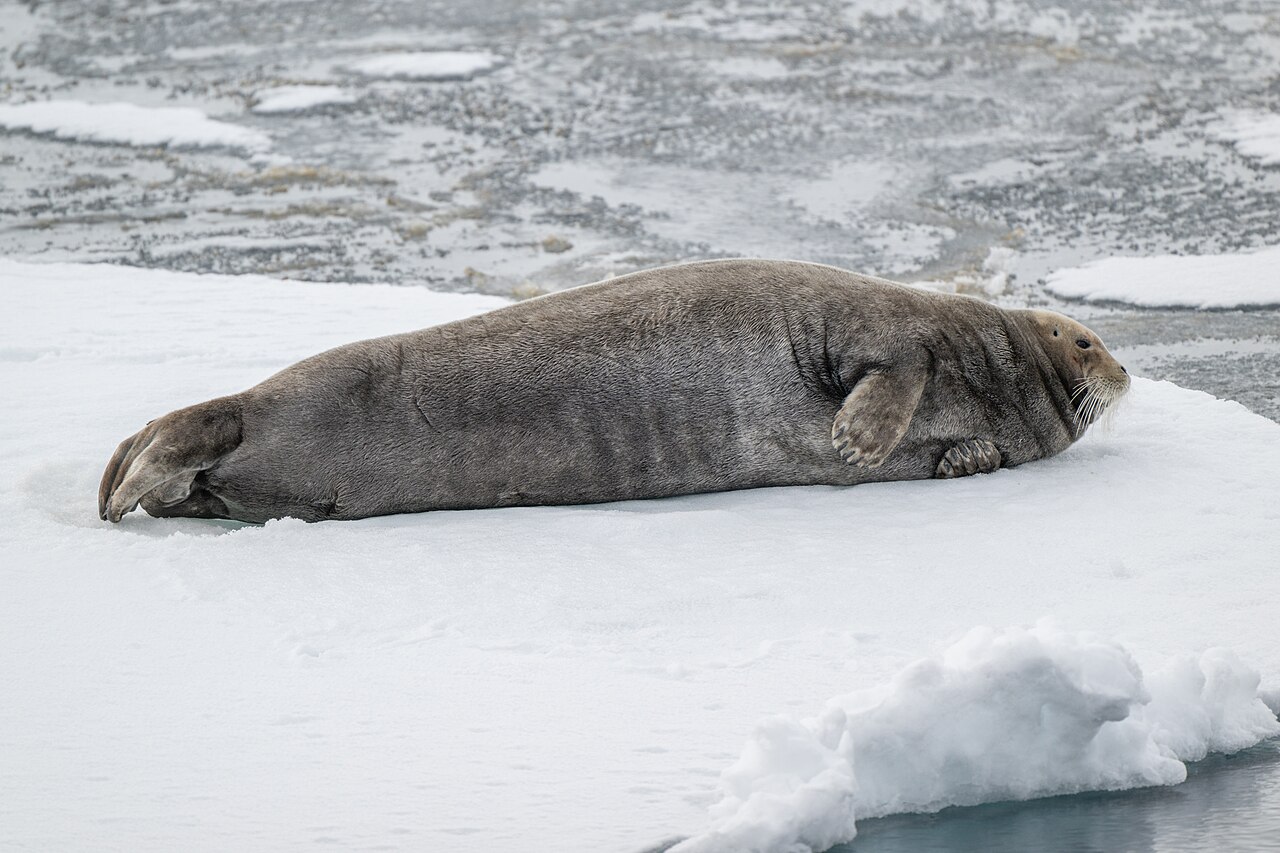
The Bearded Seal is the largest true seal of the Arctic. In spring the long, descending trills of the males can be heard under the ice, carrying up to thirty kilometres under water. The main field character is a dense bush of creamy-white whiskers that curl at the tips when dry.
Tracks
On the seabed the Bearded Seal leaves the same kind of signs as the walrus, but smaller: shallow pits and disturbed patches in soft mud and sand, where it searches with its whiskers for bivalves, worms, shrimps and crabs and blows the sediment away with a jet of water. Unlike the Ringed Seal it keeps no breathing holes open in the ice; it depends on existing leads and on the open edges of the drift ice. Haul-out sites therefore always lie within a body length of open water, with a short, broad drag groove from the edge to the resting place. The most useful sign is sound: the male's song, a long, descending trill ending in a deep moan, lasts up to three minutes and can be heard almost continuously from April to June with a hydrophone, or in calm weather through the hull of a boat. On European beaches virtually no signs of this species are found, apart from the occasional dead vagrant.
Head close-up
Identification
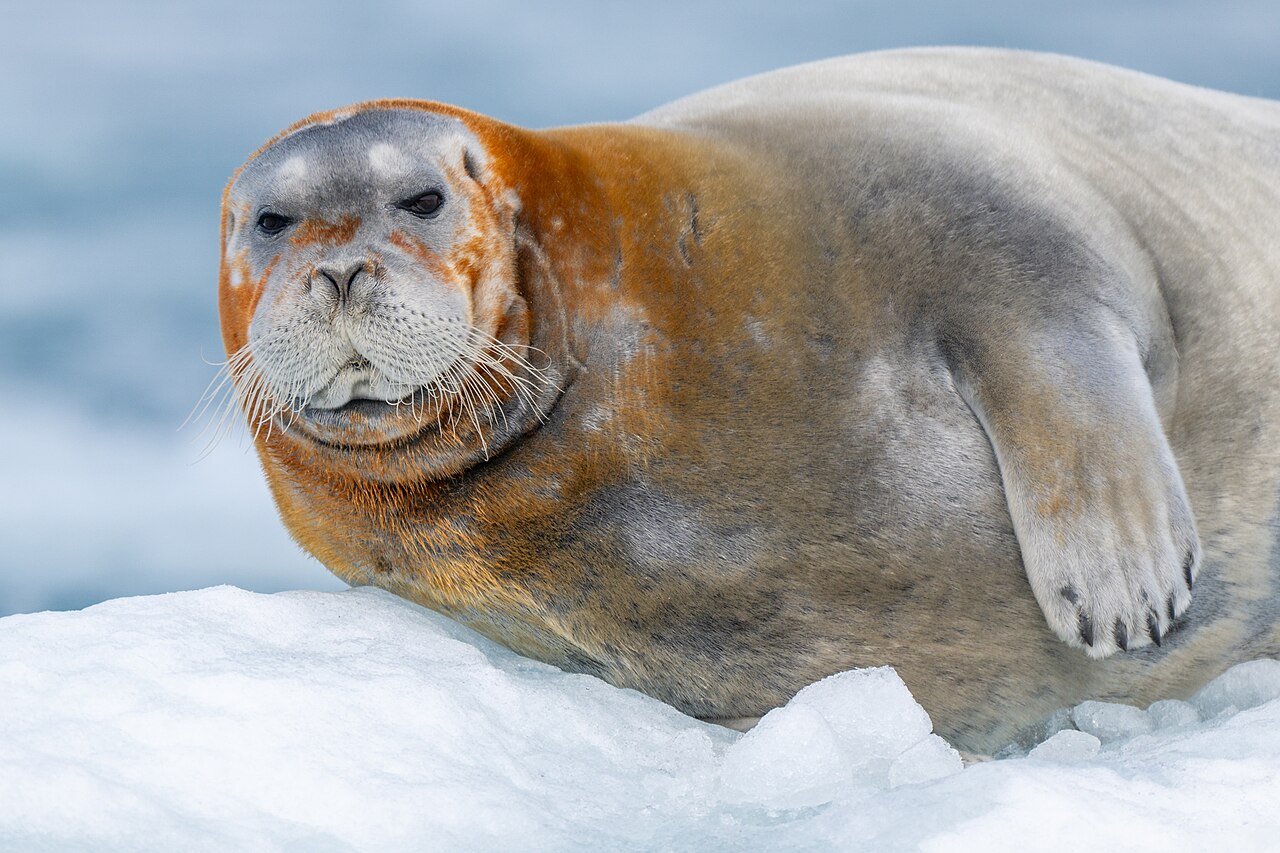
Heavily built, with a small head on a large, barrel-shaped body; this proportion is characteristic of the species. The coat is plain grey-brown to silver-grey, without spots or rings, often with a rusty staining on the head, neck and fore flippers from iron in the bottom mud in which it feeds. The whiskers are long, dense, creamy-white and smooth, and curl at the ends when dry; they cover the whole front of the head. The fore flippers are short and squared off, with the middle digit as long as or shorter than the outer ones; in all other European seals the fore flipper tapers to a point. Females are as large as or slightly larger than males. On the ice it lies with its head close to the edge of the lead, so that it can enter the water immediately.
Similar species
In the high Arctic the combination of size, small head and white whiskers is characteristic. The Ringed Seal, which lives on the same ice fields, weighs a third as much, has pale rings on a dark back and much thinner, wavy whiskers. The Harp Seal is smaller and slimmer and sharply marked, with a black head and a black saddle band. The Hooded Seal is as heavy but blotched, and the male has a nasal hood. The Walrus is much larger, with tusks and a wrinkled skin. Further south, where the odd vagrant reaches Scotland, Shetland, Iceland or Brittany, the species may occur alongside the Grey Seal; the small head, the squared fore flipper and the white whiskers are then decisive. The Grey Seal has a large, elongated head.
Habitat
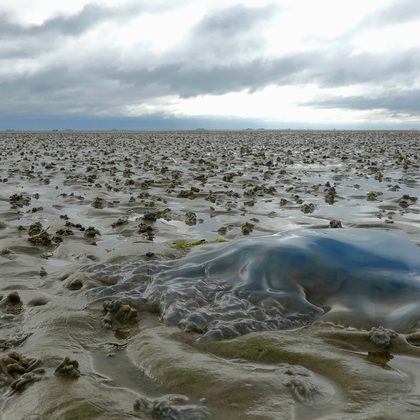
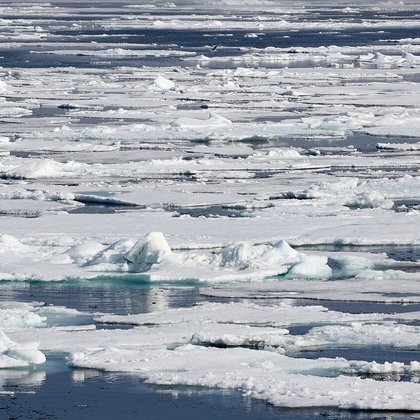
Drift ice over shallow seas: the species is tied to the edge of the pack ice over the continental shelf, where it can feed on the bottom from the ice, and avoids both closed, thick ice and the deep ocean. In summer also open water and coastal waters with floes; where the ice disappears completely it hauls out on shingle beaches and rocky coasts. It feeds almost exclusively on the bottom, down to about a hundred metres, on bivalves, worms, shrimps, crabs and demersal fish, which it extracts from the sediment by suction.
Where the animal is most at home, classified with EUNIS — the European standard for habitats.


Distribution
Circumpolar throughout the Arctic Ocean, from Svalbard and the Barents Sea to Greenland, Canada and the Bering Sea. The centre of the European range lies north of 71°N, in the fjords and in front of the glacier fronts of Svalbard, around Bjørnøya and along the Russian ice edge. Further south the species occurs along the north Norwegian coast and around Iceland, with scattered vagrants along the British and French coasts; most southern records come from Shetland and Scotland, usually of young animals that stay in a harbour for months. The species does not occur in Iberian waters.
- Native
- dark = core range, pale = thinly spread
Way of life
Solitary and dispersed; Bearded Seals do not lie in dense groups as walruses do. Dives are mostly shallow and long, and food is sought on the bottom. The male's song is courtship behaviour: the male dives downward in a spiral while giving the trill, thereby claiming an area of water and the females in it. The pup is born in April or May on an ice floe, one per litter, weighs over thirty kilos at birth and swims and dives within a few hours, an adaptation to drift ice that may break at any moment. It is suckled for eighteen to twenty-four days, doubling its weight in that time, and is then abandoned. Shortly afterwards the female mates in the water. Lifespan is twenty-five to thirty years. The Bearded Seal is an important prey of the polar bear; one adult provides a bear with food for several weeks.
Where and when to look
The best chance is an expedition cruise in Svalbard between June and August, along the ice edge in Hinlopenstretet, at the Sjuøyane or in Raudfjorden: Bearded Seals then lie alone on small floes and often allow a ship to approach closely. Note the outline, a large, rounded body with a very small head, and the white whiskers, which are visible at a distance. Under water the species is easiest to detect: on a calm day switch off the engine and listen with a hydrophone, or with an ear against the hull of an inflatable. In western Europe records are rare and unpredictable; with a large seal in a Scottish harbour, always check the fore flipper and the whiskers.
Conservation status
Near Threatened (NT, 2025). The world population numbers hundreds of thousands and is not heavily hunted, but the IUCN placed the species in the Near Threatened category in 2025 because it depends on drift ice over shallow sea. If the ice edge retreats over the deep Arctic Ocean, the combination of ice to lie on and a reachable seabed disappears, and the animals must pup on land, where they are exposed to polar bears and disturbance. In Europe, increased shipping in the Svalbard fjords and oil and gas extraction in the Barents Sea also play a role. Subsistence hunting in Greenland and Russia is limited and not the determining factor.
Scientific name
Erignathus barbatus | (Erxleben, 1777)
Erxleben described the species in 1777 as Phoca barbata; because it was later moved to another genus, the author and year stand in brackets. Erignathus is Greek, from the intensive eri-, 'very, strongly', and gnathos, 'jaw', after the heavy head. barbatus is Latin for 'bearded', from barba, 'beard', after the dense tuft of long pale whiskers. The specimen the first description was based on came from North Atlantic Ocean, southern Greenland.