All species › Rodents › Voles and hamsters › Balkan Snow Vole
Balkan Snow Vole | Dinaromys bogdanovi
Balkansneeuwmuis | Topillo nival de los Balcanes
The Balkan Snow Vole is the only surviving species of the tribe Pliomyini, a branch of the voles otherwise known only from the Pliocene and Pleistocene; its nearest relatives are known only as fossils from cave deposits in Europe. The species lives in the limestone of the Dinaric mountains, in small, scattered populations among the karst blocks. It breeds slowly, is tied to a single landscape type and is listed on the Red List as Vulnerable.
No photograph of a living wild animal of this species with a suitable Creative Commons licence exists. Do you have one that meets the rules? Send it in.
Tracks
The species is hard to find and leaves few signs. It does not dig but lives in deep fissures and cavities in the limestone; consequently there are no burrow entrances and no spoil heaps. What can be found are latrines in sheltered fissures and under overhanging blocks: heaps of dozens to hundreds of droppings six to nine millimetres long, cylindrical with rounded ends, dark green to black, large for a vole and deposited in the same place for years. In addition there are food stores: bundles of cut grasses, herbs and young conifer shoots stored in a fissure or under a stone as winter food, with the stems laid in one direction. On the rock slabs lie small clipped plant pieces of which the succulent base has been eaten. Nests of fine grass and moss lie deep in the fissures and are seldom seen. Pellets of Eagle Owl and Barn Owl from the karst villages are one of the better methods of establishing the presence of the species.
Identification
Large and long-tailed for a vole: head-body 10 to 15 cm, tail 6 to nearly 12 cm, i.e. more than half the head-body length, which is exceptional among European voles, and a weight of up to 88 g. The fur is long, dense and silky, denser in winter. The upperparts are dark blue-grey to slate, sometimes with a brown wash, the underparts distinctly paler, grey to dirty white, with a sharp boundary on the flank. The tail is two-coloured, dark above and white below, with slightly longer hairs at the tip. Characteristic are the large ears standing well clear of the fur, with a well-developed lobe, the small eyes and the broad, blunt head. The whiskers are long. The feet are strong, with long, curved claws used for climbing among the rocks. Young animals are darker and greyer.
Similar species
In the Dinaric mountains the species occurs together with the European Snow Vole (Chionomys nivalis), the only species with which serious confusion is possible. The European Snow Vole is smaller, paler and silvery to light grey, with a shorter tail (less than half the head-body length) and smaller ears, and is more finely built. At a distance the long tail, the dark blue-grey and the large ears are the characters of the Balkan Snow Vole. Bank Vole and Common Pine Vole are smaller and browner and live in woodland or grassland rather than bare karst. A Black Rat is much slimmer, with a much longer, naked, scaly tail and large eyes. Locality is an important identification character: the species lives on bare limestone at and above the treeline.
Habitat
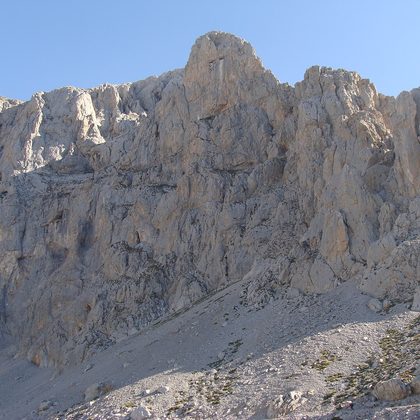
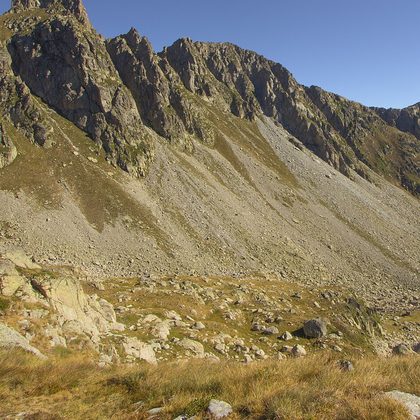
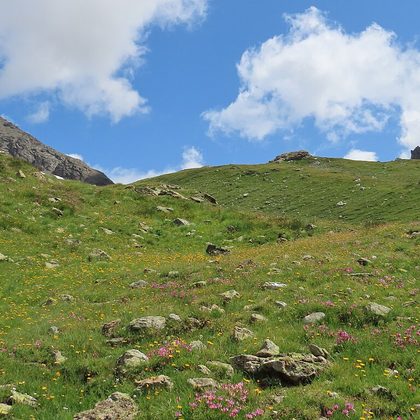
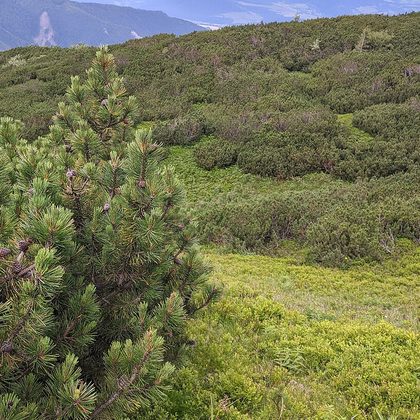
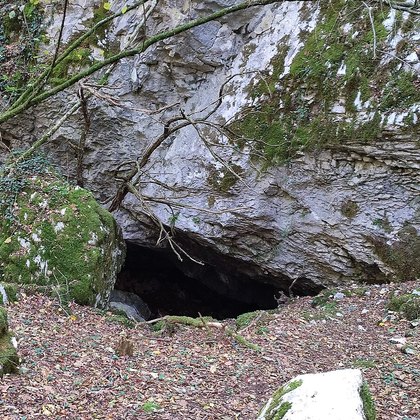
Exclusively limestone and dolomite karst: rock slabs, block fields, screes, gorge rims, doline walls and the open, herb-covered patches between the stones, usually at or above the treeline and up to about 2,200 metres. The species uses deep fissures that provide shelter and an even microclimate. It also occurs lower, into the sub-Mediterranean zone, where the karst is bare and the fissures are deep enough. The determining factor is not the vegetation but the rock: where the rock has become overgrown with forest or grassland, the species is absent.
Where the animal is most at home, classified with EUNIS — the European standard for habitats.
Distribution
Endemic to the western Balkans, in the Dinaric mountains and the ranges directly behind them: Croatia (Dalmatia and the Velebit), Bosnia and Herzegovina, Montenegro, Serbia, Kosovo, North Macedonia and northern Albania, with a single record from the far north of Greece. The type locality lies near Cetinje in Montenegro, at 680 metres. The range is small and the populations are strongly fragmented: the species lives on islands of suitable karst, separated by ground where it is absent. It does not occur outside the western Balkans. Fossil relatives of the genus have been found across Europe, including in Pleistocene deposits in Britain, the Netherlands and the Iberian Peninsula.
- Native
- dark = core range, pale = thinly spread
Way of life
Mainly nocturnal, but can be seen by day in cloudy weather and in the early morning. The species climbs nimbly over the rocks and immediately disappears into a fissure when disturbed. In summer the diet consists of green plant material, herbs and grasses, in winter of buds and young shoots of conifers and the stored food. There is no hibernation; the species remains active among the blocks under snow. Characteristic is the exceptionally slow reproduction, unique among European voles: one, at most two young a year, and the animals become sexually mature only in their second year. The lifespan is long: up to four years in the wild, whereas other voles rarely reach one year. This life history fits a stable, nutrient-poor and predictable environment, and explains why the species cannot quickly compensate for losses. Densities are low everywhere.
Where and when to look
Search the bare karst of Montenegro, south-western Bosnia or the Croatian Velebit, for example the Durmitor, the Orjen or the Lovćen, and concentrate on block fields and rock slabs at and above the treeline. By day, search for latrines: check under overhanging blocks and in the wider fissures for heaps of large, dark droppings and for stored bundles of cut grass. This gives the best chance of establishing the species' presence; the animal itself is seldom seen. To see the animal, wait quietly after sunset by a rock slab with fresh latrines, using a red lamp or a thermal imager. Many experienced Balkan field workers have never seen the species; searching for signs is the most effective method.
Conservation status
Vulnerable (VU, 2018). The assessment rests on three mutually reinforcing factors: the range is small and fragmented, the populations are small and sparse, and because of its slow reproduction the species cannot recover quickly from a decline. Where the karst becomes overgrown, through the abandonment of centuries-old extensive sheep and goat grazing in the Dinaric hinterland and through afforestation, the open rock the species needs disappears. In addition, competition with the European Snow Vole is cited; that species lives in the same rocky landscape, reproduces much faster and occupies vacated sites more quickly. Such an explanation is rarely put forward for mammals. Quarries, road construction, ski resorts and limestone extraction directly affect the block fields, and with warming the suitable climate shifts to higher altitudes, where the available area decreases. Genetic research showed that the populations have long been separated and that the north-western group differs so much that it is listed in the Mammal Diversity Database as a separate species, Dinaromys longipedis; this further reduces the range of D. bogdanovi. For conservation it is important to keep the bare karst open and undisturbed.
Scientific name
Dinaromys bogdanovi | (V. E. Martino & E. V. Martino, 1922)
V. E. Martino & E. V. Martino described the species in 1922 as Microtus (Chionomys) bogdanovi; because it was later moved to another genus, the author and year stand in brackets. Dinaromys is named after the Dinaric Alps, with Greek mys, 'mouse', added: the vole of the Dinarides. bogdanovi honours a Bogdanov, presumably the Russian zoologist Modest Bogdanov (1841–1888); Martino, himself a Russian in the Balkans, does not explain the name. The specimen the first description was based on came from Montenegro, Cetinje.