All species › Rodents › Voles and hamsters › Wood Lemming
Wood Lemming | Myopus schisticolor
Boslemming | Léming De Bosque
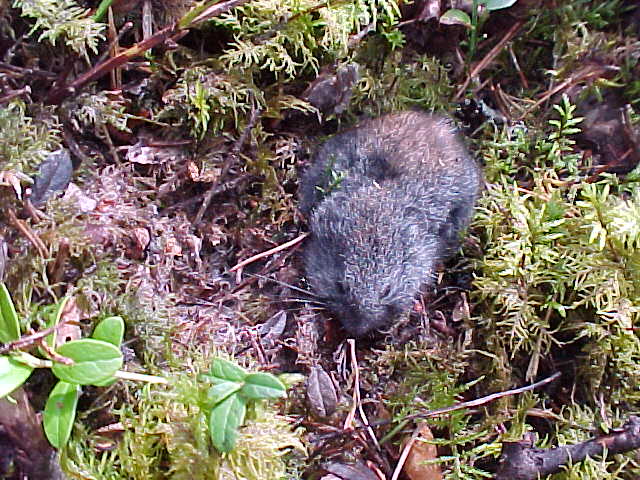
The Wood Lemming is a small, slate-blue lemming of the boreal coniferous forests. It lives hidden in the moss layer under spruces and eats almost nothing but moss. Unlike the Norway Lemming it does not make mass migrations. A distinctive feature is the sex ratio: on average two out of every three Wood Lemmings are female. The cause is an altered X chromosome that switches off the effect of the Y chromosome.
Tracks
The Wood Lemming leaves few signs, and these are mainly in the moss. In old spruce stands with a thick layer of Dicranum and Pleurozium moss, runs eaten through the moss can be found: channels three to four centimetres wide running just beneath the living moss surface, visible only when the moss layer is lifted by hand. At the junctions lie small green droppings up to five millimetres long; the green colour results from a diet almost entirely of moss and incomplete digestion. The feeding patches are bare, cropped spots in the moss where the top centimetre of the shoots has been eaten; a brownish, hollowed patch in an otherwise intact moss layer is the clearest sign. Nests of finely teased moss lie under a fallen trunk, in a rotten stump or in a cavity beneath a stone; in winter they are built on the ground under the snow and after the thaw remain as felted balls five to ten centimetres across. In the pellets of Tengmalm's Owl, Great Grey Owl and Hawk Owl the species is well represented in northern Scandinavia; pellets are often the first indication of its presence.
Identification
Small and stocky, head-body 8 to 12.5 cm, tail 1.2 to 2 cm; nearly as short-tailed as the Norway Lemming, but much smaller and much darker. The fur is dense, soft and uniformly slate blue-grey to blackish grey, with a rusty to cinnamon saddle along the middle of the back that is distinct in some animals and barely visible in others. The belly is slightly paler grey, without a sharp division. The ears are small and hidden in the fur, the eyes small, the muzzle short and blunt, the feet short and furred. Females average slightly larger than males. In the hand the velvety fur and short tail are characteristic: the tail is less than a fifth of the head-body length.
Similar species
Within its range the distinction is chiefly one of colour and tail. The Norway Lemming is larger, has a sharp black, yellow and rust pattern and a black head, and is therefore immediately distinguishable. The Bank Vole and Grey Red-backed Vole live in the same forest and are the main confusion species: both have an obvious tail a third to half the head-body length and a red-brown back without a bluish tone; the Wood Lemming has almost no tail and is dark blue-grey. The Field Vole is grey-brown, has a longer tail and lives in open grassy patches rather than in dense moss. In poor light size and rounded body shape are the first characters; when in doubt, tail length is decisive.
Habitat
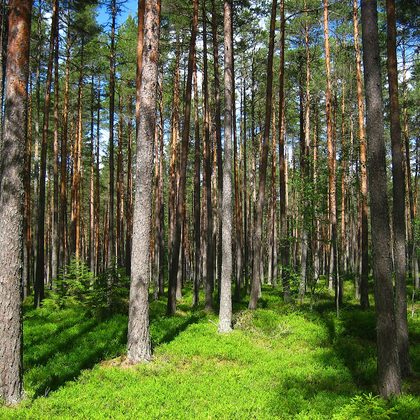
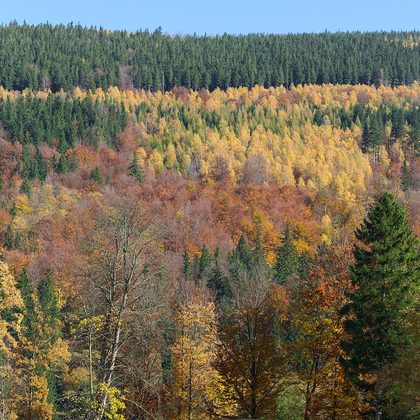
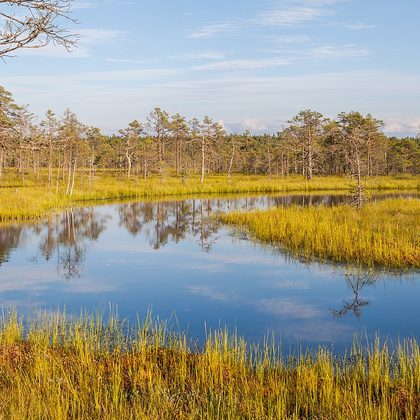
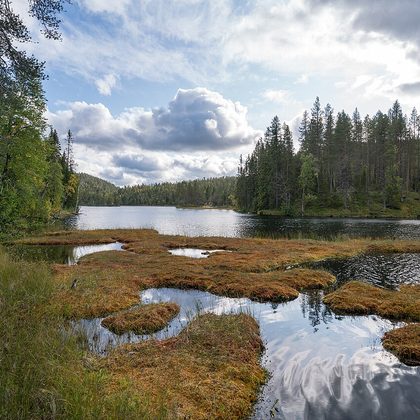
Old, damp coniferous and mixed forest with a thick moss layer, especially spruce forest with much dead wood, fallen trunks, rotten stumps and mossy boulders. Also raised and transition bog surrounded by spruce, forest mires and the mossy banks of taiga streams. The species avoids dry, bare or young forest: clear-fells, plantations without ground vegetation and thinned stands are unsuitable. From the lowlands into the birch belt, and in southern Norway up to around a thousand metres.
Where the animal is most at home, classified with EUNIS — the European standard for habitats.
Distribution
The taiga belt from Fennoscandia to Kamchatka. In Europe: Norway, Sweden, Finland, the Baltic states (very scarce in Estonia and Latvia), Belarus, and European Russia from the Kola Peninsula to beyond the Urals. To the south the range reaches central Sweden, southern Finland and the southern limit of the Russian taiga. Throughout its range the species is local and scarce and occurs in separate populations.
- Native
- dark = core range, pale = thinly spread
Way of life
Active in short bouts by day and night, with an emphasis on twilight, and all year round; it does not hibernate and in winter lives under the snow. More than ninety per cent of the diet is moss, chiefly Dicranum and Pleurozium; this makes the Wood Lemming almost the only European mammal that lives on leafy moss. Sedges, bilberry leaves and lichens are also eaten. Moss is low in protein and high in indigestible material; the Wood Lemming has a long gut and re-ingests its own soft droppings. Litters are small, two to seven young, with two or three litters per summer. Numbers fluctuate on the same three- to four-year cycle as in other lemmings, but with smaller peaks. A distinctive feature is the skewed sex ratio: about two-thirds to three-quarters of the animals are female. The cause is a mutated X chromosome, designated X*, that switches off the sex-determining effect of the Y chromosome. Females therefore occur in three genetic forms (XX, X*X and X*Y), males only as XY. An X*Y animal is outwardly a normal female, is more fertile than an XX female and produces almost only daughters. This allows a small population with few males to grow rapidly. Such a system is rare in mammals.
Where and when to look
The species is usually encountered by chance, especially in peak years. The chance is greatest in summer or early autumn in old spruce forest in central or northern Sweden, Finland or Norway, in places with much dead wood and a thick moss layer; watch for movement in the moss just ahead of your feet. The animals move slowly and often remain in view for a while. Lift the moss layer carefully to see the runs; these are found more often than the animal itself. The chance of a sighting is greatest at dusk along forest tracks. Where Tengmalm's Owls and Hawk Owls are breeding, voles and lemmings are numerous.
Conservation status
Least Concern (2016), with a large range from Scandinavia to the Pacific. In Europe forestry is the main threat: the species depends on old, damp, mossy forest with dead wood, and this forest type has declined sharply through modern production forestry in Fennoscandia. Clear-felling, soil scarification, drainage and the replacement of mixed old forest by even-aged plantations destroy the moss layer, and the species then disappears. In Estonia and Latvia it has been reduced to a few sites and is listed as threatened on the national red lists; in Sweden and Finland it has disappeared locally from districts where it was formerly common. Winter weather also has an effect: thaw and ice in the snowpack have the same negative effect on this species as on the Norway Lemming. The species is regarded as an indicator of the quality of boreal forest.
Scientific name
Myopus schisticolor | (Lilljeborg, 1844)
Lilljeborg described the species in 1844 as Myodes schisticolor; because it was later moved to another genus, the author and year stand in brackets. Myopus is read as Greek mys, genitive myos, 'mouse', and pous, 'foot'; Miller gave no explanation of the name. schisticolor means 'slate-coloured', from Latin schistus, 'slate' (Greek schistos, 'split'), and color, 'colour', after the bluish-grey back. The specimen the first description was based on came from Norway, Gudbrandsdal.