All species › Rodents › Voles and hamsters › Western Dinaric Vole
Western Dinaric Vole | Dinaromys longipedis
Dinaromys longipedis | Dinaromys longipedis
Dinaromys longipedis was split from the Balkan Snow Vole in 2022 and forms the north-western lineage of the genus Dinaromys, an old relict group, in the area of Mount Dinara and the karst of Dalmatia and south-western Bosnia. The species has no vernacular name in English, Dutch or Spanish, no freely licensed photograph is known, and no field measurements have been published.
No photograph of a living wild animal of this species with a suitable Creative Commons licence exists. Do you have one that meets the rules? Send it in.
Tracks
Nothing has been published separately on the signs of this species; there is no indication that they differ from those of the Balkan Snow Vole. They are probably the same: no burrows and no spoil heaps, because the species lives in fissures and cavities in the limestone, but latrines under overhanging blocks and in sheltered crevices, with dozens to hundreds of dark, cylindrical droppings six to nine millimetres long, used at the same spot for years; and small stores of cut grasses, herbs and conifer shoots in a fissure, with the stems aligned. Signs on Dinara or in the Velebit are assigned to this species on the basis of locality, not of the sign itself.
Identification
In appearance it is indistinguishable from the Balkan Snow Vole: the same long, silky, dark blue-grey fur, the same paler underparts, the same large, protruding ears and the same long, bicoloured tail of more than half the head-body length. The character on which Đulić and Vidinić based their 1967 description is in the name: longipedis, long-footed, after the longer hind foot of the animals from Dinara. This is an average difference across a series of measured specimens and not a character visible on a living animal. No published measurements of head-body length, tail length and weight have been found for this species. They probably differ little from those of the Balkan Snow Vole, but this has not been measured.
Similar species
The species cannot be identified in the field. From the Balkan Snow Vole, from which it was split, it can be distinguished only on the basis of DNA and locality: D. longipedis belongs to the north-western lineage, in Dalmatia and south-western Bosnia, D. bogdanovi to the south-eastern, from Montenegro to North Macedonia; exactly where the boundary runs has not been established. From the European Snow Vole (Chionomys nivalis), which lives in the same rocky areas, it can be distinguished on the same characters as its sister species: darker and bluer, larger, with a longer tail and larger ears. There are no other confusion species. A large, dark, long-tailed vole in the Croatian or Bosnian karst can be recorded only as Dinaromys.
Habitat
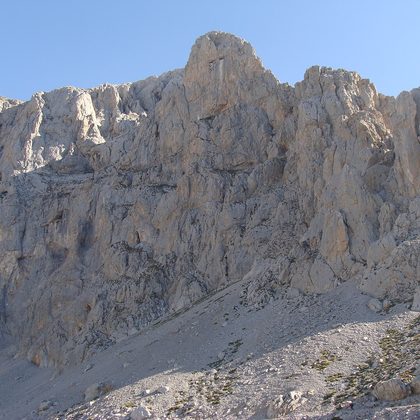
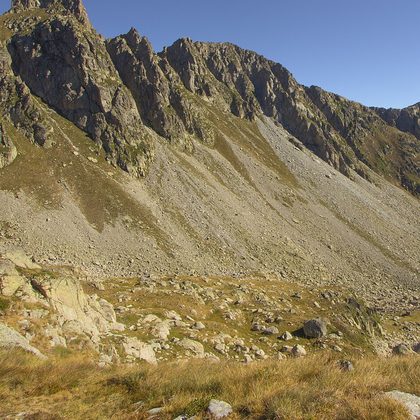
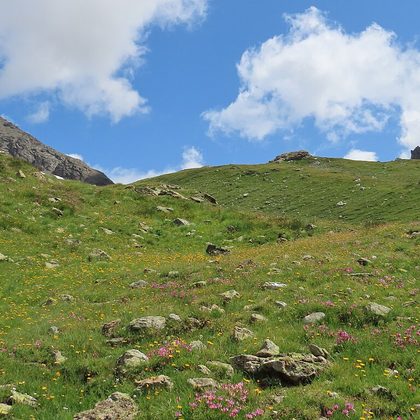
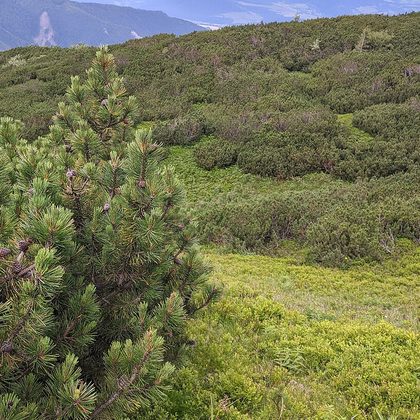
The same limestone karst as the Balkan Snow Vole: rock slabs, block fields, scree slopes and the open herb-rich patches between them, at and above the treeline. The type locality is on Dinara at 1,420 metres, in the former Yugoslavia and present-day Croatia: bare karst high on the mountain, where the fissures are deep enough for shelter and a stable microclimate.
Where the animal is most at home, classified with EUNIS — the European standard for habitats.
Distribution
According to the Mammal Diversity Database, Croatia and Bosnia and Herzegovina, the north-western part of the former range of Dinaromys. The centre lies at Mount Dinara, after which the Dinaric Alps are named, with the karst of Dalmatia and south-western Bosnia around it. Where the boundary with D. bogdanovi lies has not been established, and there is no reason to assume that it coincides with a national border. The range is very small, much smaller than that of the sister species, and like that species consists of isolated areas of suitable karst.
Way of life
Nothing is known separately about the way of life of this species. What is known about Dinaromys was studied in the south-eastern populations and described for the Balkan Snow Vole: nocturnal, no hibernation, green plant parts in summer and conifer buds and its own store in winter, and an exceptionally low reproductive rate of one or at most two young per year, in animals that do not reach sexual maturity until their second year and can live to four years. There is no indication that this differs in D. longipedis, but there are also no observations that confirm it.
Where and when to look
Observation is as difficult as for the Balkan Snow Vole, and even when an animal is seen the species cannot be determined in the field. On Dinara, in the Croatian Velebit or in the karst of south-western Bosnia, search above the treeline for block fields with fresh latrines and stored bundles of grass, and record finds with a precise location. For a recently split species a well-documented record with photograph and coordinates has scientific value, even if identification remains at genus level. Report records to a national mammal group or a records portal; research into the boundary between the two species is ongoing.
Conservation status
Not Evaluated (NE). The IUCN has not assessed this species separately, because it has only recently been recognised as a species; the Red List assessment concerns Dinaromys bogdanovi in the old, broad sense, and is Vulnerable. The factors that make the Balkan Snow Vole vulnerable apply here to a still smaller area, because the split divides an already limited range in two: a small and fragmented range, small populations, a low reproductive rate that makes losses difficult to compensate, the overgrowing of the karst after traditional grazing ceased, quarries and ski resorts, and climate change shifting suitable habitat to higher parts of the mountains. The species has a range of only a few mountain areas and no separate assessment; its status is unknown.
Scientific name
Dinaromys longipedis | (Đulić & Vidinić, 1967)
Đulić & Vidinić described the species in 1967 as Dolomys bogdanovi longipedis; because it was later moved to another genus, the author and year stand in brackets. Dinaromys is named after the Dinaric Alps, with Greek mys, 'mouse', added: the vole of the Dinarides. longipedis belongs to longipes, 'long-footed', from longus, 'long', and pes (pedis), 'foot'; the form chosen is the genitive, which is unusual for a specific name. The specimen the first description was based on came from Croatia, Dinara.