All species › Penguins › Penguins › Western Rockhopper Penguin
Western Rockhopper Penguin | Eudyptes chrysocome
Westelijke rotspinguïn | Pingüino Saltarrocas Meridional
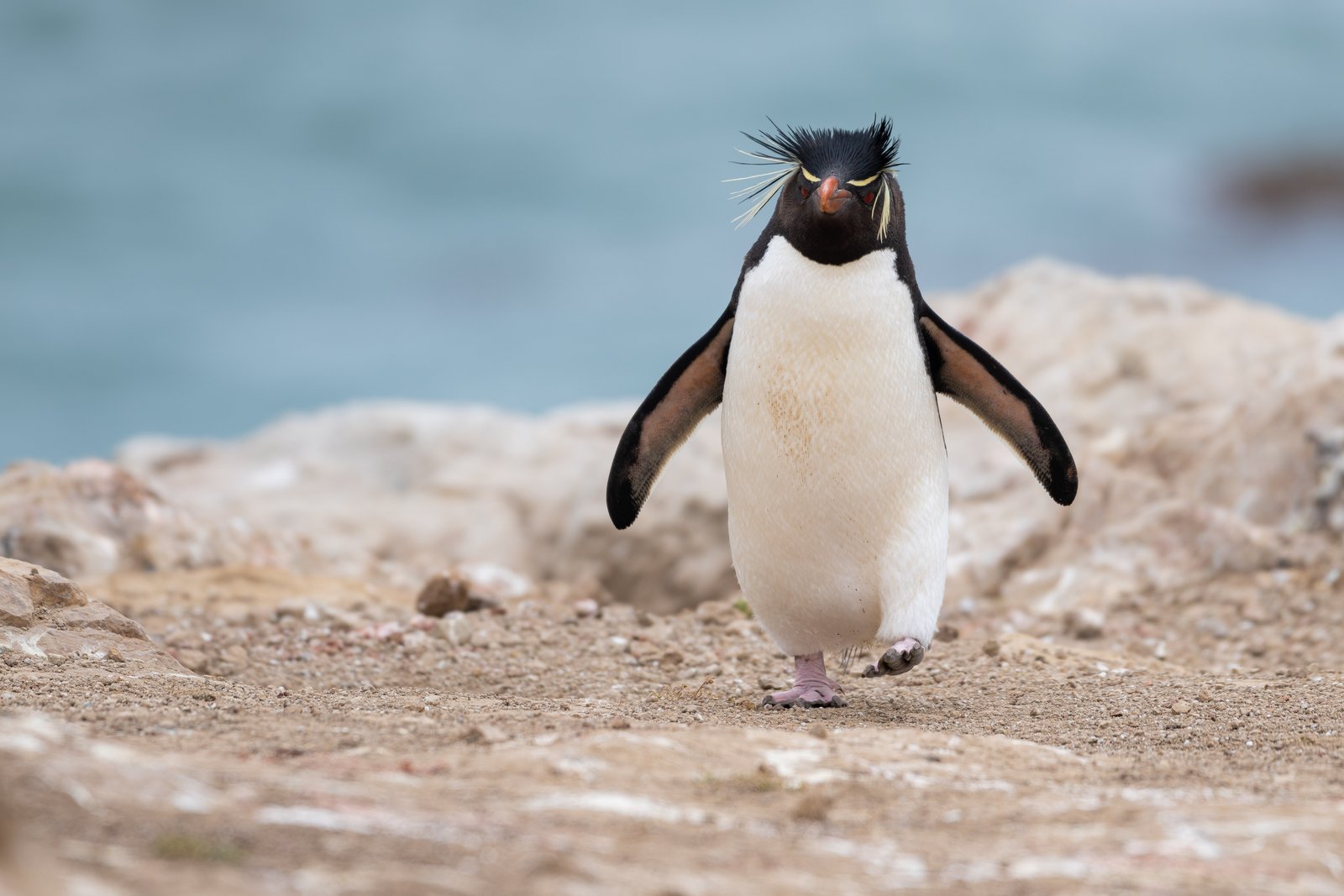
The Western Rockhopper Penguin is the rockhopper of the Falkland Islands and southern South America, a small, pugnacious crested penguin with a narrow yellow brow stripe and red eyes. Within the region it is a very rare vagrant to the mainland coast; the rockhoppers breeding on the Prince Edward Islands belong to the eastern species.
Voice
A hoarse, rattling, braying trumpet, ek-ek-ek-aaah, with the head swung, higher and harsher than that of Macaroni Penguin, and short barks at sea.
Recording: Meena Haribal — CC BY-NC-SA 4.0 · shortened to the first 60 s, mono · xeno-canto
Identification
About 50–55 cm, compact and short-billed. Head, throat and upperparts are blackish grey, the underparts white. A narrow, bright yellow brow stripe starts behind the bill base, does not meet on the forehead and ends behind the eye in a tuft of fairly short yellow plumes; the black crown feathers form a scruffy crest. The bill is short and orange-red, with a narrow dark edge of bare skin along the gape. The eye is red, the feet pink. The underwing is largely dark with a white central stripe. Immatures have a greyish throat, a duller bill and only a faint pale yellow brow stripe.
Confusion species
Eastern Rockhopper Penguin Eudyptes filholi is almost identical; it has a broad fleshy pink edge along the gape and slightly longer, fuller plumes, but a firm identification of a vagrant needs good photographs of the head. Northern Rockhopper Penguin Eudyptes moseleyi has much longer, drooping plumes and a broader brow stripe. Macaroni Penguin Eudyptes chrysolophus is larger, with a heavy bill and orange plumes that meet on the forehead.
Habitat
It breeds in dense colonies on steep rocky coasts and among tussock grass, often high above the surf, where birds hop up over boulders with their characteristic jumps. It forages at sea over the shelf and shelf slope on krill, other crustaceans, squid and small fish. Vagrants in the region usually come ashore to moult.
Where the bird is most at home, classified by the vegetation units of southern Africa.
Range and movements
Within the region confirmed only a few times on the coast of South Africa, mainly in the Western and Eastern Cape; older rockhopper records were often not assigned to species. Beyond the region it breeds on the Falkland Islands and on islands off southern Chile and Argentina, such as Staten Island and the Diego Ramírez Islands.
How and when to look
Moulting crested penguins wash up on Cape beaches mainly in the southern summer. Photograph the head from the side and front, noting the width of the brow stripe, the length of the plumes and the colour of the gape skin; only then can it be separated from Eastern and Northern Rockhopper Penguins. Report the bird to SANCCOB if it seems weakened.
Conservation status
Vulnerable. The population has fallen steeply since the mid-twentieth century, especially on the Falkland Islands, through changes in sea temperature and food supply, fisheries and oil pollution; recent counts suggest local recovery. Within the region the species is of no real significance.
Scientific name
Eudyptes chrysocome | (Forster, 1781)
Forster described the species in 1781 as Aptenodytes chrysocome; because it was later moved to another genus, the author and year stand in brackets. The genus Eudyptes was introduced in 1816 by Vieillot. Eudyptes comes from the Greek eu, 'good', and duptēs, 'diver' — 'good diver', for the agility with which these crested penguins hunt underwater. chrysocome comes from the Greek khrusos, 'gold', and komē, 'hair' — 'golden hair', for the yellow plumes on either side of the head. The specimen the first description was based on came from Kidney Island, Falkland Islands.