All species › Tubenoses › Albatrosses › Snowy Albatross
Snowy Albatross | Diomedea exulans
Grote albatros | Albatros Viajero
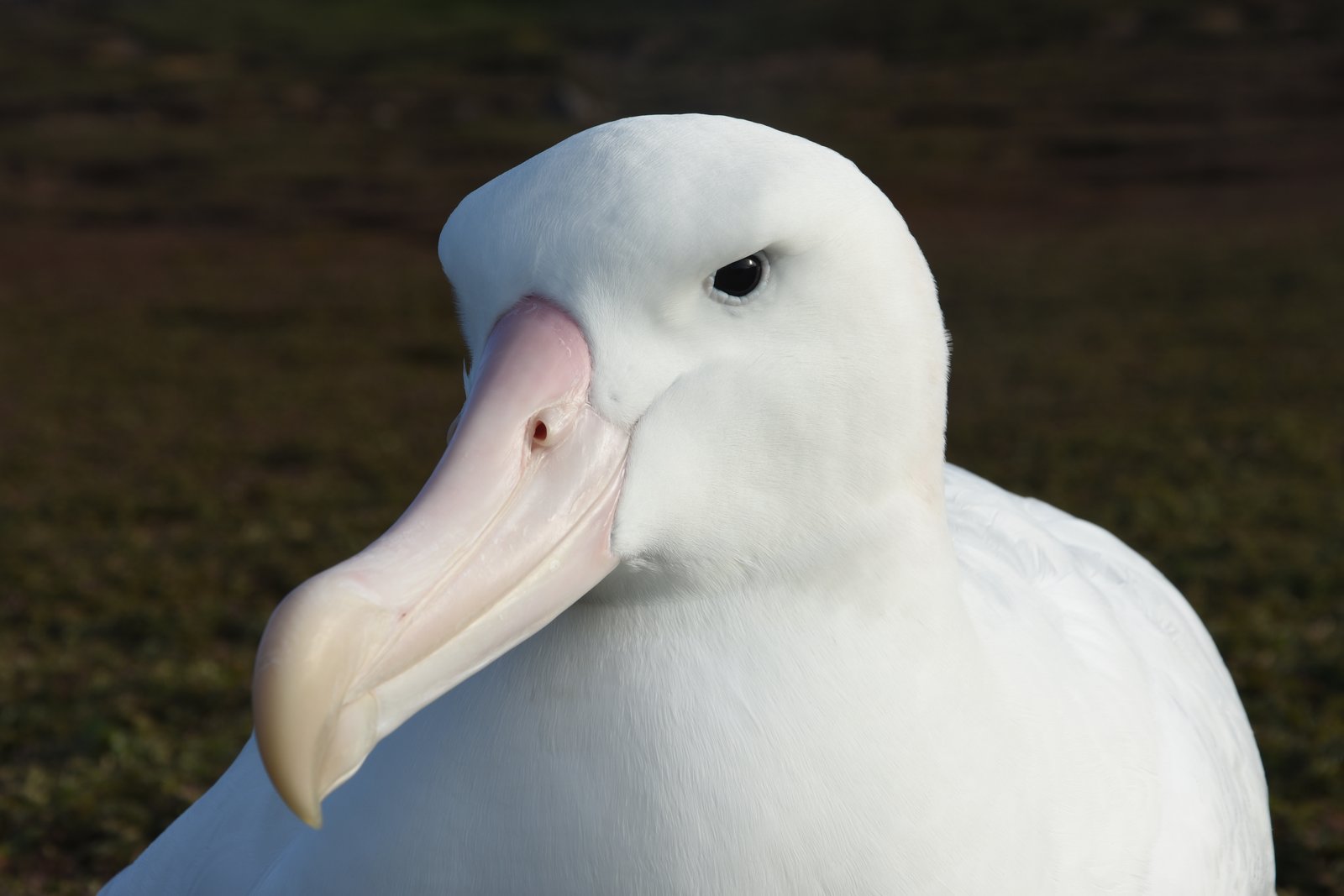
The Snowy Albatross has the greatest wingspan of any living bird, up to more than three metres. It glides for days without a wingbeat over the southern oceans and covers tens of thousands of kilometres per breeding cycle; the Prince Edward Islands hold a large share of the world population.
Voice
Largely silent at sea, apart from hoarse croaks and gurgles when squabbling over food behind ships. At the breeding site an elaborate display with spread wings, bill clapping, skypointing and a loud groaning and whistling wheee-oo.
Recording: Barry Edmonston — CC BY-NC-SA 4.0 · converted to mono · xeno-canto
Identification
Huge: 107 to 135 cm long, with long, narrow wings spanning 2.5 to 3.5 m. The bill is massive and pink with a yellowish horn tip and no black cutting edge. The plumage changes over many years: juveniles are chocolate brown with a white face; then body and back gradually turn white, with fine vermiculation that persists for a long time, and finally the upperwing whitens from the centre and the leading edge. Old males are almost wholly white with only black primaries and a black trailing edge; females stay darker and often keep a brownish cap. The underwing is white with a narrow black trailing edge and black tip. There is often a pink patch on the side of the neck.
Confusion species
The Southern Royal Albatross (Diomedea epomophora) and Northern Royal Albatross (Diomedea sanfordi) have a black cutting edge along the upper mandible, a white head and body from fledging and no brown juvenile plumage; in Southern Royal the upperwing whitens from the leading edge rather than the centre. The Tristan Albatross (Diomedea dabbenena) is slightly smaller with a shorter bill and stays dark for longer; at sea it is barely separable from younger Snowy Albatrosses. Dark juveniles can recall the Southern Giant Petrel (Macronectes giganteus), which has a pale, stout bill with the nostril tube on top and a stiffer flight.
Habitat
Open ocean, especially over deep water beyond the continental shelf, where it glides with the wind. It follows fishing vessels and eats squid, fish and offal. It breeds on open, vegetated plains and low hills on subantarctic islands, where the nest is a mound of mud and plant material. A breeding cycle takes almost a year, so successful pairs breed only every second year.
Where the bird is most at home, classified by the vegetation units of southern Africa.
Range and movements
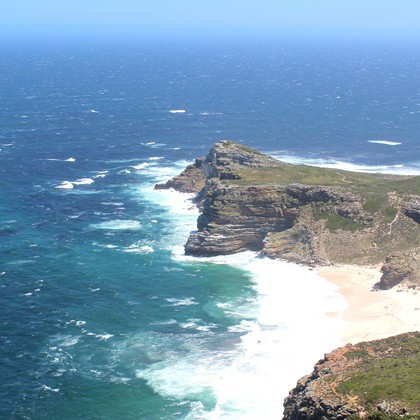
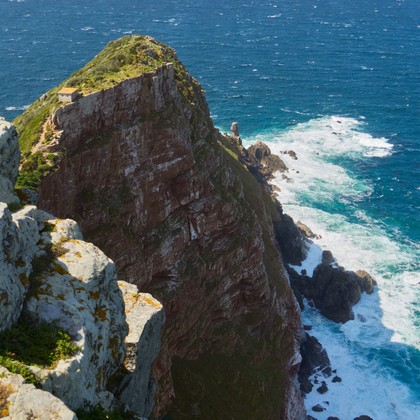
Within the region it breeds on Marion and Prince Edward, together several thousand pairs and one of the most important breeding sites in the world. At sea it is seen over deep water off South Africa and Namibia, from spring to winter mainly behind trawlers beyond the shelf edge; scarce closer inshore, off Mozambique and in northern Namibia. Elsewhere it breeds on South Georgia, Crozet, Kerguelen and Macquarie and ranges right around the southern ocean.
- Resident
- dark = core range, pale = thinly spread
How and when to look
Best seen on a pelagic trip from Cape Town to the shelf edge, where it stands out by sheer size among the smaller albatrosses behind trawlers. With any large white albatross check the bill first: no black cutting edge means Snowy or Tristan. Plumage gives an estimate of age, but is not a reliable guide to sex.
Conservation status
Vulnerable. The species is very long-lived and breeds slowly, so bycatch on longlines has caused steep population declines. On Marion introduced house mice have recently also started to attack albatross chicks; the Mouse-Free Marion project aims to eradicate them there. Bycatch mitigation, such as bird-scaring lines and night setting, is increasingly applied.
Scientific name
Diomedea exulans | Linnaeus, 1758
Linnaeus described the species in 1758 and placed it straight away in the genus where it still stands. He introduced the genus Diomedea in that same work. Diomedea refers to Diomedes, the Greek hero whose companions, according to myth, were turned into seabirds. exulans is Latin for 'living in exile, wandering' — for the enormous distances this albatross travels over the southern oceans. The specimen the first description was based on came from Open sea off the Cape of Good Hope.