All species › Pelicans, herons and ibises › Shoebill › Shoebill
Shoebill | Balaeniceps rex
Schoenbekooievaar | Picozapato
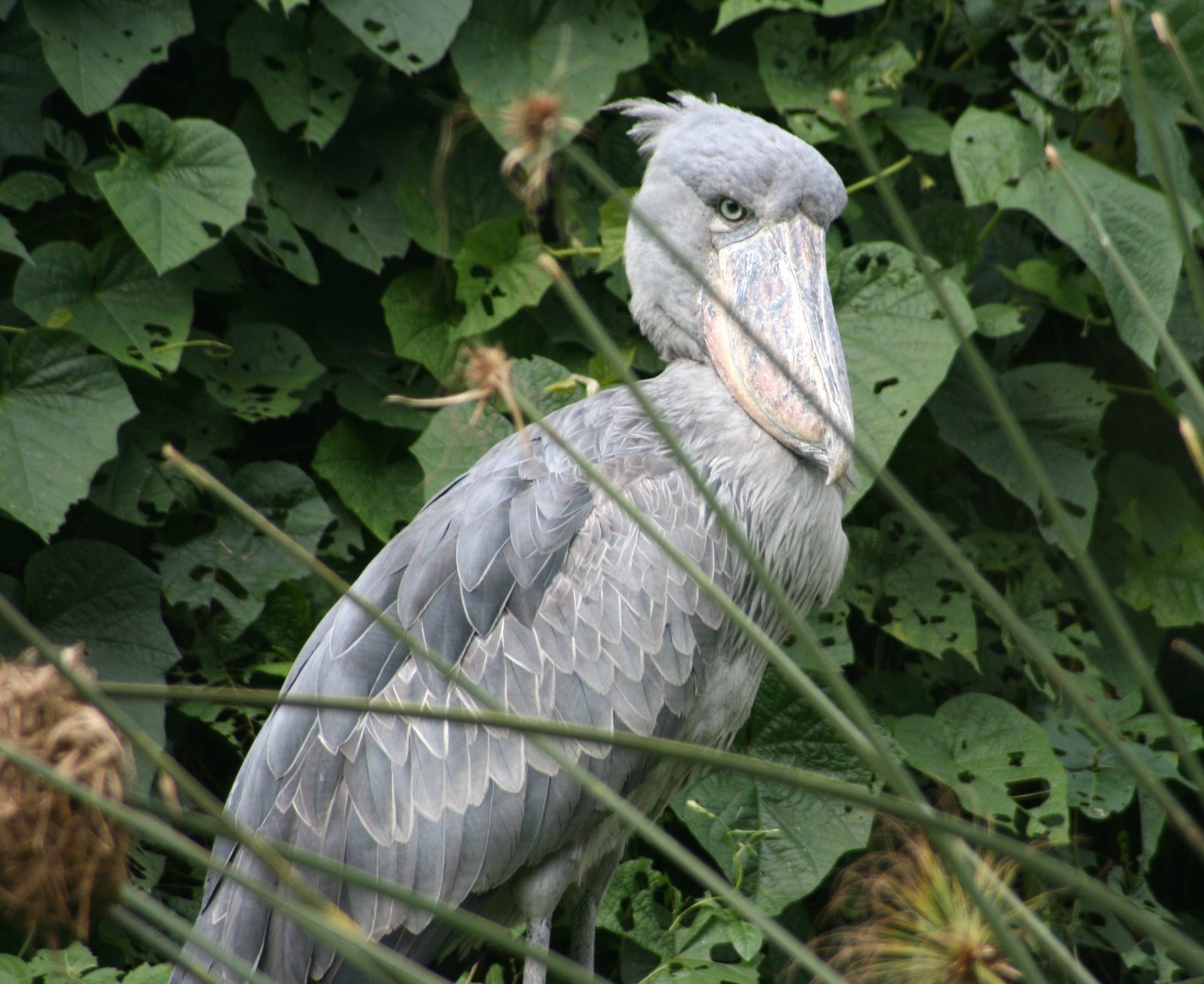
The Shoebill is a huge slate-grey swamp bird with an enormous clog-shaped bill ending in a sharp hook. It stands motionless for hours among floating vegetation waiting for lungfish and catfish, and is the sole member of its family. The region lies at the southern edge of its range.
Voice
Usually silent. At the nest and in greeting it claps the bill loudly and at length, a hollow, machine-gun-like trrrrrr. Chicks beg with a hiccuping mewing; adults occasionally give a cow-like moo.
No recording with a suitable Creative Commons licence is available for this species yet.
Identification
110–140 cm, wingspan 2.3 to 2.6 metres. Wholly blue-grey, with slightly darker flight feathers and a small erect tuft on the hindcrown. The bill is colossal, broad and deep, yellowish-grey with dark blotches and a sharp nail at the tip; at rest it lies on the breast. The eyes are large, pale yellow to bluish-white and face forward. The legs are long and blackish-grey with very long toes that let the bird stand on floating plants. The sexes are alike; juveniles are browner grey with a smaller bill. It flies with the neck retracted on slow, deep wingbeats and regularly soars high on thermals.
Confusion species
Unmistakable with a good view of the bill. From behind or in flight it can be confused with the Goliath Heron Ardea goliath, which also flies with the neck retracted but is rufous and grey with a dagger bill, or with the Marabou Stork Leptoptilos crumenifer, which has a bare head, white underparts and a hanging throat pouch.
Habitat
Extensive permanent papyrus and reed swamps with floating vegetation mats, channels and shallow open patches of oxygen-poor water. It hunts from a standstill or with extremely slow steps, then collapses forward on its prey with wings spread: mainly African lungfish, catfish and tilapias, sometimes water snakes, frogs and young crocodiles. It nests on a platform of plant material on a floating island or grass tussock deep in the swamp.
Where the bird is most at home, classified by the vegetation units of southern Africa.

Range and movements
In the region almost confined to northern Zambia, its stronghold being the Bangweulu Swamps; otherwise scarce in the Mweru Wantipa area and a rare wanderer to the Kafue Flats and Busanga Swamps. Reports from Botswana, Malawi and Angola are unconfirmed or highly exceptional. Beyond the region it occurs in the swamps of eastern and central Africa: South Sudan (the Sudd), Uganda, Tanzania, Rwanda, eastern DR Congo and western Ethiopia.
- Resident
- dark = core range, pale = thinly spread
How and when to look
The Bangweulu Swamps in the dry season, from April to July, when the birds can be approached by canoe or on foot with a local guide across the floating grasslands. Patience pays: a hunting bird may stand still for an hour. Also scan for soaring birds high above the swamp on warm afternoons.
Conservation status
Vulnerable on the Red List, with a total population of a few thousand birds. It is threatened by the draining and burning of swamps, disturbance by fishermen, the taking of eggs and chicks for the illegal live-animal trade, and hunting. At Bangweulu, local community members work as nest guards, which has clearly raised breeding success there.
Scientific name
Balaeniceps rex | Gould, 1850
Gould described the species in 1850 and placed it straight away in the genus where it still stands. He introduced the genus Balaeniceps in that same work. Balaeniceps comes from the Latin balaena, 'whale', and -ceps, '-headed' — for the enormous, clog-shaped bill. rex is Latin for 'king' — for its imposing, stately appearance. The specimen the first description was based on came from upper White Nile, South Sudan.