All species › Pelicans, herons and ibises › Ibises and spoonbills › African Sacred Ibis
African Sacred Ibis | Threskiornis aethiopicus
Heilige ibis | Ibis Sagrado
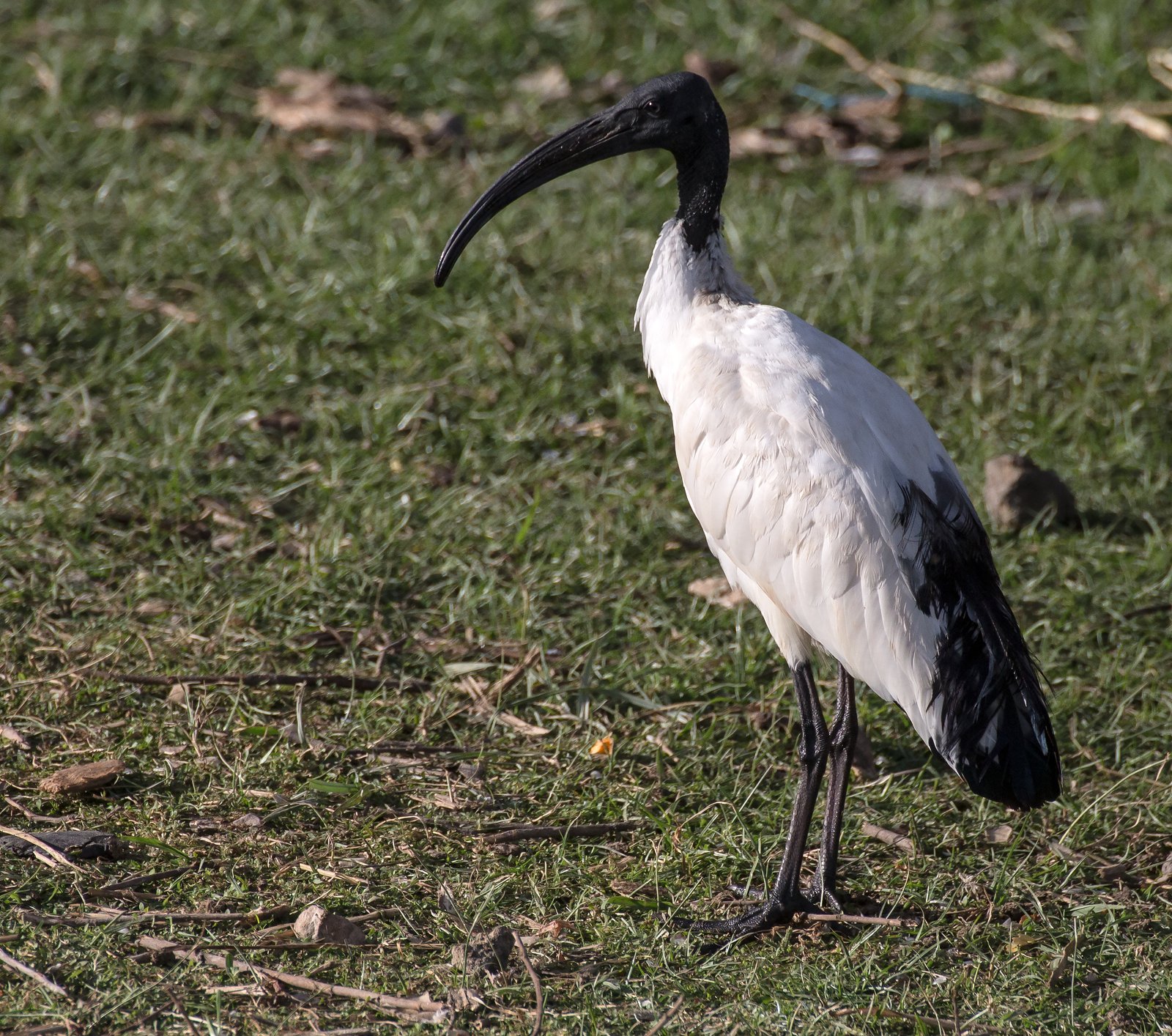
The African Sacred Ibis is a large white ibis with a bare black head and neck and a heavy, decurved black bill. In ancient Egypt it was venerated as the embodiment of the god Thoth; today in southern Africa it is an everyday sight on farmland, rubbish dumps and along water.
Voice
Usually silent. At the colony and roost soft croaks and squeals, and a hoarse krok-krok in nest greeting.
Recording: African Bioacoustics Community — CC BY-NC-SA 4.0 · converted to mono · xeno-canto
Identification
About 80 cm. The body is white, often soiled; the head and neck are unfeathered and black, the bill black, long and decurved. Black, blue-glossed plumes of the tertials hang over the back. In the breeding season a red strip of bare skin shows on the underwing along the flank. The legs are black. The sexes are alike. Juveniles have a feathered, black-and-white mottled head and neck and more black on the wings. In flight the wing is white with a narrow black trailing edge and black tips; neck and legs are outstretched.
Confusion species
The African Spoonbill Platalea alba is also white but has a red face, a spoon-shaped bill and red legs. The Yellow-Billed Stork Mycteria ibis has a red face, a yellow bill and black flight feathers and tail. The White Stork Ciconia ciconia has a straight red bill and a white head and neck.
Habitat
Marshes, floodplains, lake shores, dams, riverbanks, coastal lagoons, estuaries and rocky shores, as well as farmland, pastures, sports fields, rubbish dumps and sewage works. An opportunist that takes insects, worms, molluscs, frogs, fish, eggs, nestlings, refuse and carrion. Breeds in dense colonies in trees, on islets or in reeds, often with herons, cormorants and spoonbills.
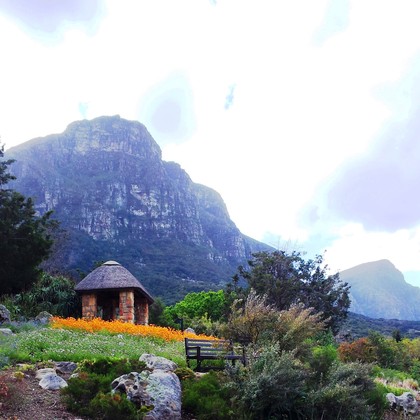
Where the bird is most at home, classified by the vegetation units of southern Africa.


Range and movements
Across most of the region: common in South Africa, Eswatini, Lesotho, Zimbabwe, Botswana, Zambia, Malawi, Mozambique and Angola; in Namibia mainly in the north and on the coast, scarce in the dry interior. Beyond the region in sub-Saharan Africa, south-eastern Iraq and formerly Egypt, where it is extinct; feral populations in France, Spain, Italy and Taiwan among other places.
- Resident
- Summer visitor (c. Oct–Mar)
- Winter visitor (c. Apr–Sep)
- Passage (Mar–Apr, Oct–Nov)
- dark = core range, pale = thinly spread
How and when to look
Often found all year at rubbish dumps, on ploughed fields and around dams. Groups fly in V-formations in the evening to communal roosts in trees or on islets, a good moment to study the black wing edge.
Conservation status
Not threatened, and numerous and increasing in southern Africa, helped by rubbish dumps, arable farming and dams. Outside Africa escaped birds have become invasive in several places, where they eat eggs and young of other waterbirds.
Scientific name
Threskiornis aethiopicus | (Latham, 1790)
Latham described the species in 1790 as Tantalus aethiopicus; because it was later moved to another genus, the author and year stand in brackets. The genus Threskiornis was introduced in 1842 by Gray. Threskiornis comes from the Greek thrēskeia, 'religious worship', and ornis, 'bird', for the Sacred Ibis, venerated in ancient Egypt as a symbol of the moon god Thoth. aethiopicus means 'Ethiopian'; to classical writers the name stood for Africa south of Egypt. The specimen the first description was based on came from Egypt.