All species › Pelicans, herons and ibises › Shoebill
Shoebill | Balaenicipitidae
Schoenbekken | Picozapato
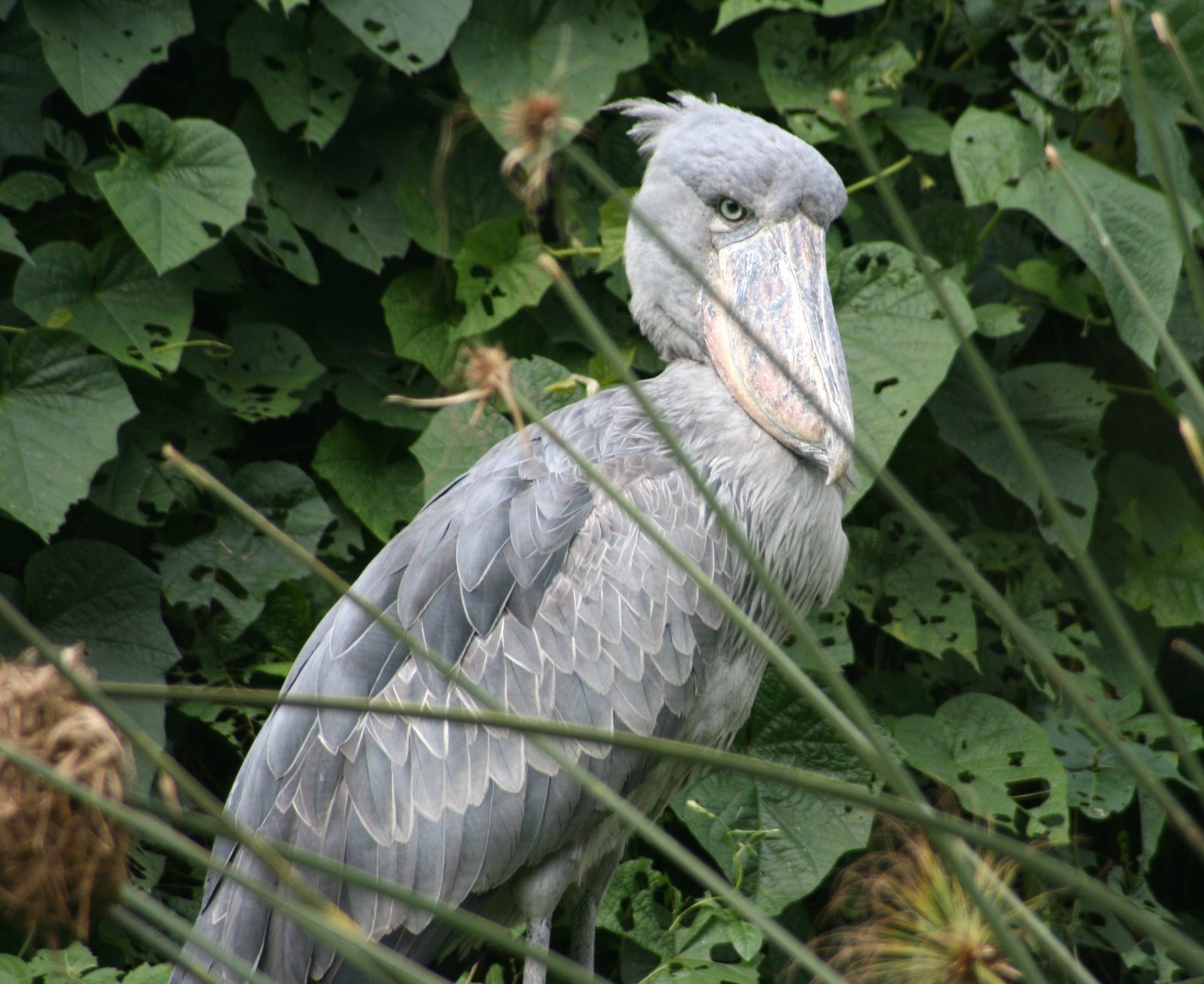
A monotypic family comprising only the Shoebill (Balaeniceps rex). It inhabits extensive papyrus and reed swamps from South Sudan to Zambia, where the Bangweulu Swamps are its southernmost stronghold. Standing up to 1.5 m tall with a wingspan well over two metres, it is dominated by a colossal, bulbous, clog-shaped bill. The bill ends in a sharp nail-like hook and has keen cutting edges, used to seize, decapitate and strip vegetation from prey. The Shoebill is a solitary ambush predator. It stands statue-still at the edge of open water or on floating vegetation, sometimes for hours. It then 'collapses' forward with wings raised and engulfs prey and plants together. Its main prey are lungfish, catfish and tilapia. Water snakes, frogs, young crocodiles and monitor lizards are also taken. It flies with the neck retracted, as pelicans do, and often soars on thermals. It is mostly silent, but bill-clattering serves as a greeting at the nest. The nest is a mound of floating vegetation holding one to three eggs. Usually only one chick fledges, since the eldest commonly kills or outcompetes its siblings, so reproduction is slow. Its classification has long been disputed among storks, herons and pelicans. It is now placed with the pelicans, with the Hamerkop as its closest relative.
Native species 1 species
Species that occur here by nature: breeding birds, winter visitors and passage migrants. They are arranged by genus, in the sequence of the list.
Balaeniceps 1 species