All species › Passerines › Bulbuls › Plain Greenbul
Plain Greenbul | Eurillas curvirostris
Alexanders buulbuul | Bulbul Piquicurvo
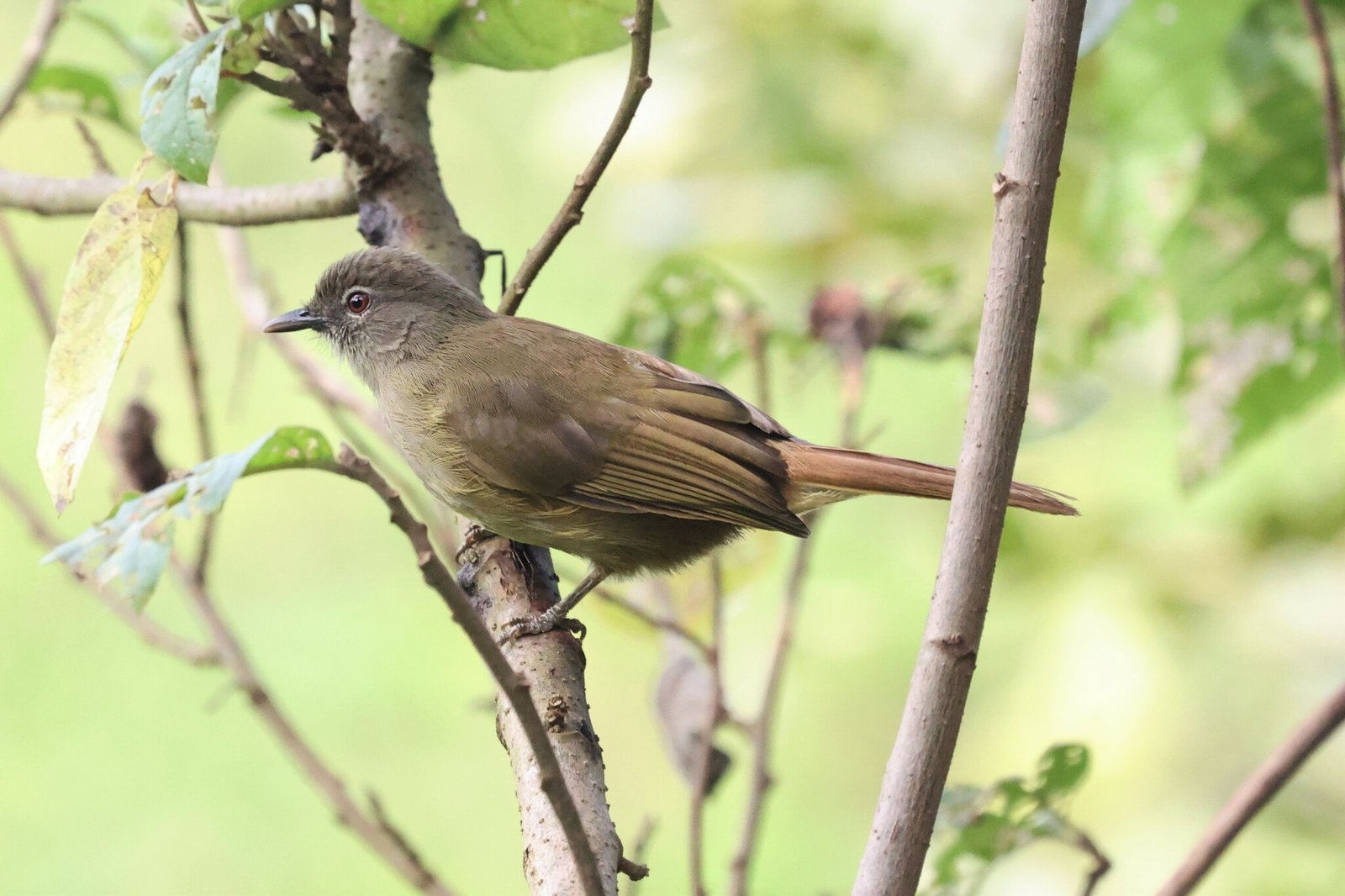
Plain Greenbul is a plain olive-brown greenbul of the understorey and middle stratum of lowland forest in West and Central Africa. In the region it is known only from northern Angola. Because of its simple plumage it is identified in the field mainly by its song, a mournful whistled phrase.
Voice
The song is a short, mournful phrase of whistled, slurred notes, chuk ... wheee-oo-oo, often introduced by a few dry chuk notes. Also a soft, nasal nyeh as contact call.
Recording: Alain Verneau — CC BY-NC-SA 4.0 · converted to mono · xeno-canto
Identification
16–18 cm. A slim, nondescript greenbul. The upperparts are olive-brown, the crown slightly greyer. The throat is pale grey, breast and flanks are greyish olive, the belly paler with a yellow wash, the undertail-coverts yellowish brown. A narrow pale eye-ring. The bill is dark, fairly long and slightly decurved, the legs brownish grey. Males are slightly larger and longer-billed than females. Juveniles are browner.
Confusion species
Little Greenbul Eurillas virens is greener and more compact, with a shorter bill, and has a scratchy, swelling song. Yellow-Whiskered Greenbul Eurillas latirostris is darker, with yellow gape feathers (except juveniles). Little Grey Greenbul Eurillas gracilis is smaller, with a greyer head, a clearer eye-ring and a yellower belly, and keeps higher in the canopy.
Habitat
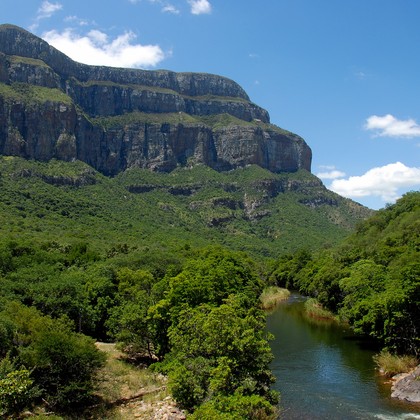
Understorey and middle stratum of humid lowland forest, forest edge, riverine forest and older secondary forest. It lives singly or in pairs, often joins mixed foraging flocks and eats insects and small fruits.
Where the bird is most at home, classified by the vegetation units of southern Africa.

Range and movements
In the region only in northern Angola: mainly in Cuanza Norte and Uíge, more sparsely in Bengo, Malanje, Cabinda and Lunda Norte. Beyond the region from Guinea east through the West African forest belt to Uganda and western Kenya and south to DR Congo.
- Resident
- dark = core range, pale = thinly spread
How and when to look
All year. Look for it in the forests of Uíge and Cuanza Norte and learn the mournful whistled song: without it, it is barely distinguishable among the other plain greenbuls. Note the slightly decurved, fairly long bill.
Conservation status
Not threatened; common over most of its range. In Angola rarely recorded and confined to the northern forests, which are being fragmented by logging and agriculture.
Scientific name
Eurillas curvirostris | (Cassin, 1859)
Cassin described the species in 1859 as Andropadus curvirostris; because it was later moved to another genus, the author and year stand in brackets. The genus Eurillas was introduced in 1899 by Oberholser. Eurillas comes from the Greek eurus, 'broad', and illas, 'thrush' — probably for the rather broad bill of some species. curvirostris comes from the Latin curvus, 'curved', and rostrum, 'bill' — for the slightly curved bill. The specimen the first description was based on came from Camma River, Gabon.