All species › Passerines › Bulbuls › Yellow-Whiskered Greenbul
Yellow-Whiskered Greenbul | Eurillas latirostris
Geelbaardbuulbuul | Bulbul Sibá
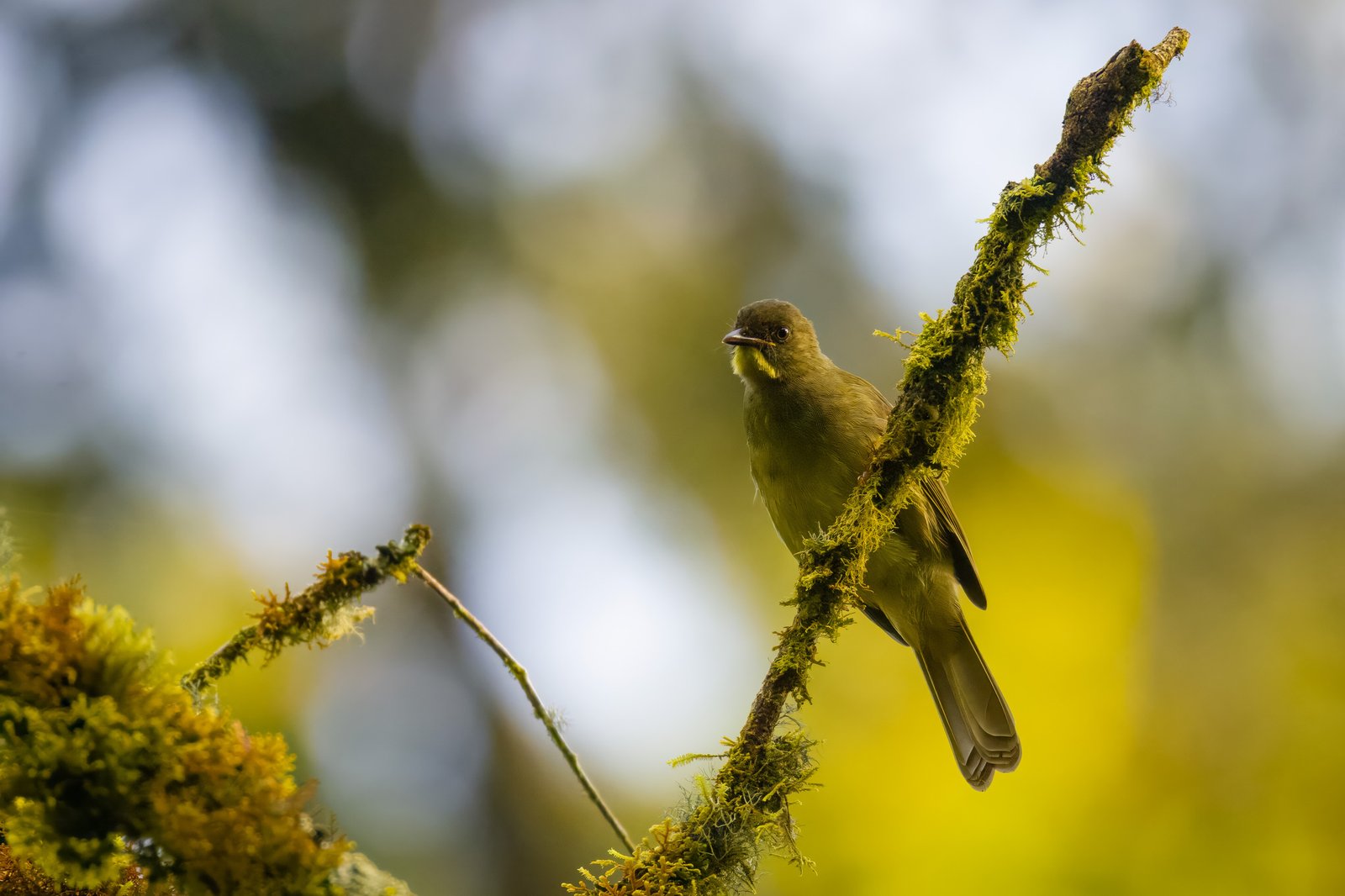
Yellow-Whiskered Greenbul is a dark olive-green greenbul of the forest interior, recognised by the bright yellow feathers at the gape that stick out sideways like whiskers. In the region it occurs only in north-western Angola, where it is common in the forests of the Cuanza Sul escarpment. Its monotonous, endlessly repeated call is typical of these forests.
Voice
The most frequently heard call is a monotonous series of a single note, chuk ... chuk ... chuk, sometimes repeated for minutes on end. The song is a short, hurried chattering phrase, chuk-chuk-chee-chewirrr, often following the series of calls.
Recording: Jaap van der Waarde — CC BY-NC-SA 4.0 · converted to mono · xeno-canto
Identification
16–18 cm. A medium-sized, dark greenbul. The upperparts are dark olive-green, the crown slightly darker. At the gape a tuft of bright yellow feathers that can be raised to stick out sideways like a yellow moustache. Throat and breast are greyish olive, the belly slightly paler and yellowish. The eye is dark, the bill blackish, the legs greyish brown. Females are slightly smaller, with smaller yellow whiskers. Juveniles largely lack the yellow whiskers and are browner.
Confusion species
Little Greenbul Eurillas virens is paler and plainer, without yellow whiskers, and has a different, scratchy song. Plain Greenbul Eurillas curvirostris is browner and greyer, without yellow whiskers. Falkenstein's Greenbul Chlorocichla falkensteini has an entirely yellow throat and lives more at forest edges. Juveniles without yellow whiskers are best identified by voice and by the company of their parents.
Habitat
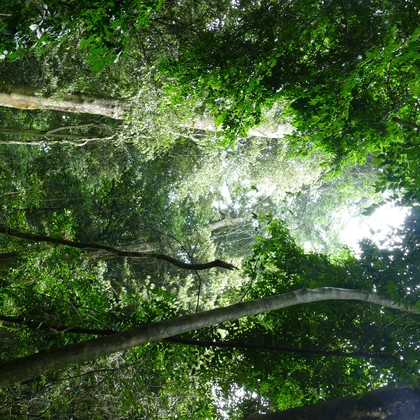
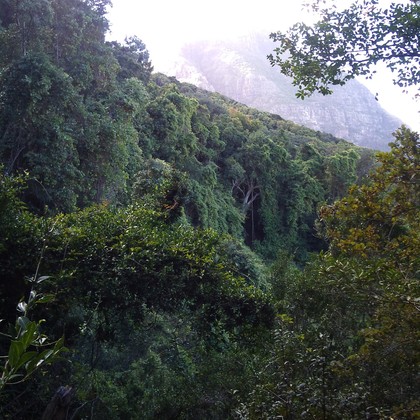
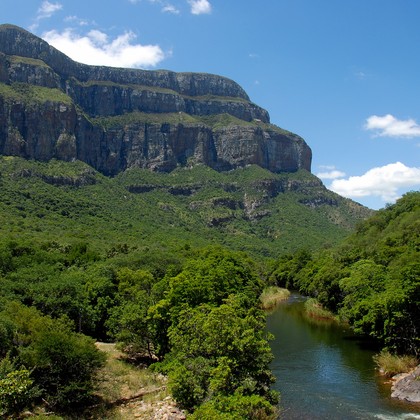
Understorey and middle stratum of lowland and hill forest, forest edge, riverine forest, secondary forest and shade coffee; mostly between 300 and 1,500 m. It lives singly or in pairs, often joins mixed foraging flocks and eats fruit, berries and insects.
Where the bird is most at home, classified by the vegetation units of southern Africa.
Range and movements
In the region only in north-western Angola: especially common in the escarpment forests of Cuanza Sul (Kumbira, Gabela), also in Cuanza Norte, Uíge and Cabinda, with scattered records in Malanje and the Lunda provinces. Beyond the region from Senegal east to Ethiopia and Kenya and south to western Tanzania and southern DR Congo.
- Resident
- dark = core range, pale = thinly spread
How and when to look
All year. In the forests at Kumbira and Gabela the monotonous chuk series is often the most frequently heard bird sound. Follow the sound to the middle stratum and wait for the bird to turn: the yellow whisker feathers then light up.
Conservation status
Not threatened; over most of its range one of the commonest forest greenbuls. In Angola dependent on the fragmented escarpment forest, which is declining through logging and agriculture.
Scientific name
Eurillas latirostris | (Strickland, 1844)
Strickland described the species in 1844 as Andropadus latirostris; because it was later moved to another genus, the author and year stand in brackets. The genus Eurillas was introduced in 1899 by Oberholser. Eurillas comes from the Greek eurus, 'broad', and illas, 'thrush' — probably for the rather broad bill of some species. latirostris comes from the Latin latus, 'broad', and rostrum, 'bill' — for the rather broad bill. The specimen the first description was based on came from Bioko (Fernando Po), Equatorial Guinea.