All species › Nightjars › Nightjars › Freckled Nightjar
Freckled Nightjar | Caprimulgus tristigma
Rotsnachtzwaluw | Chotacabras Pecoso
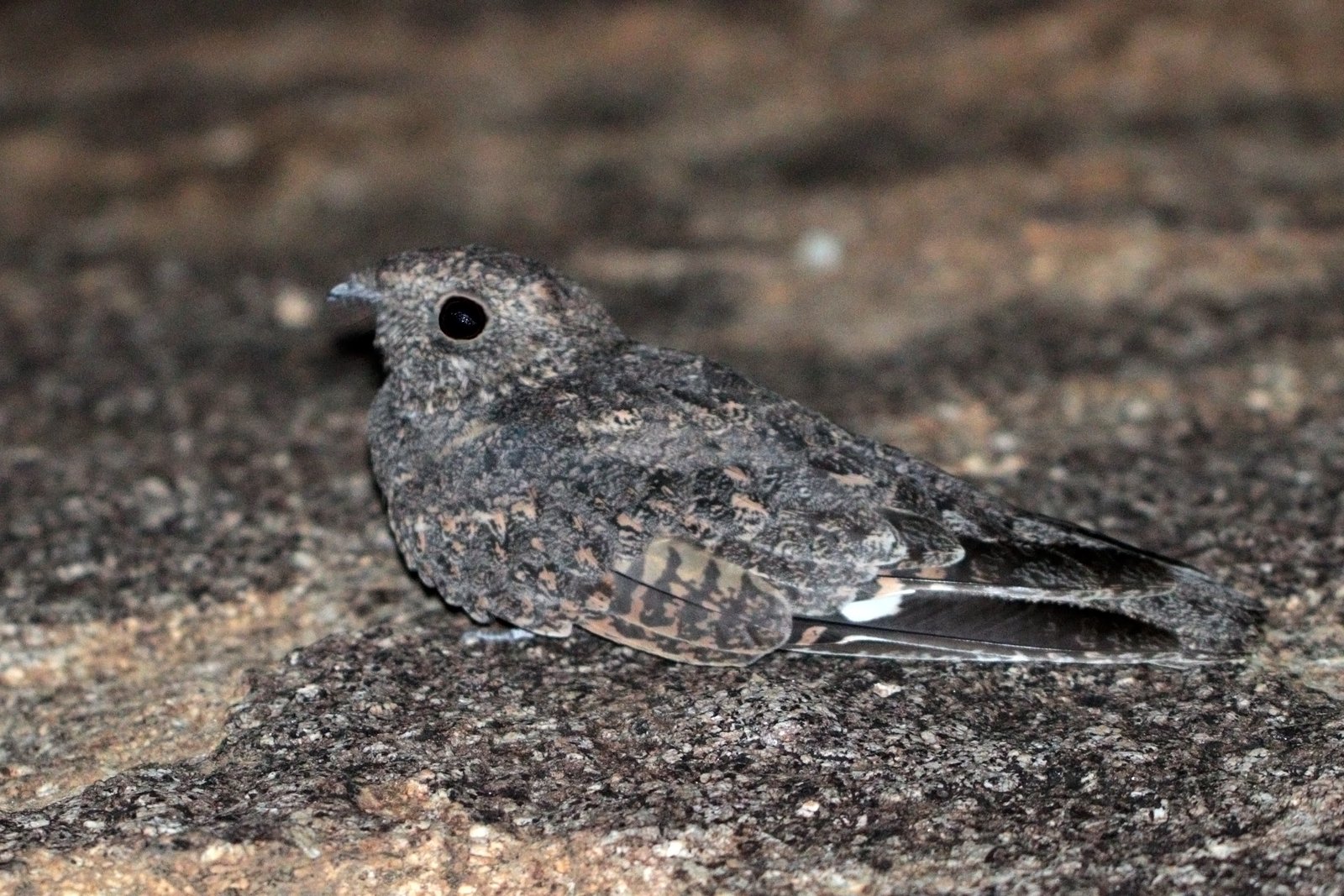
The Freckled Nightjar is a large, dark nightjar that roosts by day on bare rock, where its finely speckled plumage vanishes completely among lichen and weathered stone. In some towns it has adopted flat roofs as a substitute for rock sheets.
Voice
A loud, yelping double note, kow-kow or wow-wow, like a small dog in the distance, often repeated several times. It calls from a boulder or roof, mainly at dusk, by moonlight and in early spring.
Recording: Bram Vogels — CC BY-NC-SA 4.0 · converted to mono · xeno-canto
Identification
26–28 cm. A large, heavily built nightjar with a rather short tail. The plumage is dark grey-brown to blackish, densely covered all over with fine pale and grey speckles, with no obvious streaks on crown or mantle and no rufous hind collar. The throat has a white patch on each side. The male has small white spots on the four outer primaries and narrow white tips to the outer tail feathers; the female has smaller wing spots and no white in the tail. The colour varies with the substrate: birds on reddish sandstone are warmer, birds on granite greyer.
Confusion species
No other nightjar in the region is so dark and evenly speckled without a rufous collar. The Fiery-Necked Nightjar (Caprimulgus pectoralis) and the Rufous-Cheeked Nightjar (Caprimulgus rufigena) are smaller and paler, with an obvious collar. The Montane Nightjar (Caprimulgus poliocephalus) is smaller with much white in the tail. The preference for bare rock and the yelping call distinguish it.
Habitat
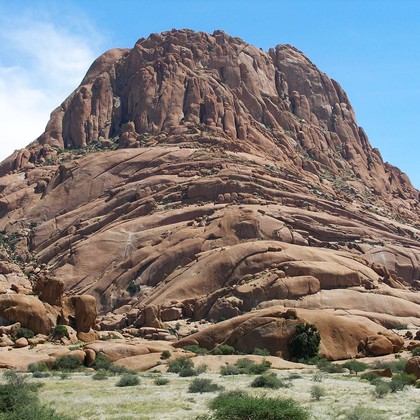
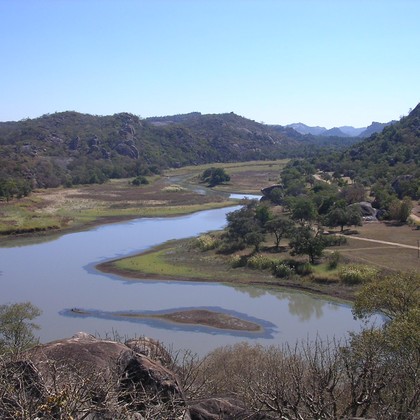
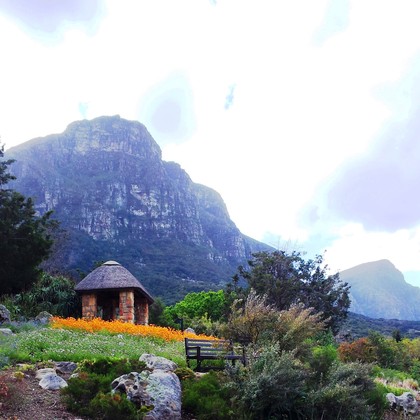
Rocky hills, granite koppies, inselbergs, gorges and rock sheets in woodland and savanna, from sea level to high mountains. It roosts by day on bare rock, often in full sun. In towns such as Pretoria, Harare and Bulawayo it also uses flat roofs, hunting insects around street lights.
Where the bird is most at home, classified by the vegetation units of southern Africa.
Range and movements
Wherever bare rock occurs: Angola, Zambia, Malawi, Zimbabwe, inland Mozambique, eastern Botswana, central and western Namibia and, in South Africa, Limpopo, Mpumalanga, Gauteng, North West, KwaZulu-Natal and along the Orange River in the Northern Cape; also Eswatini. Absent from flat country without rock. Beyond the region over much of sub-Saharan Africa, from Senegal to Ethiopia.
- Resident
- Summer visitor (c. Oct–Mar)
- Winter visitor (c. Apr–Sep)
- Passage (Mar–Apr, Oct–Nov)
- dark = core range, pale = thinly spread
How and when to look
All year at a granite koppie or rock sheet, at dusk. Listen for the yelping kow-kow and search the rock edges with a torch. By day a roosting bird can be found only by scanning rock sheets inch by inch with binoculars; in the Matobo Hills and the Magaliesberg this regularly succeeds.
Conservation status
Not threatened and common in rocky areas. It is little affected by land use, since bare rock is rarely converted, and in some towns it has adapted to buildings. There is no evidence of declines.
Scientific name
Caprimulgus tristigma | Rüppell, 1840
Rüppell described the species in 1840 and placed it straight away in the genus where it still stands. The genus Caprimulgus was introduced in 1758 by Linnaeus. Caprimulgus is Latin, from capra 'nanny goat' and mulgere 'to milk', after the old belief that nightjars suckled goats at night. tristigma comes from Greek tri-, 'three', and stigma, 'spot': 'three-spotted', for white spots in the plumage. The specimen the first description was based on came from Gondar, Ethiopia.