All species › Birds of prey › Hawks, eagles and kites › European Honey Buzzard
European Honey Buzzard | Pernis apivorus
Wespendief | Abejero Europeo
The European Honey Buzzard is a Palearctic migrant that reaches the wooded north and east of southern Africa as a scarce summer visitor. It feeds mainly on the larvae and pupae of wasps and bees, which it digs out of the ground or from nests with its feet, and spends the southern summer inconspicuously in woodland and forest edges.
Voice
Practically silent in southern Africa. On the breeding grounds a high, plaintive whistled whee-hu or pee-lu, only rarely heard in the non-breeding range.
Recording: Mathieu Franzkeit — CC BY-NC-SA 4.0 · converted to mono · xeno-canto
Identification
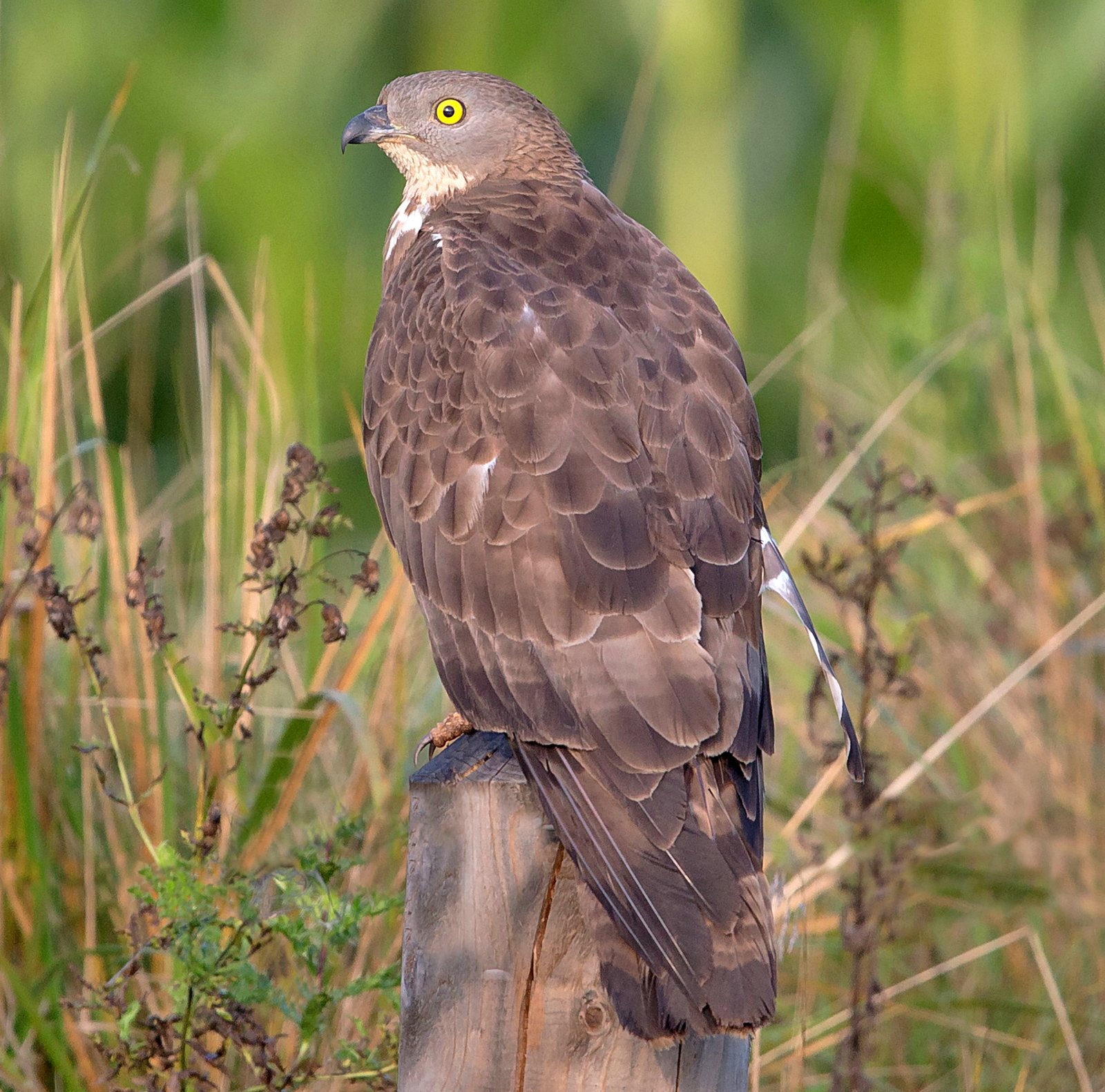
About 55 cm, slightly larger and slimmer than a Common Buzzard, with a small, pigeon-like head on a long neck, a fairly long tail and a yellow eye. The plumage ranges from almost white to dark chocolate-brown, with many streaked and barred intermediates. The male has a grey head and grey lores; its tail shows two dark bands near the base and a broad terminal band, and the underwing has a black trailing edge and a few dark bars. The female is browner with narrower, more evenly spaced tail bands. Dense, scale-like feathering on the head and lores protects against stings. Juveniles have a dark eye, a yellow cere and a darker tail with more, finer bands. In flight the protruding head, the long tail with narrow base and the flat-held wings are distinctive.
Confusion species
Common Buzzard (Buteo buteo) has a shorter neck and a broader, rounded head, a shorter, finely barred tail and holds its wings in a shallow V. Wahlberg's Eagle (Hieraaetus wahlbergi) has a square tail without broad bands, feathered tarsi and straight, plank-like wings. Booted Eagle (Hieraaetus pennatus) shows white 'landing lights' at the base of the leading edge and a uniformly pale tail. A small head on a long neck, the typical tail bands and the yellow eye point to Honey Buzzard.
Habitat
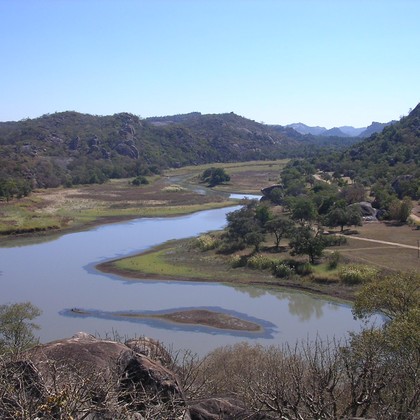
Woodland, miombo, riverine forest, forest edges and plantations, also large gardens with tall trees; avoids dry open plains. It sits for long periods hidden in the canopy or walks on the ground to dig out wasp nests; also takes termites, other insects, lizards and frogs. Does not breed in the region.
Where the bird is most at home, classified by the vegetation units of southern Africa.


Range and movements
Scarce but annual in the north and east of the region: Angola, Zambia, Malawi, Mozambique and Zimbabwe, northern Botswana and the Zambezi Region of Namibia, and in South Africa mainly Limpopo, Mpumalanga, Eswatini and KwaZulu-Natal; further south and west only occasional. It breeds in Europe and western Asia to western Siberia and winters in West and Central Africa; southern Africa lies at the edge of the winter range.
- Summer visitor (c. Oct–Mar)
- Passage (Mar–Apr, Oct–Nov)
- dark = core range, pale = thinly spread
How and when to look
Chances are best in December and January in wooded lowveld, for example in northern Kruger or along the Zambezi. Check raptors flying over woodland for the small, protruding head and the tail pattern; a bird standing on the ground digging is almost always a Honey Buzzard. Any record south of the Limpopo is worth noting.
Conservation status
Not threatened; the European breeding population is large and stable. Large numbers of migrants are, however, shot on passage across the Mediterranean, notably in Lebanon and on Malta. In southern Africa the species is so scarce that trends cannot be measured.
Scientific name
Pernis apivorus | (Linnaeus, 1758)
Linnaeus described the species in 1758 as Falco apivorus; because it was later moved to another genus, the author and year stand in brackets. The genus Pernis was introduced in 1816 by Cuvier, GLCFD. Pernis goes back to the Greek pernēs, the name Aristotle used for a bird of prey. apivorus is Latin, from apis 'bee' and -vorus 'eating', after its digging out of wasp and bee nests. The specimen the first description was based on came from Sweden.