All species › Birds of prey › Hawks, eagles and kites › Hooded Vulture
Hooded Vulture | Necrosyrtes monachus
Kapgier | Alimoche Sombrío
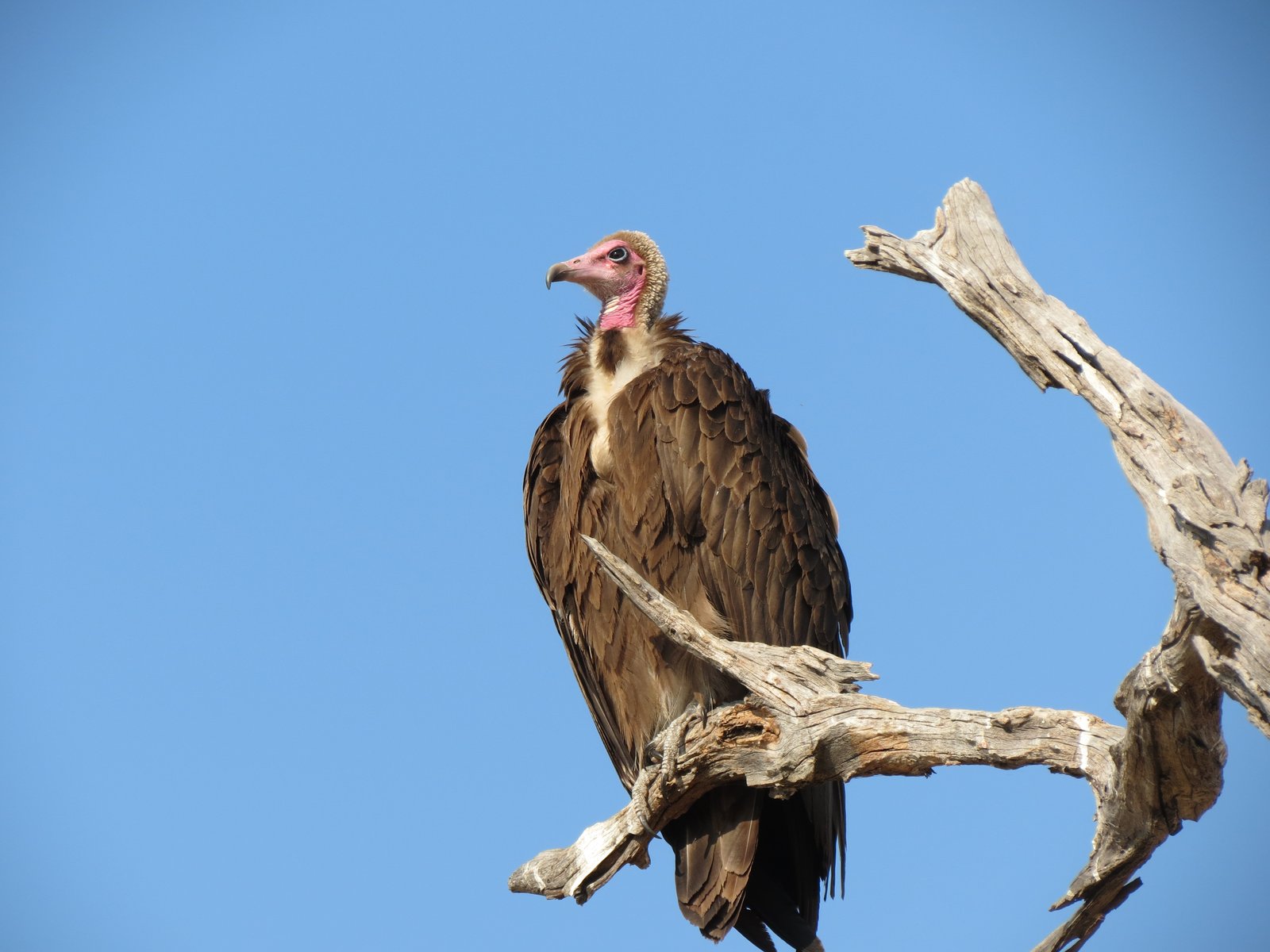
The Hooded Vulture is the smallest vulture in southern Africa: a uniformly dark brown bird with a thin, long bill and a bare pink face below a hood of pale brown down. With that slender bill it picks scraps from between bones and around the carcasses the large vultures leave behind.
Voice
Mostly silent. At the nest and at carcasses soft, squeaky twittering.
No recording with a suitable Creative Commons licence is available for this species yet.
Identification
About 70 cm. Wholly dark chocolate-brown, with a hood of pale brown to greyish down on the crown and hindneck. The face and foreneck are bare and pink, flushing deep red when excited. The bill is long and thin, dark with a pale base. The legs are bluish-grey. The sexes are alike. Juveniles have a darker hood and paler, bluish-grey facial skin and are somewhat plainer brown. In flight a compact dark vulture with broad wings and well-spread primaries, a short rounded tail and a pale band across the base of the primaries below.
Confusion species
A young Egyptian Vulture (Neophron percnopterus) is also dark brown with a thin bill, but has a yellow face, a long wedge-shaped tail and narrower wings; that species is moreover very rare in the region. A young Palm-Nut Vulture (Gypohierax angolensis) is brown with a heavy yellow bill base and a square tail. Dark young White-Backed Vultures (Gyps africanus) are much larger with a long neck and a heavy bill.
Habitat
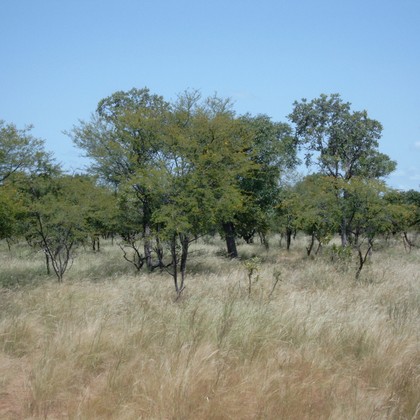
Low-lying savanna and woodland, especially mopane, mixed thornveld and miombo, and along the large rivers. Elsewhere in Africa a common resident of villages, markets and rubbish dumps; in southern Africa almost confined to protected areas rich in game. It eats carrion, refuse, insects and the dung of predators and people. It nests solitarily in a large, densely leaved tree, often along a river.
Where the bird is most at home, classified by the vegetation units of southern Africa.


Range and movements
The north-east and north of the region: Mozambique, Zimbabwe (especially the lowveld and the Zambezi Valley), Zambia, Malawi, northern Botswana, the Zambezi Region of Namibia and Angola. In South Africa almost confined to Kruger National Park and the adjoining lowveld reserves in Limpopo and Mpumalanga, with wanderers to Eswatini and northern KwaZulu-Natal; it has disappeared as a breeder from the rest of KwaZulu-Natal and the Eastern Cape. Beyond the region across almost all of sub-Saharan Africa, from Senegal to Ethiopia and Somalia.
- Resident
- Summer visitor (c. Oct–Mar)
- Winter visitor (c. Apr–Sep)
- Passage (Mar–Apr, Oct–Nov)
- dark = core range, pale = thinly spread
How and when to look
The best chance is in Kruger National Park (especially north of the Olifants River), the Zimbabwe lowveld and the Luangwa Valley. At a carcass watch for a small dark vulture waiting at the edge of the scrum and quickly picking up scraps; in flight it stands out among the large vultures by its compact shape and rounded tail. At camps and lodges it sometimes forages around refuse sites.
Conservation status
Critically Endangered on the Red List. In West Africa the species is still relatively numerous, but declines through poisoning, hunting and trade for traditional use are rapid everywhere. In southern Africa the breeding population is small and largely dependent on Kruger and surrounding reserves; lead poisoning, poaching with poison and the loss of game outside parks are the main threats.
Scientific name
Necrosyrtes monachus | (Temminck, 1823)
Temminck described the species in 1823 as Cathartes monachus; because it was later moved to another genus, the author and year stand in brackets. The genus Necrosyrtes was introduced in 1841 by Gloger. Necrosyrtes comes from Greek nekros, 'corpse', and surō, 'to drag' — a scavenger that tugs at carcasses. monachus is Late Latin for 'monk' — for the downy 'hood' on the head and neck, like a monk's cowl. The specimen the first description was based on came from Senegal.