All species › Waders, gulls and terns › Crab Plover › Crab-Plover
Crab-Plover | Dromas ardeola
Krabplevier | Dromas
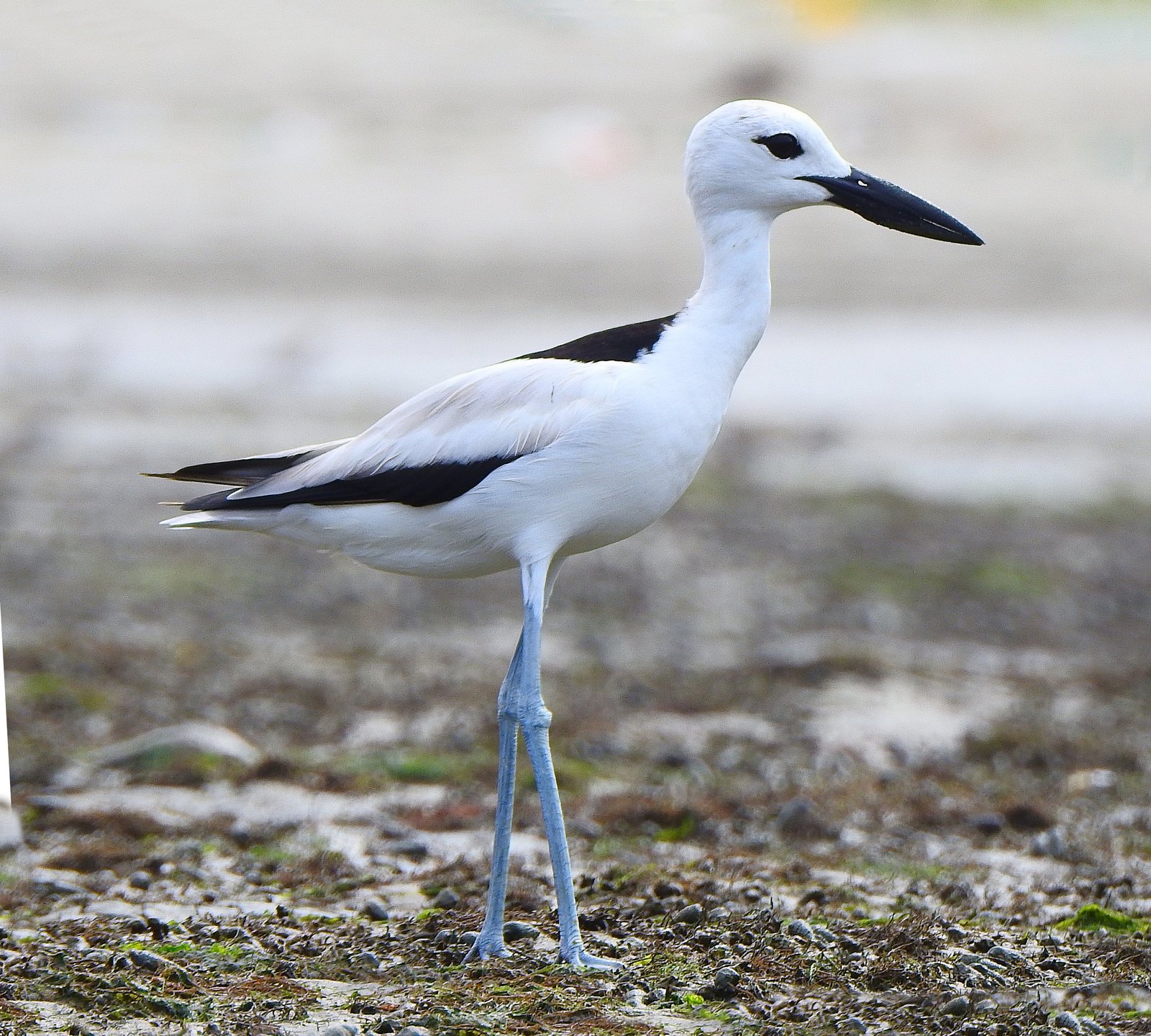
The Crab-Plover is a large, black-and-white wader with a heavy, dagger-shaped black bill, the only species in its own family. It breeds around the Red Sea and the Persian Gulf in burrows it digs itself in sand dunes, unique among waders, and reaches the coast of Mozambique as a non-breeding visitor.
Voice
Flocks are noisy, with a nasal, barking kyook-kyook or kwerrk and a fast, hoarse cackling, ha-ha-ha-ha, especially on take-off and at night on the feeding grounds.
Recording: Sven Normant — CC BY-NC-SA 4.0 · converted to mono · xeno-canto
Identification
38–41 cm, sturdily built with a large head and a short, very heavy, straight black bill recalling that of a heron. Adults are gleaming white with a black mantle and black primaries; the long legs are bluish grey and project well beyond the tail in flight. Juveniles have a greyer back, grey streaking on the crown and nape and a somewhat smaller bill; they often remain with their parents for a long time. It often rests on one leg in tight groups and walks with a jerky, rather ungainly gait.
Confusion species
Unmistakable in the region. Pied Avocet Recurvirostra avosetta is also black and white but slimmer, with a thin, upturned bill and a black cap. Eurasian Oystercatcher Haematopus ostralegus and African Oystercatcher Haematopus moquini have a long orange-red bill and pink legs. At distance a roosting flock can suggest terns such as Sandwich Tern Thalasseus sandvicensis, but the long legs and heavy bill settle it.
Habitat
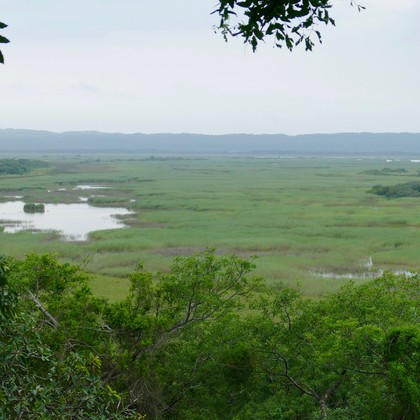
Tidal flats, sandbanks, coral reef flats and mangrove coasts, with high-tide roosts on sandbanks or islets. It often feeds at dusk and at night, when crabs are active; it walks and runs at a crab, seizes it and cracks the shell with its heavy bill, or swallows small crabs whole. It also takes molluscs and worms.
Where the bird is most at home, classified by the vegetation units of southern Africa.
Range and movements
Within the region almost only along the coast of Mozambique, especially around Inhambane Bay, at Vilankulo and in the Bazaruto Archipelago; irregular south to Maputo Bay. In South Africa a vagrant to KwaZulu-Natal and rare further along the coast. Beyond the region it breeds along the Red Sea, the Gulf of Aden, the Persian Gulf and the Gulf of Oman; outside the breeding season it ranges along the coasts of East Africa, Madagascar, the Seychelles, India, Sri Lanka and the Andaman Islands.
- Resident
- Summer visitor (c. Oct–Mar)
- Passage (Mar–Apr, Oct–Nov)
- dark = core range, pale = thinly spread
How and when to look
Visit the tidal flats around Vilankulo or Inhambane Bay between October and March on a rising tide, when flocks gather at high-tide roosts. A telescope is essential. At dusk the birds are more active and noisier; boat trips to the Bazaruto islands often give good views.
Conservation status
Not threatened. The world population is estimated at a few tens of thousands of birds and is vulnerable because it is concentrated in a few large breeding colonies. Disturbance of breeding dunes, coastal development and egg collecting in the breeding range are the main threats; in Mozambique disturbance of roosts and tidal flats is a local risk.
Scientific name
Dromas ardeola | Paykull, 1805
Paykull described the species in 1805 and placed it straight away in the genus where it still stands. He introduced the genus Dromas in that same work. Dromas is the Greek word for 'runner' — for the way Crab-plover runs across the mudflats after crabs. ardeola is a diminutive of the Latin ardea, 'heron' — 'little heron', for the long-legged, heron-like appearance and black-and-white plumage. The specimen the first description was based on came from India.