All species › Waders, gulls and terns › Jacanas › African Jacana
African Jacana | Actophilornis africanus
Lelieloper | Jacana Africana
The African Jacana is the familiar chestnut bird that walks across water lilies on enormously long toes, as though walking on the water itself. The female is clearly larger than the male and may have several mates; the males incubate and, when needed, carry the chicks under their wings.

Voice
Loud and noisy: a sharp, rasping kyowrr, a high rolling krrrrk in alarm, and a series of rapid squeaking notes during skirmishes between neighbours. Flushed birds often call in flight.
Recording: Bernard BOUSQUET — CC BY-NC-SA 4.0 · converted to mono · xeno-canto
Identification
25–30 cm; the female is noticeably larger than the male. Body and wings are deep chestnut, the throat and foreneck white, grading into a golden band on the lower neck. The hindneck and a stripe through the eye are black. The bill and frontal shield are pale blue. The legs are long and grey, with extremely long toes and claws. In flight the flight feathers are black and the legs trail far behind the body. Juveniles are brown above and white below, with a white supercilium, dark crown and hindneck, and no blue shield yet.
Confusion species
Adults are unmistakable. Juveniles resemble Lesser Jacana Microparra capensis, but that species is half the size, has a chestnut crown and hindneck, and shows a white trailing edge to the wing in flight. Allen's Gallinule Porphyrio alleni shares the habitat but is purple-blue and green with a red bill.
Habitat
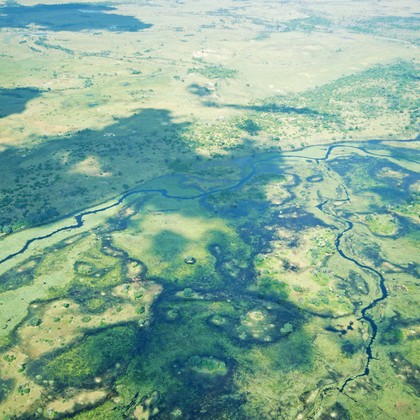
Fresh water with floating vegetation: lagoons, floodplains, dams, pans and quiet river backwaters with water lilies, duckweed, water hyacinth or floating grasses. It walks over the leaves and flips them over in search of insects, snails and other invertebrates. The nest is a loose pile of plant material on the floating vegetation, where the eggs sometimes lie half in the water.
Where the bird is most at home, classified by the vegetation units of southern Africa.
Range and movements
Common in the north and east of the region: the Okavango Delta and Chobe in Botswana, the Zambezi Region and north of Namibia, Zambia, Malawi, Zimbabwe, Mozambique and Angola. In South Africa mainly in Limpopo, Mpumalanga and KwaZulu-Natal, and in Eswatini; scarcer on the highveld and to the west, and rare in the Eastern and Western Cape. Beyond the region it occurs across almost all of sub-Saharan Africa.
- Resident
- Summer visitor (c. Oct–Mar)
- Winter visitor (c. Apr–Sep)
- Passage (Mar–Apr, Oct–Nov)
- dark = core range, pale = thinly spread
How and when to look
Often seen on any dam or lagoon with water lilies in the north and east, all year and even in the middle of the day. With a breeding pair, watch the male: when danger threatens he gathers the chicks under his wings, so that only a bundle of long legs sticks out beneath his body.
Conservation status
Not threatened; common and widespread. Dam construction provides new habitat, but invasive aquatic plants, wetland drainage and altered flooding can cause local declines.
Scientific name
Actophilornis africanus | (Gmelin, 1789)
Gmelin described the species in 1789 as Parra africana; because it was later moved to another genus, the author and year stand in brackets. The genus Actophilornis was introduced in 1925 by Oberholser. Actophilornis comes from the Greek aktē, 'shore', philos, 'loving', and ornis, 'bird' — a 'shore-loving bird', for its life along the edges of lakes and marshes. africanus means 'African', for its range in sub-Saharan Africa. The specimen the first description was based on came from Africa (later restricted to Ethiopia).