All species › Passerines › Tits › Ashy Tit
Ashy Tit | Melaniparus cinerascens
Acaciamees | Carbonero Cinéreo
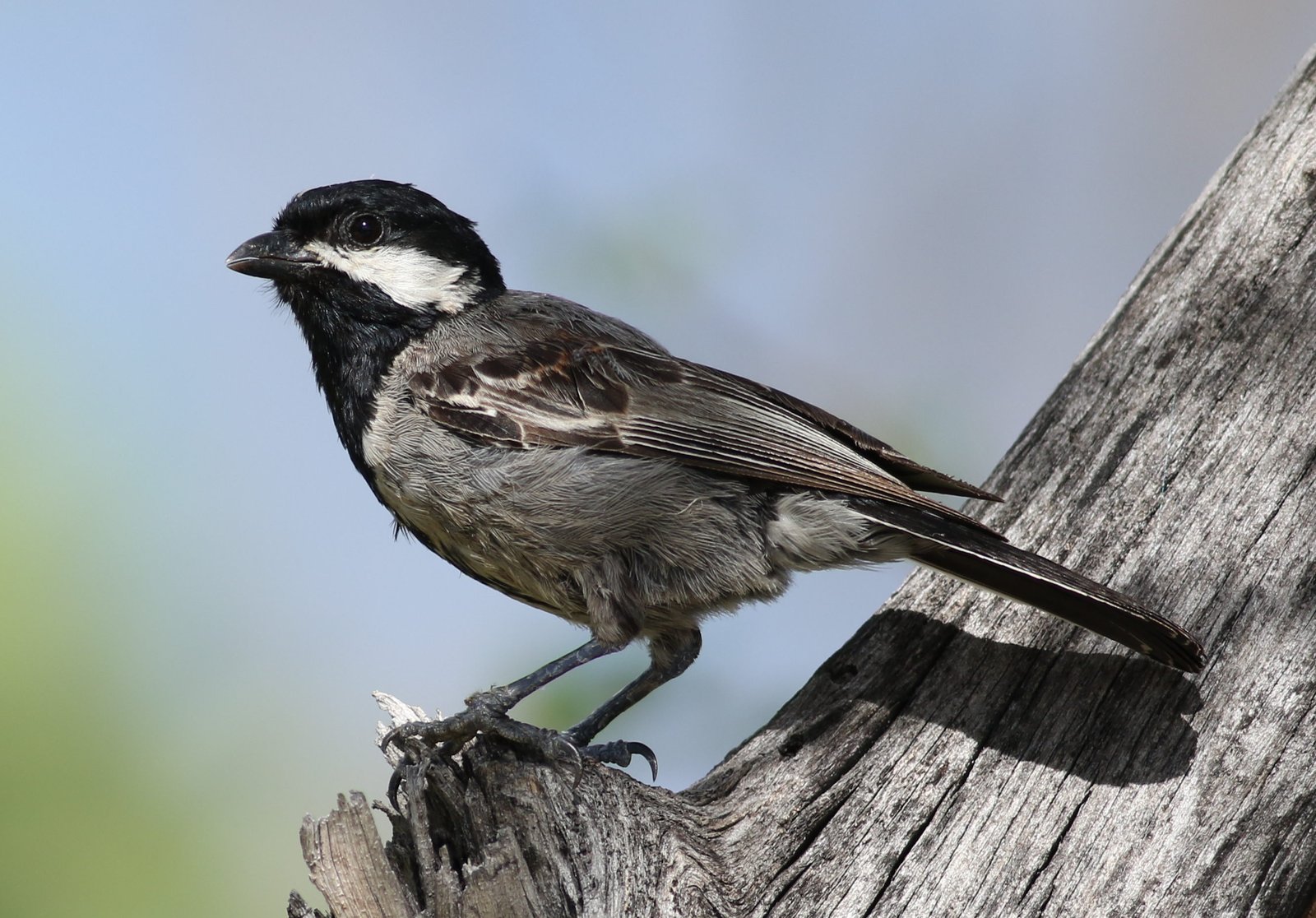
The Ashy Tit is the blue-grey tit of the dry thornveld in the west of southern Africa: a black head and bib with a broad white cheek stripe, otherwise cool ash-grey. It works noisily through acacia branches and often joins mixed foraging flocks. The species is endemic to southern Africa.
Voice
Noisy. A harsh, rasping chrr-chrr-chrr, often followed by clear whistles. The song is a repeated, penetrating tjoo-tjoo-tjoo or pee-pee-cherr, given from a treetop in the breeding season.
Recording: Campbell Fleming — CC BY-NC-SA 4.0 · shortened to the first 60 s, mono · xeno-canto
Identification
14 cm. Cap, throat and a broad central stripe down the breast are black; a broad white band runs from the bill base below the eye to the side of the neck, completed behind by a white nape patch. Back and rump are uniform blue-grey, the flanks and belly paler ash-grey with no brown or buff wash. The wings are blackish with broad white fringes to the coverts and inner secondaries, the tail black with white outer edges. The bill is short and black. The sexes are nearly alike; juveniles are duller, with a brownish-black cap.
Confusion species
Grey Tit Melaniparus afer has the same head pattern but a brownish-grey back and a buff wash on the belly and flanks; the two overlap only in a narrow belt in the Karoo, where intergrades occur. Miombo Tit Melaniparus griseiventris of the northern miombo is paler, with a light grey to whitish belly and a narrower black breast stripe; their habitats hardly meet. Southern Black Tit Melaniparus niger and Carp's Tit Melaniparus carpi are largely black and lack the white cheek stripe.
Habitat
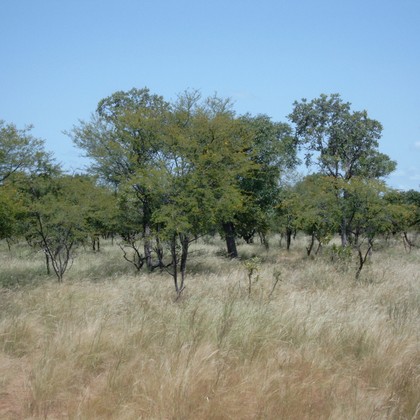
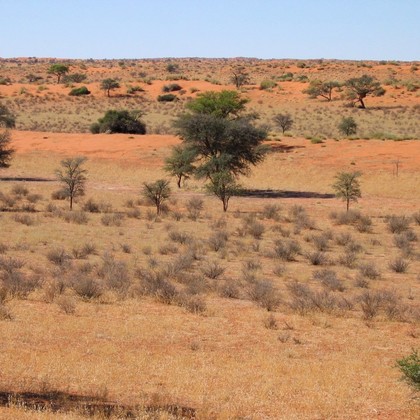
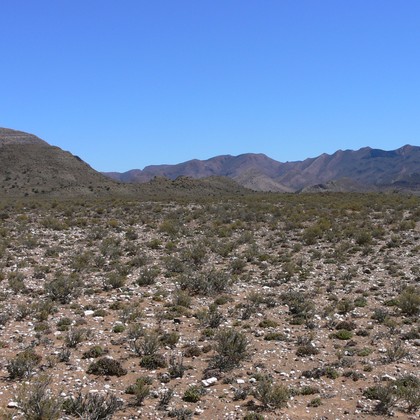
Acacia savanna, Kalahari thornveld, dry watercourses lined with thorn trees and scrub in the Nama Karoo, down to farmyards and dry gardens. It searches twigs and bark for insects, larvae and spiders, sometimes hanging upside down from thin sprays, and holds hard prey under one foot to hammer it open. It nests in a hole in a tree or post.
Where the bird is most at home, classified by the vegetation units of southern Africa.
Range and movements
Endemic to southern Africa. Widespread in Namibia (except the barren Namib), in western, central and southern Botswana, and in south-western Angola. In South Africa it occurs in the Northern Cape, North West, the Free State and western Limpopo, south through the Karoo into the Eastern Cape. It is absent from the moist eastern lowlands and from fynbos.
- Resident
- Summer visitor (c. Oct–Mar)
- Winter visitor (c. Apr–Sep)
- Passage (Mar–Apr, Oct–Nov)
- dark = core range, pale = thinly spread
How and when to look
Year-round in thornveld; usually detected by ear, as the rasping call and whistles carry far. In the Karoo check the belly: cool grey points to Ashy Tit, a buff wash and browner back to Grey Tit. In winter often in parties with Pririt Batis, eremomelas and penduline tits.
Conservation status
Not threatened; common in suitable thornveld. No large-scale threats are known. Felling of old acacias with nest holes may matter locally, but the species also uses posts and artificial cavities.
Scientific name
Melaniparus cinerascens | (Vieillot, 1818) (GBIF: Parus cinerascens)
Vieillot described the species in 1818 as Parus cinerascens; because it was later moved to another genus, the author and year stand in brackets. The genus Melaniparus was introduced in 1850 by Bonaparte. Melaniparus combines the Greek melas, 'black', with Parus, Latin for 'tit' — for the largely black plumage of many species. cinerascens is Latin for 'greyish, ashy', from cinis, 'ash' — for the grey back and flanks. The specimen the first description was based on came from Pelladrift, Northern Cape, South Africa.