All species › Passerines › Tits › Miombo Tit
Miombo Tit | Melaniparus griseiventris
Miombomees | Carbonero del Miombo
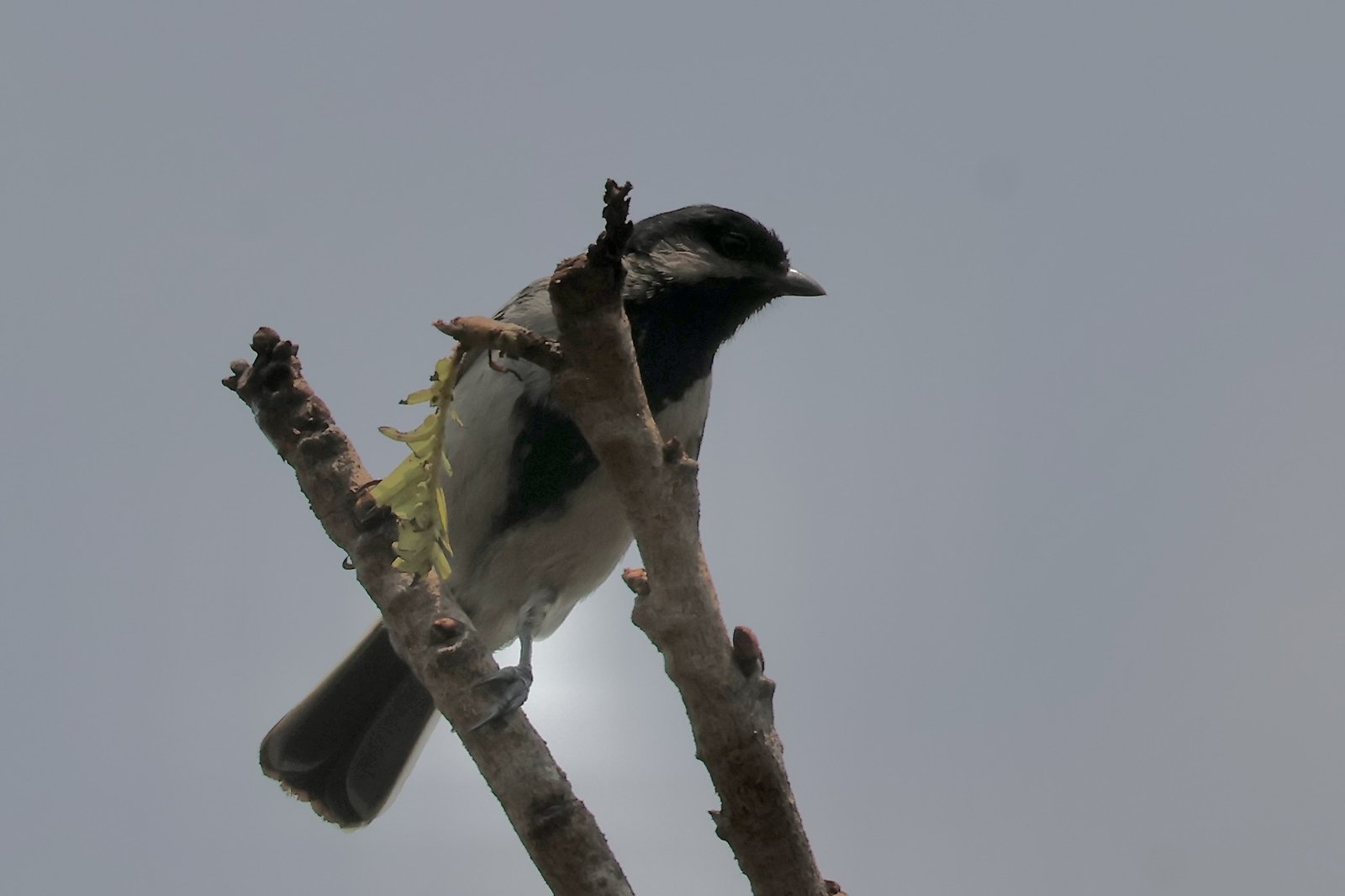
Miombo Tit is the grey tit of miombo woodland, the northern counterpart of Ashy Tit and Grey Tit. It is closely tied to miombo and is part of almost every mixed bird party there.
Voice
A harsh, rattling cher-cher-cher, often preceded by a high tsi-tsi, and a clear, repeated whistled song, chee-wee chee-wee or pee-pee-choo. Very similar to the voice of Ashy Tit.
Recording: Derek Solomon — CC BY-NC-SA 4.0 · converted to mono · xeno-canto
Identification
14 cm. Cap and broad bib glossy black, separated by large white cheeks that continue as a white band towards the nape. Back and scapulars blue-grey, wings dark grey with white edges to coverts and tertials, tail black with white outer edges. Breast and belly pale grey to greyish white, clearly paler than the back. Bill black, iris dark. The sexes are alike.
Confusion species
Ashy Tit Melaniparus cinerascens of acacia and Kalahari thornveld further south and west is darker and more uniformly grey below, with less contrast between belly and back; the two largely exclude each other by habitat. Grey Tit Melaniparus afer of south-western South Africa has a buff belly and does not occur in miombo. Rufous-Bellied Tit Melaniparus rufiventris, often in the same party, has a black breast and rufous belly.
Habitat
Almost exclusively miombo, on plateaus and slopes; locally also other broadleaved woodland adjoining miombo. It forages on branches and in the canopy for insects, often hanging from twigs, and joins mixed bird parties. Nests in a tree hole.
Where the bird is most at home, classified by the vegetation units of southern Africa.

Range and movements
Within the region in central and eastern Angola, Zambia, Malawi, western and central Mozambique and northern and central Zimbabwe. Beyond, in south-eastern DR Congo and Tanzania.
- Resident
- dark = core range, pale = thinly spread
How and when to look
Year-round. In any good miombo, such as around Harare and on the Zambian plateau, it is often the first species seen in a bird party. Grey Tits away from miombo, in acacia country, are more likely to be Ashy Tits where the two ranges meet.
Conservation status
Not threatened; common in suitable miombo. Large-scale clearance of miombo for charcoal and farming is the main long-term threat.
Scientific name
Melaniparus griseiventris | (Reichenow, 1882) (GBIF: Parus griseiventris)
Reichenow described the species in 1882 as Parus griseiventris; because it was later moved to another genus, the author and year stand in brackets. The genus Melaniparus was introduced in 1850 by Bonaparte. Melaniparus combines the Greek melas, 'black', with Parus, Latin for 'tit' — for the largely black plumage of many species. griseiventris is Latin for 'grey-bellied', from griseus, 'grey', and venter, 'belly'. The specimen the first description was based on came from Kakoma, near Tabora, Tanzania.