All species › Passerines › Tits › Grey Tit
Grey Tit | Melaniparus afer
Kaapse mees | Carbonero Gris
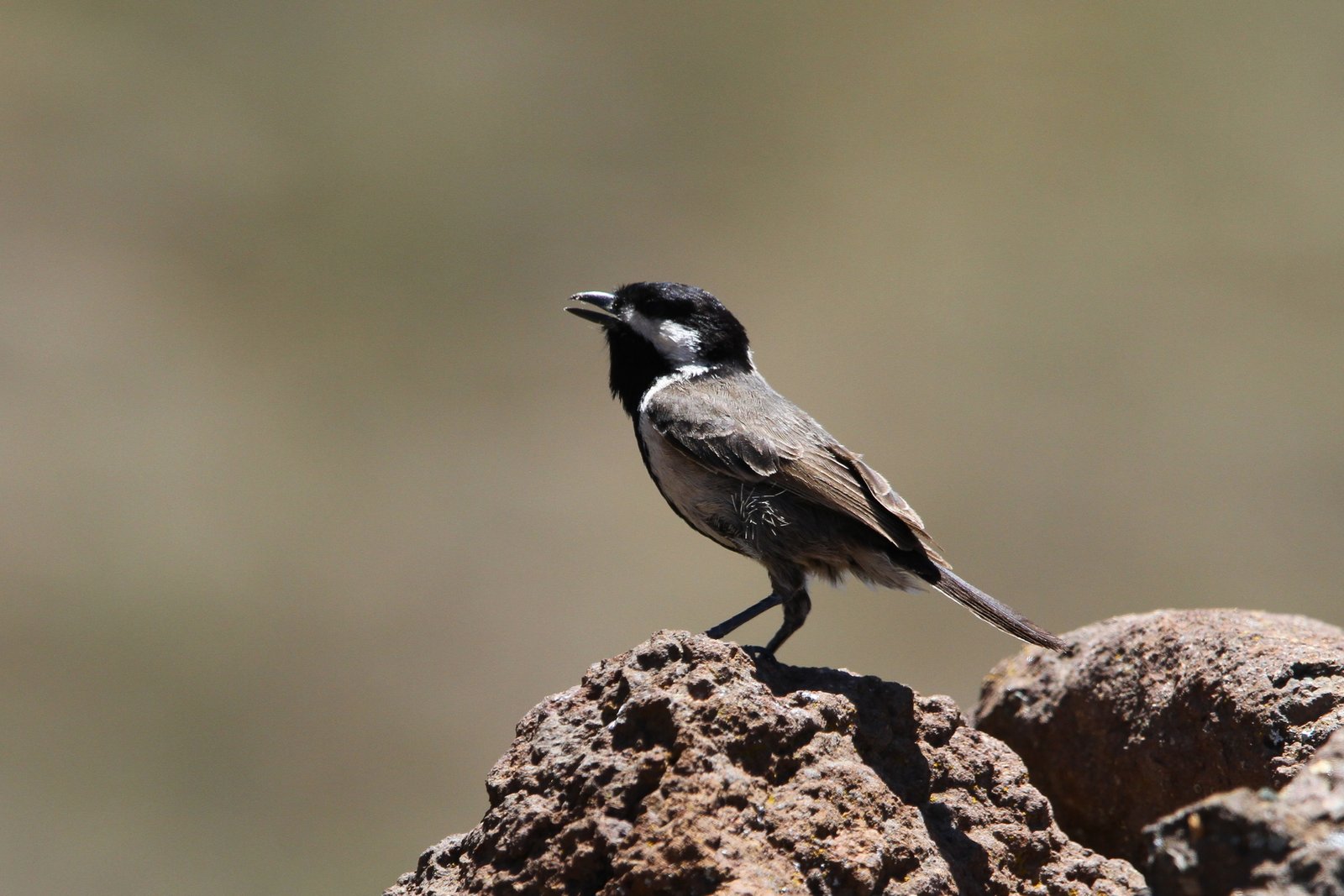
The Grey Tit is the tit of fynbos and Karoo scrub: black head and bib, a white cheek stripe, a brownish-grey back and a buff wash below. Its whistled call, which gave it the Afrikaans name 'Piet-tjou-tjou-grysmees', is typical of the dry Cape hills. The species is almost confined to South Africa.
Voice
A whistled three-note piet-tjou-tjou or tchee-tchoo-tchoo, the first note higher, and a hoarse, rasping tcherr-tcherr. Pairs often call to each other while foraging.
Recording: Lynette Rudman — CC BY-NC-SA 4.0 · shortened to the first 60 s, mono · xeno-canto
Identification
13 cm. Cap, throat and a central breast stripe are black, with a broad white band from the bill base to the side of the neck and a white nape patch. The back is brownish-grey, clearly warmer than in Ashy Tit. Belly and flanks are pale grey with a soft buff to sandy wash. The wings are dark with white fringes to the coverts and secondaries, the tail dark with white outer edges. The bill is short and black. The sexes are alike; juveniles are duller, with a browner cap.
Confusion species
Ashy Tit Melaniparus cinerascens has the same head pattern but a cool blue-grey back and a grey belly without buff, and lives in thornveld; intergrades occur in the Karoo contact zone. Southern Black Tit Melaniparus niger in the east is largely black. Cape Penduline Tit Anthoscopus minutus is much smaller, with a yellowish belly, a black forehead with white speckles and a short, sharp bill.
Habitat
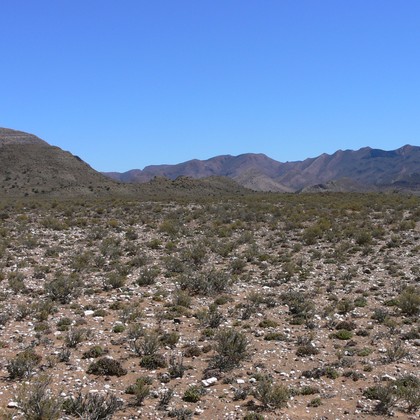
Fynbos, renosterveld, Succulent and Nama Karoo scrub, dry watercourses and rocky hills with low shrubs; also farm gardens. It forages low in bushes and on the ground for insects and seeds. It nests in a hole in a rock crevice, bank, post or tree.
Where the bird is most at home, classified by the vegetation units of southern Africa.


Range and movements
Almost endemic to South Africa: the Western Cape, the west and south of the Northern Cape (Namaqualand, Bushmanland and the Karoo) and the west of the Eastern Cape, into the south-western Free State. Beyond that only in the extreme south of Namibia along the Orange River and in western and southern Lesotho.
- Resident
- Summer visitor (c. Oct–Mar)
- Winter visitor (c. Apr–Sep)
- Passage (Mar–Apr, Oct–Nov)
- dark = core range, pale = thinly spread
How and when to look
Year-round in fynbos and Karoo scrub; follow the whistled piet-tjou-tjou. Good sites are the Cederberg, Tankwa Karoo National Park, Karoo National Park and the fynbos around Cape Town. Where Ashy and Grey Tits meet, concentrate on back colour and the wash on the belly.
Conservation status
Not threatened; common over most of its range. No large-scale threats are known; conversion of renosterveld to cropland has removed habitat locally.
Scientific name
Melaniparus afer | (Gmelin, 1789) (GBIF: Parus afer)
Gmelin described the species in 1789 as Parus afer; because it was later moved to another genus, the author and year stand in brackets. The genus Melaniparus was introduced in 1850 by Bonaparte. Melaniparus combines the Greek melas, 'black', with Parus, Latin for 'tit' — for the largely black plumage of many species. afer is Latin for 'African' — the tit was described from the Cape of Good Hope. The specimen the first description was based on came from Cape of Good Hope.