All species › Passerines › Finches › White-Rumped Seedeater
White-Rumped Seedeater | Crithagra leucopygia
Witstuitkanarie | Serín culiblanco
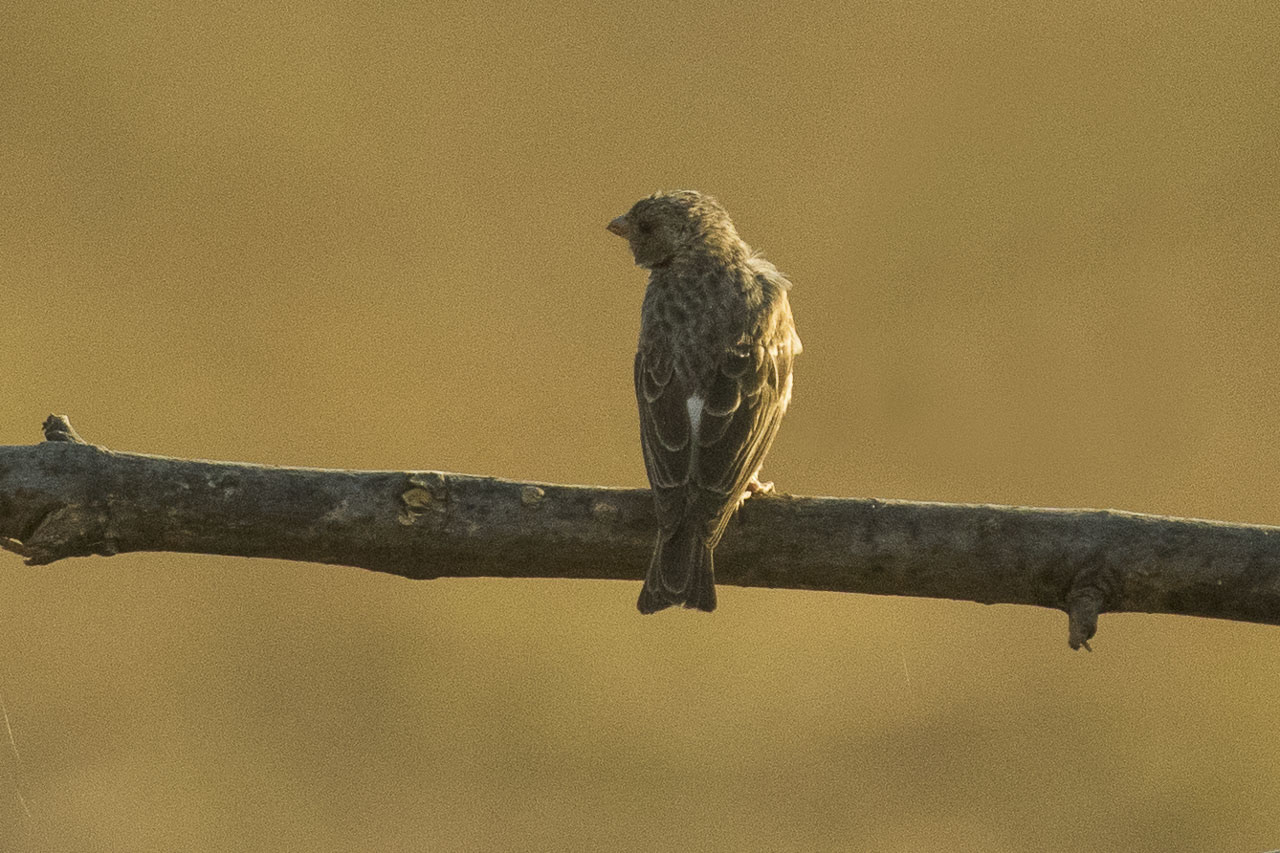
White-rumped Seedeater is a small, grey-brown serin of the Sahel with a conspicuous white rump, known in Europe and North Africa as a songster in the cage-bird trade. In the region it has only been seen in southern Algeria, probably from escaped cage birds.
Voice
The song is long, clear and highly melodious, with whistled and trilling notes; for this song it is widely kept as a cage bird. The call is a soft, rising tsweet.
Recording: Julien Birard — CC BY-NC-SA 4.0 · converted to mono · xeno-canto
Identification
10–11 cm, small and compact, with a short, thick, pale horn-coloured bill. The upperparts are grey-brown with fine dark streaks, the rump is bright white and stands out mainly in flight. The underparts are off-white, with fine, faint streaking on breast and flanks; the face is fairly plain grey-brown with a pale throat. Wings and tail are dark brown with pale edges. Sexes alike.
Confusion species
European Serin (Serinus serinus) and Syrian Serin (Serinus syriacus) have a yellow rump and yellow on head or breast. Female Eurasian Linnets (Linaria cannabina) are larger, with a whitish throat and white patches in wing and tail but no white rump. African Silverbill (Euodice cantans), also found in the cage-bird trade in the same area, has a silvery-blue bill, a black rump and a long, pointed black tail.
Habitat
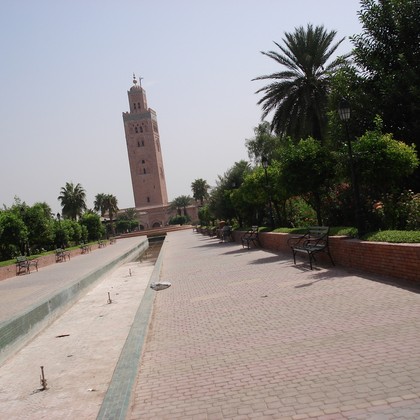
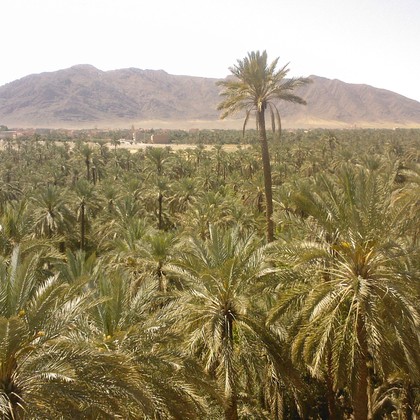
In its own range dry savanna, acacia scrub, fields and villages in the Sahel. In southern Algeria recorded in the town of Tamanrasset, among gardens and buildings.
Where the bird is most at home, classified by the habitats of North Africa and the Middle East.
Range and movements
Native to the Sahel and Sudan zone, from Senegal and Gambia through Mali, Niger, Chad and Sudan to Eritrea, Ethiopia and northern Uganda. In the region only in Algeria: a first record in the south around 2020 and a singing bird in central Tamanrasset on 31 January 2022. Hundreds of Sahelian birds are offered for sale in the bird shops of Tamanrasset, and according to dealers some regularly escape; both records are therefore regarded as escaped cage birds. The species does not originate from the region itself.
- Resident
- Summer visitor (c. Apr–Sep)
- Winter visitor (c. Oct–Mar)
- Passage (Mar–Apr, Oct–Nov)
- dark = core range, pale = thinly spread
How and when to look
A White-rumped Seedeater in the region is almost certainly an escape. Anyone who sees a small grey serin with a white rump, or hears one singing, in Tamanrasset or another town of the Algerian Sahara should document the record with a photo or sound recording.
Conservation status
Not globally threatened and common in the Sahel. In the region an escaped cage bird; given the large trade in Tamanrasset, establishment of a small population in future cannot be ruled out.
Scientific name
Crithagra leucopygia | Sundevall, 1850
Sundevall described the species in 1850 and placed it straight away in the genus where it still stands. The genus Crithagra was introduced in 1827 by Swainson. Crithagra comes from the Greek krithē, 'barley', and agra, 'hunting' — a 'barley hunter', for the seed-eating diet of these canaries and seedeaters. leucopygia is Greek for 'white-rumped', from leukos 'white' and pugē 'rump'. The specimen the first description was based on came from Sennar, Sudan.