All species › Passerines › Longspurs and snow buntings › Snow Bunting
Snow Bunting | Plectrophenax nivalis
Sneeuwgors | Escribano nival
An Arctic bunting recorded in the region only as an exceptional vagrant. A Snow Bunting on a Moroccan beach or on Israel's Mediterranean coast is a bird far outside its normal winter quarters in northern and central Europe and the steppes of Central Asia.
Voice
The flight call is a rippling, rolling tirrirrirrit, alternating with a clear, rather plaintive tyoo. The song belongs to the breeding grounds and is hardly ever heard in winter.
Recording: Mats Rellmar — CC BY-NC-SA 4.0 · converted to mono · xeno-canto
Identification
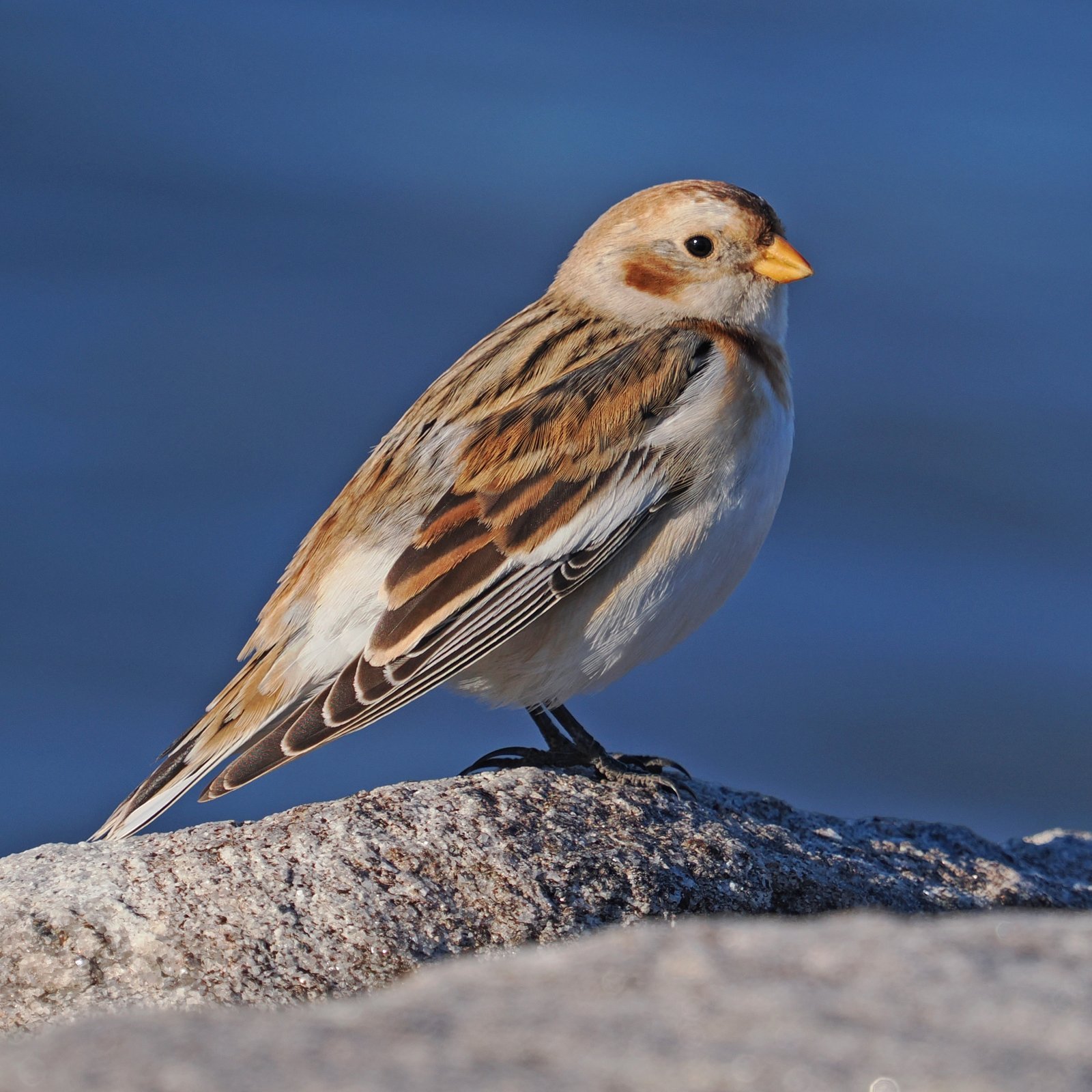
Bulky and compact for a bunting, with short legs, a short neck and long, pointed wings. Every plumage shows a large white wing panel, white outer tail feathers and a white belly. In winter, the plumage in which it appears here, crown, ear coverts and breast sides are washed warm ochre-brown, the back is streaked blackish-brown and the bill is yellow-orange with a dark tip. Females and first-winter birds have less white in the wing and a duller head. The summer male is pure white with a black back and black wing tips. Creeps mouse-like over the sand.
Confusion species
There is no real look-alike in the region. Horned Lark (Eremophila alpestris) has a black-and-yellow face pattern and no white in the wing. Lapland Bunting (Calcarius lapponicus), not itself recorded in the region, is browner, with a rufous wing panel and little white. A Snow Bunting taking off may briefly suggest a small white gull or a white-winged finch because of the white wing panel, but the white areas in wing and tail together are diagnostic.
Habitat
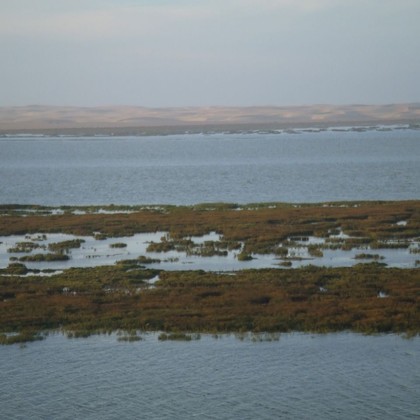
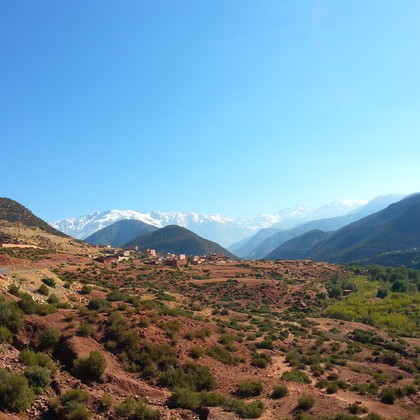
In winter on open, bare ground: sandy beaches with tideline debris, coastal plains, bare fields and plateaux and, very exceptionally, mountain grassland. The birds in the region were seen on a beach and in the Middle Atlas.
Where the bird is most at home, classified by the habitats of North Africa and the Middle East.
Range and movements
In Morocco a few records: two birds at Oualidia on the Atlantic coast in February 1964, three at Anergui in the Middle Atlas in March 1982, and a first for the Atlantic Sahara, reported in 2014. In Israel one bird stayed on the beach at Akko from December 2013 into February 2014. We know of no confirmed records from the rest of the region. Breeds circumpolar on the Arctic tundra and on bare mountains of Scotland, Scandinavia, Iceland, Greenland, northern Russia and North America; winters south to the coasts of north-west Europe, the steppes of Central Asia and the northern United States.
How and when to look
A Snow Bunting in the region is an extraordinary rarity; take photographs and report the sighting to the national rarities committee. The chances are greatest after severe cold spells in Europe, on beaches and coastal plains.
Conservation status
Not globally threatened, although declining in parts of its breeding range. In the region a very rare vagrant with only a handful of records since 1964: a few in Morocco and one in Israel (winter 2013–2014).
Scientific name
Plectrophenax nivalis | (Linnaeus, 1758)
Linnaeus described the species in 1758 as Emberiza nivalis; because it was later moved to another genus, the author and year stand in brackets. The genus Plectrophenax was introduced in 1882 by Stejneger. Plectrophenax is Greek, from plēktron 'cock's spur', after the long hind claw, and phenax 'impostor'. nivalis is Latin for 'snow-white', from nix, nivis 'snow', after the white plumage. The specimen the first description was based on came from Lapland.