All species › Waders, gulls and terns › Gulls and terns › West African Crested Tern
West African Crested Tern | Thalasseus albididorsalis
Afrikaanse koningsstern | Charrán real africano
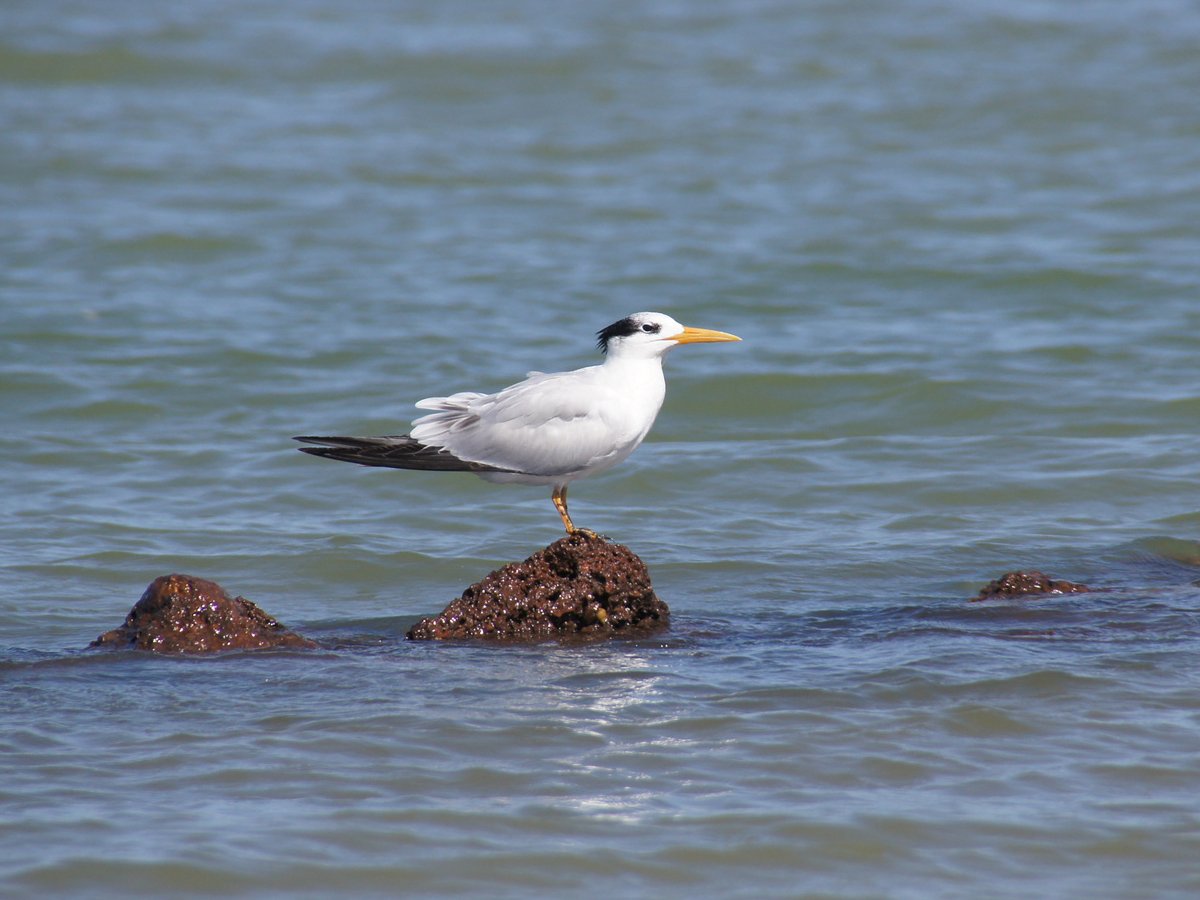
A large, slender crested tern with a long orange bill, which breeds from Mauritania to the Gulf of Guinea and wanders north along the Atlantic coast after the breeding season. In the bays of Western Sahara it is common in winter, and in summer there are increasingly hundreds of birds with young, which may point to a northward expansion of the breeding range.
Voice
A loud, rolling kirreet or kree-it, somewhat higher and purer than Sandwich Tern.
Recording: Bram Piot — CC BY-NC-SA 4.0 · converted to mono · xeno-canto
Identification
Large, with long, narrow wings, a forked tail and a long, fairly slender, pointed orange to yellow-orange bill. In summer plumage a black cap with a shaggy crest; for most of the year a white forehead and forecrown and a black, streaked rear crown. The upperparts are very pale silver-grey, paler than in Greater Crested Tern, with darker outer primaries; the underparts are white. Juveniles have dark spotting on mantle and wings, dark wing bars and a yellowish bill.
Confusion species
Royal Tern (Thalasseus maximus) of the Americas is slightly larger and heavier, with a shorter, thicker, redder-orange bill; in the field they are hardly separable. Caspian Tern (Hydroprogne caspia) is larger and heavier, with a heavy red bill and black primary tips below. Lesser Crested Tern (Thalasseus bengalensis) is clearly smaller, greyer above, with a finer orange-yellow bill. Sandwich Tern (Thalasseus sandvicensis) has a black bill with a yellow tip.
Habitat
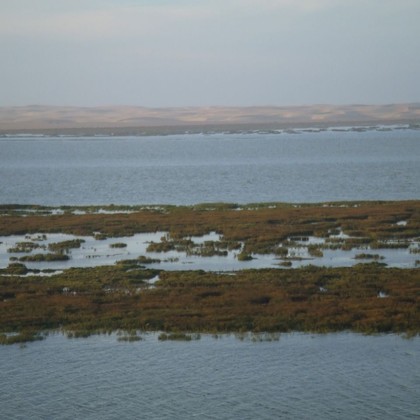
Shallow bays, lagoons, estuaries and sandy beaches along a cold, fish-rich coast; rests in flocks on sandbanks and beaches, often with gulls and other terns. Fishes in shallow inshore water with a steep plunge.
Where the bird is most at home, classified by the habitats of North Africa and the Middle East.
Range and movements
In the region mainly on the Atlantic coast of Western Sahara and southern Morocco: common in Dakhla Bay, less numerous at Khnifiss Lagoon, Tan-Tan Plage, the mouth of the Oued Draa and the mouths of the Oued Massa and Oued Souss; scarce further north, with isolated records to Oualidia and the Strait of Gibraltar. The first record dates from April 1955 near Dakhla. Flocks of tens to hundreds of birds are also present in June and July; in 2012 and 2014 juveniles and adults feeding young were seen in Dakhla Bay and at Khnifiss, but no nest has been found in Morocco. Beyond the region it breeds on a few islands in Mauritania (Banc d'Arguin), Senegal (Saloum Delta), Gambia and Guinea-Bissau, and possibly east to Nigeria; outside the breeding season along the coast to Namibia.
- Resident
- Summer visitor (c. Apr–Sep)
- Winter visitor (c. Oct–Mar)
- Passage (Mar–Apr, Oct–Nov)
- dark = core range, pale = thinly spread
How and when to look
Dakhla Bay is the best site, in winter and also in summer: search the sandbanks at low tide and around the fishing harbour. At Khnifiss hundreds sometimes roost in summer; tern flocks on the beaches of Tan-Tan Plage are also worth checking.
Conservation status
Not yet evaluated by the IUCN. The world population numbered about 25,000 pairs in the early 1990s, concentrated in a handful of colonies, which makes it vulnerable to disturbance and overfishing of coastal waters. In the region it appears to be increasing.
Scientific name
Thalasseus albididorsalis | (Hartert, 1921)
Hartert described the species in 1921 as Sterna maxima albididorsalis; because it was later moved to another genus, the author and year stand in brackets. The genus Thalasseus was introduced in 1822 by Boie. Thalasseus derives from Ancient Greek thalassa 'sea'. albididorsalis comes from the Latin albidus, 'whitish', and dorsalis, 'of the back' — for the pale back, lighter than in American Royal Tern. The specimen the first description was based on came from Baie du Lévrier near Cap Blanc, Mauritania.