All species › Waders, gulls and terns › Gulls and terns › Lesser Crested Tern
Lesser Crested Tern | Thalasseus bengalensis
Bengaalse stern | Charrán bengalí
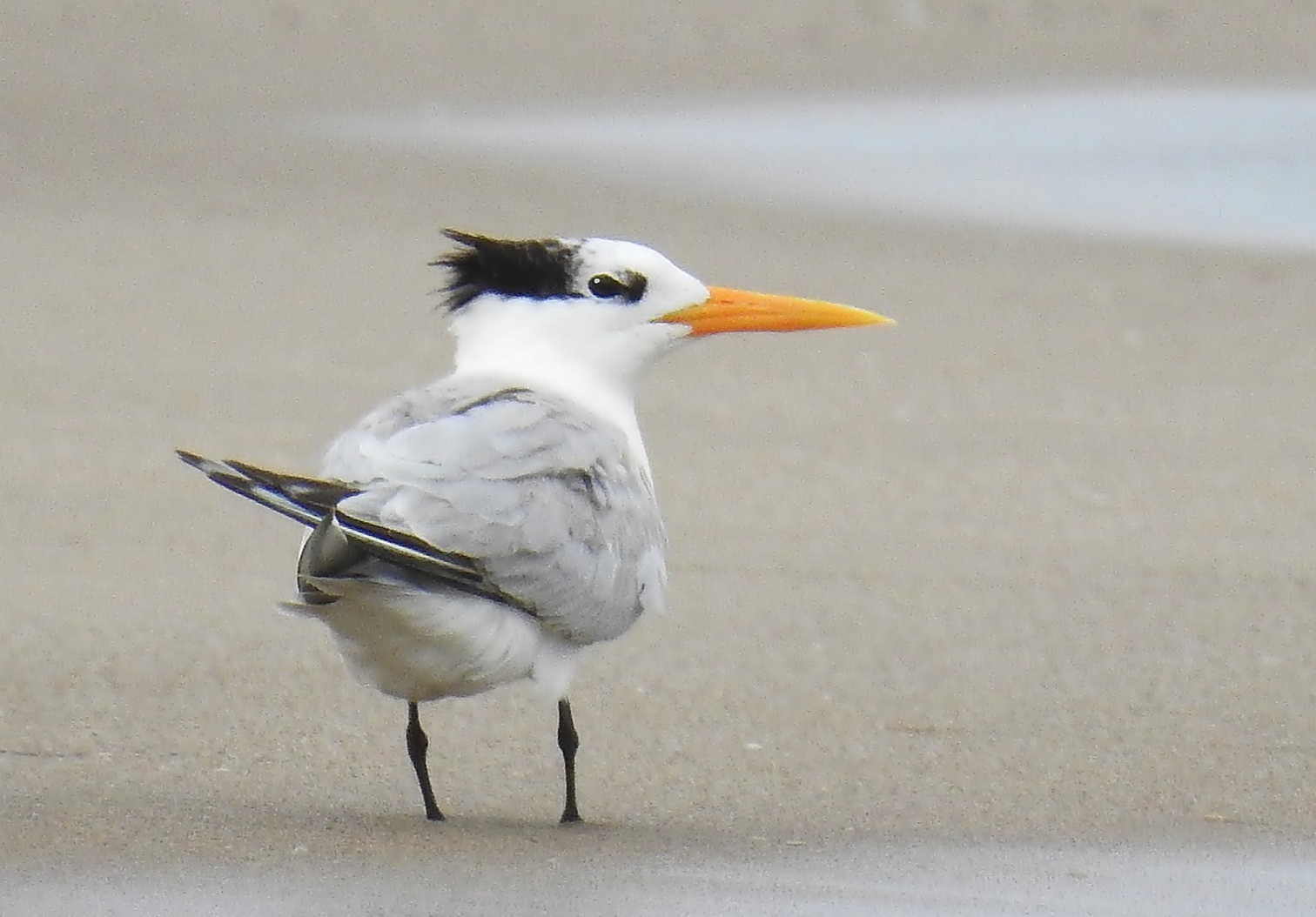
A medium-sized crested tern with a bright orange bill, which has its world stronghold in the region: tens of thousands of pairs breed on the coral islands off the Saudi Gulf coast. There is also a small, isolated Mediterranean population on two islets off the Libyan coast, which migrates via Tunisia, Algeria and Morocco to West Africa.
Voice
A shrill, rasping kreek or kerrick, higher and sharper than Sandwich Tern; at colonies a continuous grating chatter.
Recording: David Darrell-Lambert — CC BY-NC-SA 4.0 · converted to mono · xeno-canto
Identification
Slim, with long narrow wings and a straight, fairly slender bill that is orange to yellow-orange along its whole length, without a dark tip. In breeding plumage the black cap reaches the bill base and ends in a short, shaggy crest; from summer the forehead turns white. Mantle and upperwing are mid-grey, and rump and tail are grey too, so the back runs into the tail without a white patch. Legs black. Juveniles have a yellowish bill, brown-scaled coverts and a dark secondary bar.
Confusion species
Sandwich Tern (Thalasseus sandvicensis) is paler, with a black bill with a yellow tip and a white rump. Greater Crested Tern (Thalasseus bergii), which often shares colonies in the Gulf and Red Sea, is clearly larger and darker grey, with a heavy, drooping greenish-yellow bill and a white band between cap and bill even in breeding plumage. West African Crested Tern (Thalasseus albididorsalis) and Royal Tern (Thalasseus maximus) on Morocco's Atlantic coast are larger, paler-backed and have a thicker, orange-red bill.
Habitat
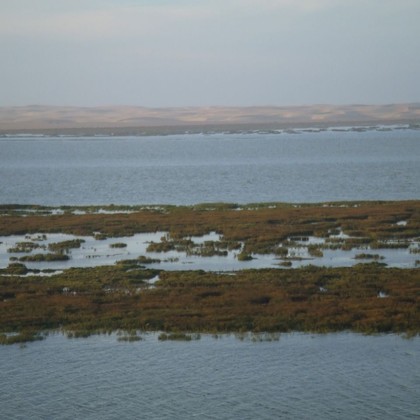
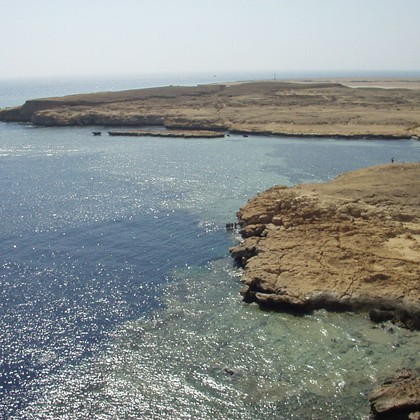
Warm coastal waters: coral reefs, shallow bays, lagoons and sandbanks, where it plunge-dives for small fish. Breeds in dense colonies on low, bare sand and coral islets, often with Greater Crested, Bridled and White-Cheeked Terns; roosts on beaches, sandbars and harbour piers.
Where the bird is most at home, classified by the habitats of North Africa and the Middle East.
Range and movements
The stronghold is the Gulf: the Saudi coral islands (Juraid, Jana, Karan, Kurain, Harqus) together hold more than 20,000 pairs, and there are colonies in Kuwait (Kubbar, Qaru, Umm al Maradim), Bahrain, Qatar and Abu Dhabi. It also breeds on islands in the Red Sea off Egypt, Saudi Arabia and Yemen, and locally along the coast of Oman. In the Mediterranean a small population of a few thousand pairs breeds on the islets of Gara and Elba off the Libyan coast; these birds pass Tunisia, Algeria and Morocco in autumn, through the Strait of Gibraltar to West Africa, and return in spring. In Israel a scarce migrant along the coast and at Eilat. Beyond the region it breeds in Iran, Somalia and Eritrea and east to Indonesia, New Guinea and northern Australia.
- Resident
- Summer visitor (c. Apr–Sep)
- Winter visitor (c. Oct–Mar)
- Passage (Mar–Apr, Oct–Nov)
- dark = core range, pale = thinly spread
How and when to look
At the Strait of Gibraltar and on the coast near Tangier (Morocco) birds regularly pass with Sandwich Terns in August – September; look for the orange bill and grey rump. In the Gulf it is easy in summer along the Dammam corniche, in Bahrain and from the Kuwaiti coast; boat trips to the coral islands are restricted to avoid disturbing the colonies.
Conservation status
Not globally threatened. Because much of the world population breeds on a handful of islands, the species is sensitive to disturbance, egg collecting, oil pollution and coastal development in the Gulf. The small Libyan population in the Mediterranean is particularly vulnerable.
Scientific name
Thalasseus bengalensis | (Lesson, 1831)
Lesson described the species in 1831 as Sterna bengalensis; because it was later moved to another genus, the author and year stand in brackets. The genus Thalasseus was introduced in 1822 by Boie. Thalasseus derives from Ancient Greek thalassa 'sea'. bengalensis means 'of Bengal', the region the type specimen came from. The specimen the first description was based on came from the coast of India.