All species › Passerines › Bush warblers › Streaked Scrub Warbler
Streaked Scrub Warbler | Scotocerca inquieta
Maquiszanger | Prinia desértica
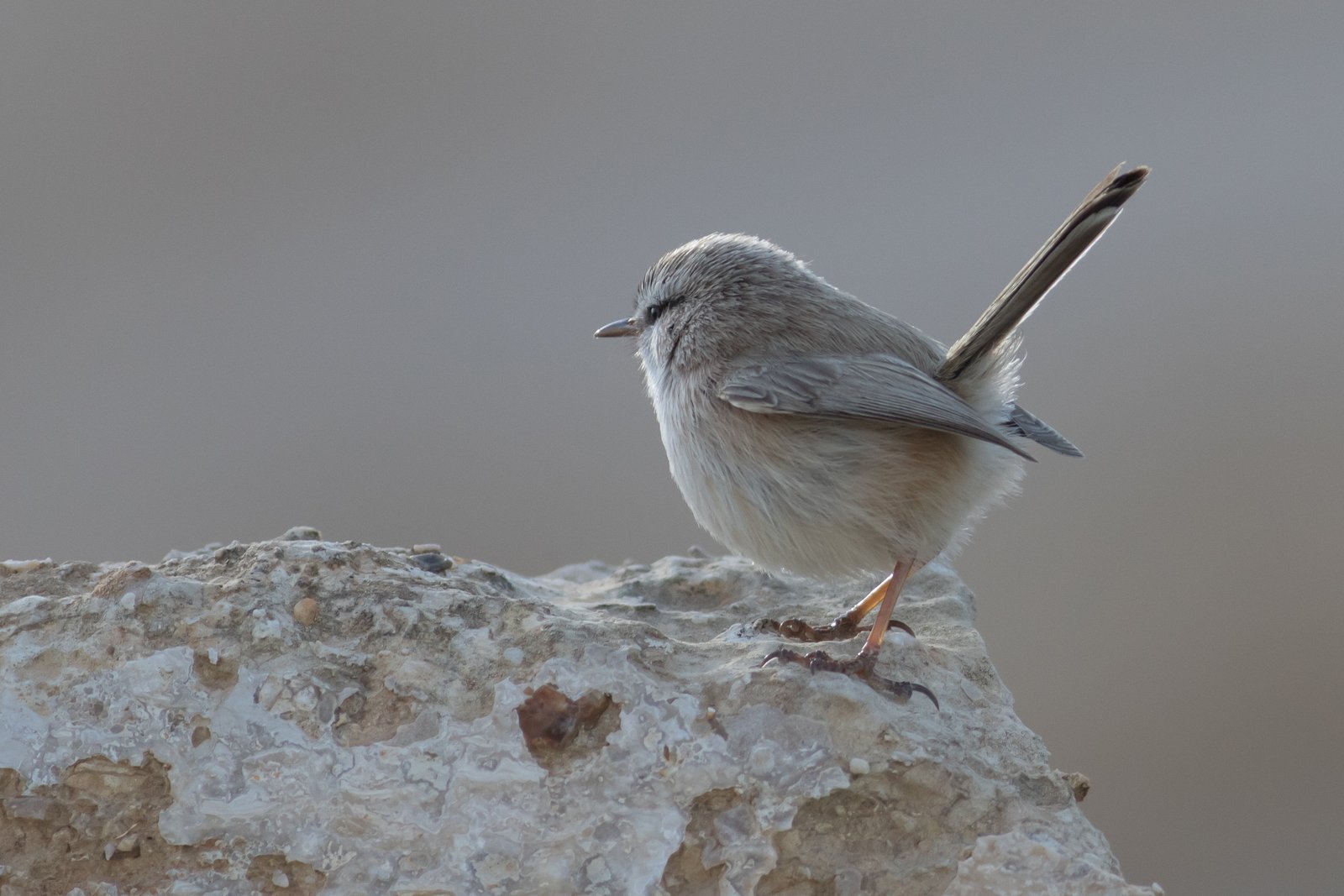
The Streaked Scrub Warbler is a small, restless warbler with a long, cocked tail that lives in wadis, stony desert and dry steppe from the Moroccan desert edge to Oman. It is a true bird of the region: outside North Africa and the Middle East it occurs only in Iran and Central Asia.
Voice
The song is a clear, ringing and somewhat plaintive ditty, for example tee-tee-tee dweedle-doo, alternating clear whistles and quick trills; Saharan and Levant forms sound different. Calls: a rolling prrt, a dry chek and a sharp, nasal dzee-dzee. Pairs and family groups are often noisy.
Recording: David Darrell-Lambert — CC BY-NC-SA 4.0 · converted to mono · xeno-canto
Identification
10–11 cm. Small, round and softly marked, with a long, dark, graduated tail with white tips to the outer feathers that is almost always held up and waved from side to side. Upperparts sandy grey to dull grey-brown, with a finely dark-streaked crown; the head pattern with a long white supercilium over a dark eye-stripe is characteristic. Underparts off-white, warm ochre on the flanks and undertail. The forms differ: the Saharan forms (saharae, theresae) are pale and weakly streaked, hardly marked on the breast, while the forms of the Levant and Arabia (inquieta, grisea, buryi) are greyer, with clear streaks on throat and breast. Legs long and pale. Sexes alike.
Confusion species
Graceful Prinia (Prinia gracilis) is slimmer, with an even longer tail, evenly streaked upperparts, no white supercilium and a preference for green scrub near water and fields. African Desert Warbler (Curruca deserti) is plain sandy without streaks, with a yellow eye and a rufous tail. Cricket Warbler (Spiloptila clamans) of the Sahel has a black-and-white patterned crown and wings.
Habitat
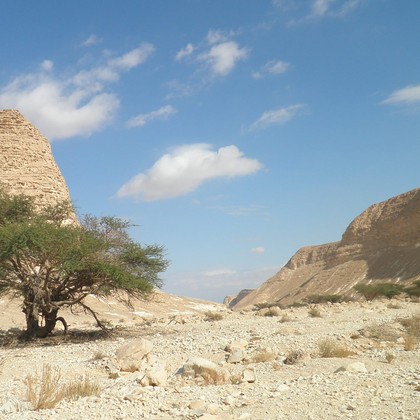
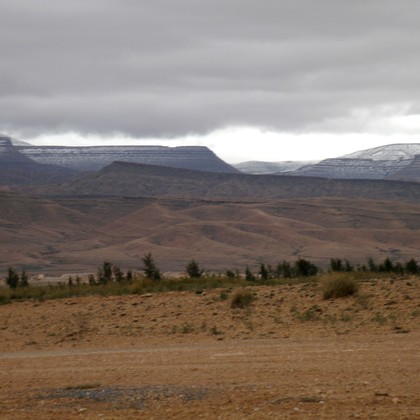
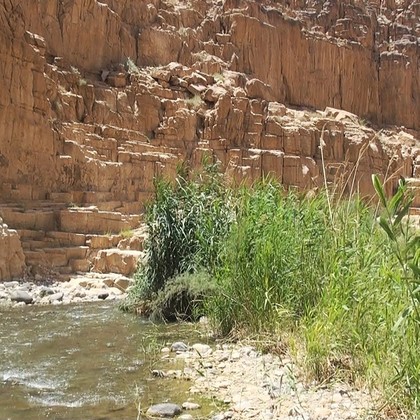
Desert fringes and semi-desert with scattered bushes: wadis with denser vegetation, stony slopes, gorges and scree with shrubs, alfa and artemisia steppe and saltbush. In the Atlas and the mountains of Yemen and Oman to well over 2000 m. Forages low among bushes for insects and runs a lot.
Where the bird is most at home, classified by the habitats of North Africa and the Middle East.
Range and movements
In Morocco south and east of the Atlas, from the Souss and the Anti-Atlas to the eastern high plateaux (theresae in the south-west); in Algeria, Tunisia and Libya along the northern edge of the Sahara and in the Saharan Atlas (saharae). Further in north-eastern Egypt and Sinai, the Negev, the Judean Desert and the Arava in Israel, in Jordan and the desert steppe of Syria, in western and southern Saudi Arabia, Yemen and Oman, with small numbers in the UAE, and in central and southern Iraq. Beyond the region in Iran, Afghanistan, Pakistan and Central Asia.
- Resident
- Summer visitor (c. Apr–Sep)
- Winter visitor (c. Oct–Mar)
- Passage (Mar–Apr, Oct–Nov)
- dark = core range, pale = thinly spread
How and when to look
In the Negev and the Arava, the desert near Merzouga and Erfoud or the wadis of Oman: listen at dawn for the ringing song and look for a little bird running from bush to bush over the ground with a waving tail.
Conservation status
Not globally threatened and locally common in the region, though overgrazing and drought have an effect. The taxonomy is in flux: some authors, including the latest Collins Bird Guide, split the Saharan forms as Saharan Scrub Warbler (Scotocerca saharae, Morocco to Libya), leaving the eastern forms in this species.
Scientific name
Scotocerca inquieta | (Cretzschmar, 1830)
Cretzschmar described the species in 1830 as Malurus inquietus; because it was later moved to another genus, the author and year stand in brackets. The genus Scotocerca was introduced in 1872 by Sundevall. Scotocerca is Greek, from skotos 'darkness, dark' and kerkos 'tail': 'dark-tail'. inquieta is from Latin inquietus 'restless'. The specimen the first description was based on came from northwestern Arabia.