All species › Passerines › Long-tailed tits › Long-Tailed Tit
Long-Tailed Tit | Aegithalos caudatus
Staartmees | Mito común
The Long-tailed Tit is one of the species that only touch the region in its far north-eastern corner. It lives in the oak forests of the Zagros Mountains in Iraqi Kurdistan, where the grey-backed forms of Iran and Anatolia occur; it is absent from North Africa, the Levant and Arabia.
Voice
A constant contact chatter from the flock: a thin, high see-see-see, a short pt and above all a dry, rattling tserrrp, the best clue. There is hardly a real song.
Recording: Paul Gosling — CC BY-NC-SA 4.0 · shortened to the first 60 s, mono · xeno-canto
Identification
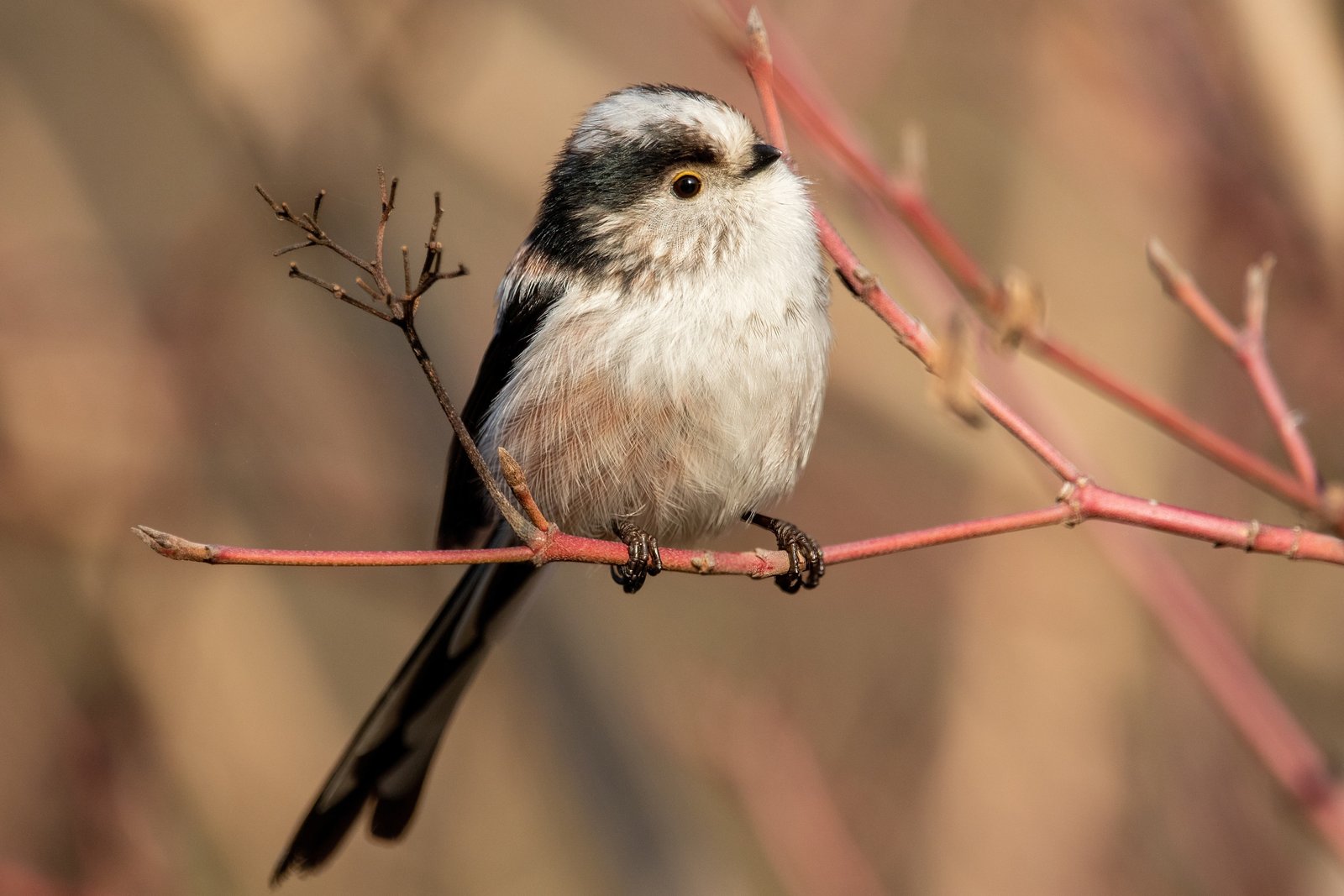
13–15 cm, of which 7–9 cm is tail. A round little body with a small round head, a minute stubby bill and a very long, black-and-white, graduated tail. The Middle Eastern forms (passekii in the Zagros, tephronotus in Anatolia) differ from European birds: they have a grey rather than black back, a white crown with a broad black band from above the eye to the nape, a small dark throat patch and little pink on the flanks. Juveniles are browner and shorter-tailed, with a dark cheek. The flight is weak and undulating, and the birds follow each other one by one.
Confusion species
There is no real confusion species in the region: no other small woodland bird combines a round body with such a long black-and-white tail. A shy bird flying away at a distance may briefly recall a Graceful Prinia (Prinia gracilis), but that is plain grey-brown and streaked and lives in low scrub, not woodland.
Habitat
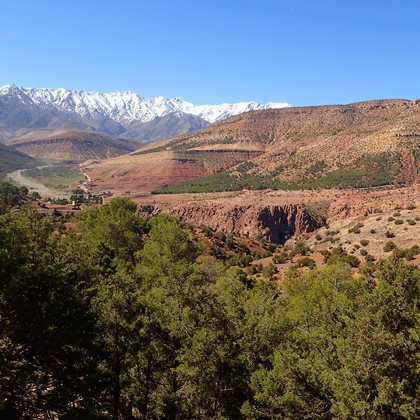
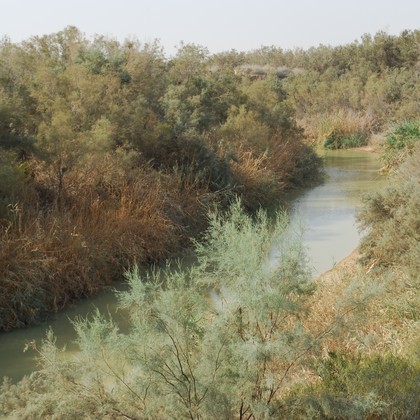
Open oak and oak-juniper woodland on mountain slopes, scrub with wild almond and hawthorn, riverine woodland along mountain streams and orchards at the forest edge. Outside the breeding season flocks of ten to twenty birds roam, often with tits.
Where the bird is most at home, classified by the habitats of North Africa and the Middle East.
Range and movements
In the region only in north-eastern Iraq, in the oak forests of the Zagros and Taurus Mountains of Iraqi Kurdistan; whether it also occurs in the far north of Syria is unclear. Beyond the region from the British Isles and Iberia through Europe and Turkey, the Caucasus and Iran to Japan, in a long series of subspecies.
- Resident
- Summer visitor (c. Apr–Sep)
- Winter visitor (c. Oct–Mar)
- Passage (Mar–Apr, Oct–Nov)
- dark = core range, pale = thinly spread
How and when to look
Search the oak forests around Sulaymaniyah and in the mountains of Duhok and Erbil for a roaming flock; the rattling tserrrp is usually the first sign.
Conservation status
Not globally threatened. In the region confined to a small, poorly studied area of montane forest in Kurdistan that suffers from logging, overgrazing, fires and conflict; numbers there are unknown.
Scientific name
Aegithalos caudatus | (Linnaeus, 1758)
Linnaeus described the species in 1758 as Parus caudatus; because it was later moved to another genus, the author and year stand in brackets. The genus Aegithalos was introduced in 1804 by Hermann. Aegithalos is Greek: aigithalos was a term used by Aristotle for several European tits, including the long-tailed tit. caudatus is Latin for 'tailed', after the long tail. The specimen the first description was based on came from Sweden.