All species › Waterfowl › Ducks, geese and swans › Ring-Necked Duck
Ring-Necked Duck | Aythya collaris
Ringsnaveleend | Porrón acollarado
A North American diving duck that crosses the Atlantic and reaches the region as a rare winter visitor. In the region it is known almost only from Morocco, where more than thirty records have been accepted, mostly single birds among Tufted Ducks and Common Pochards on lakes and reservoirs.
Voice
Almost silent on the wintering grounds. The female sometimes gives a soft, growling kerr.
Recording: Stanislas Wroza — CC BY-NC-SA 4.0 · converted to mono · xeno-canto
Identification
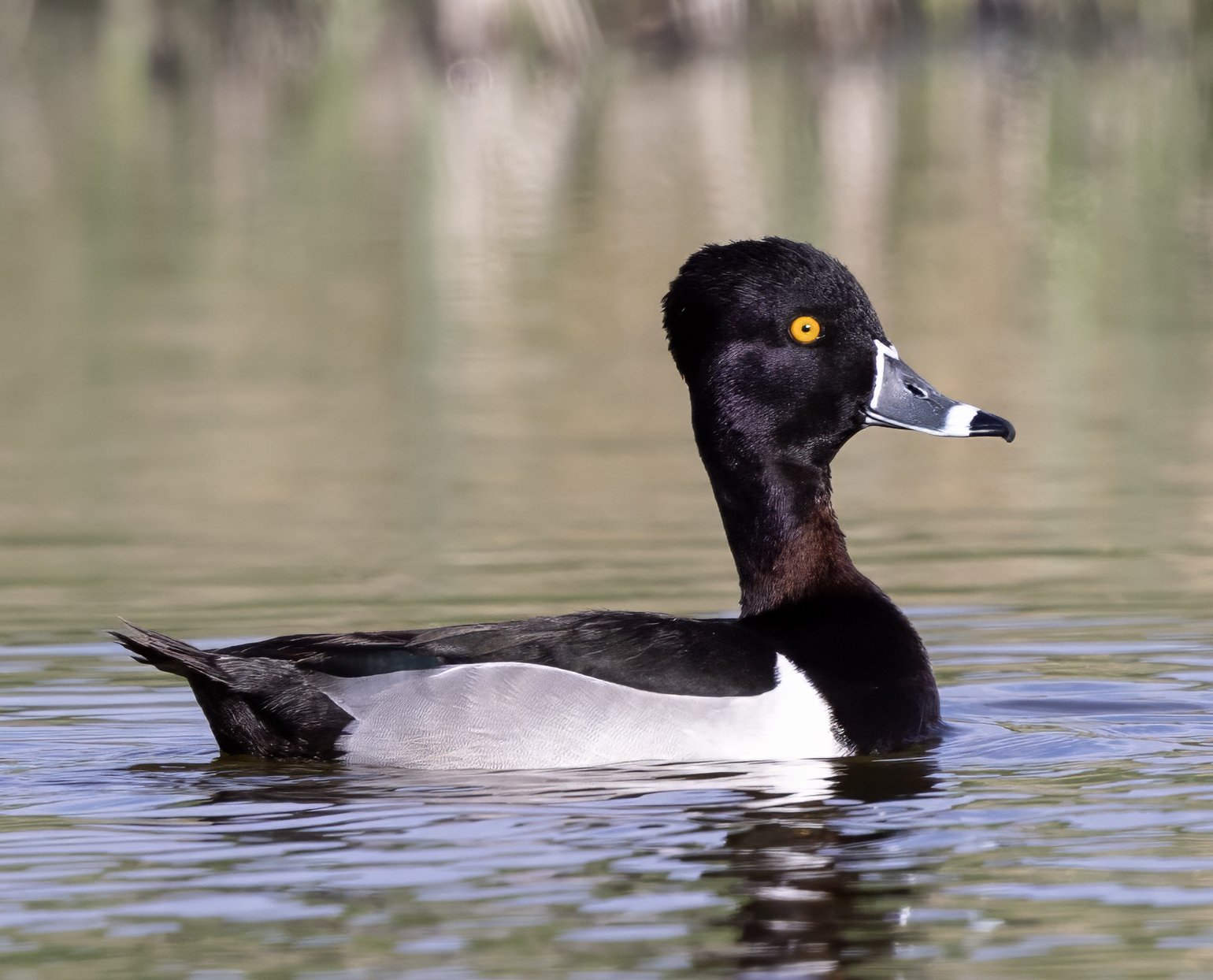
About 42 cm, with a high, peaked rear crown that gives the head an angular profile. The male has a black head glossed purple, black breast and back and grey flanks with a white, upward-pointing spur in front of the wing; the grey bill has a white border at the base, a white ring before the black tip, and the eye is yellow. The female is brown with a greyer head, a white eye-ring and a thin white line behind it, a pale bill base and the same bill ring. In flight a grey, not white, wingbar.
Confusion species
The male Tufted Duck (Aythya fuligula) has white flanks, a tuft and a bill without a white ring. Hybrids of Tufted Duck and Common Pochard (Aythya ferina) look very like Ring-necked Duck, with grey flanks and sometimes a pale bill band: check the white spur in front of the flank, the head shape and the white bill base. The female resembles a female Common Pochard but has a darker cap, a clear eye-ring and the white bill ring. Lesser Scaup (Aythya affinis) also has an angular head, but the male has a grey back.
Habitat
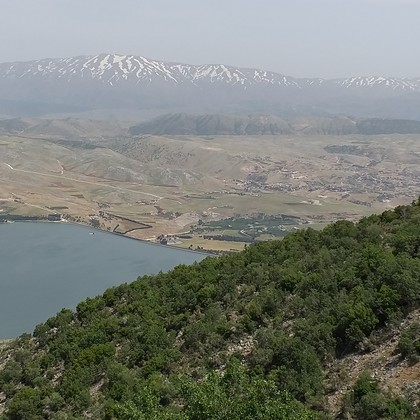
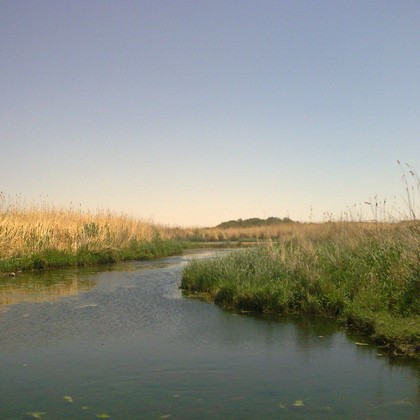
Fresh lakes, reservoirs and fishponds, including small waters with some fringing vegetation; winter visitors nearly always join flocks of Tufted Ducks or Common Pochards. It dives for aquatic plants, seeds and invertebrates.
Where the bird is most at home, classified by the habitats of North Africa and the Middle East.
Range and movements
In the region a rare winter visitor, almost only in Morocco: scattered across the country on reservoirs, lakes and estuaries, from the Mohammedia area and the lagoon of Oualidia to the mouth of the Tamri north of Agadir and a few sites in Western Sahara. Few if any records are known from the rest of North Africa and the Middle East. The species breeds in Canada and the northern United States and winters from the southern United States to Central America and the Caribbean; in western Europe it is an annual vagrant.
- Winter visitor (c. Oct–Mar)
- dark = core range, pale = thinly spread
How and when to look
In winter check every flock of Tufted Ducks on Moroccan reservoirs for a bird with grey rather than white flanks, then check the bill: the white ring and the white bill base can be seen at a fair distance.
Conservation status
Not threatened; the North American population is large and stable. In the region a rare winter visitor: more than thirty records are known from Morocco, nearly all in winter, and it is now reported there almost annually.
Scientific name
Aythya collaris | (Donovan, 1809)
Donovan described the species in 1809 as Anas collaris; because it was later moved to another genus, the author and year stand in brackets. The genus Aythya was introduced in 1822 by Boie. Aythya is from Greek aithuia, an unidentified diving seabird mentioned by Aristotle and Hesychius. collaris is Latin for 'of the neck', from collum 'neck', after the chestnut ring around the throat. The specimen the first description was based on came from Lincolnshire, England.