All species › Waterfowl › Ducks, geese and swans › Red-Crested Pochard
Red-Crested Pochard | Netta rufina
Krooneend | Pato colorado
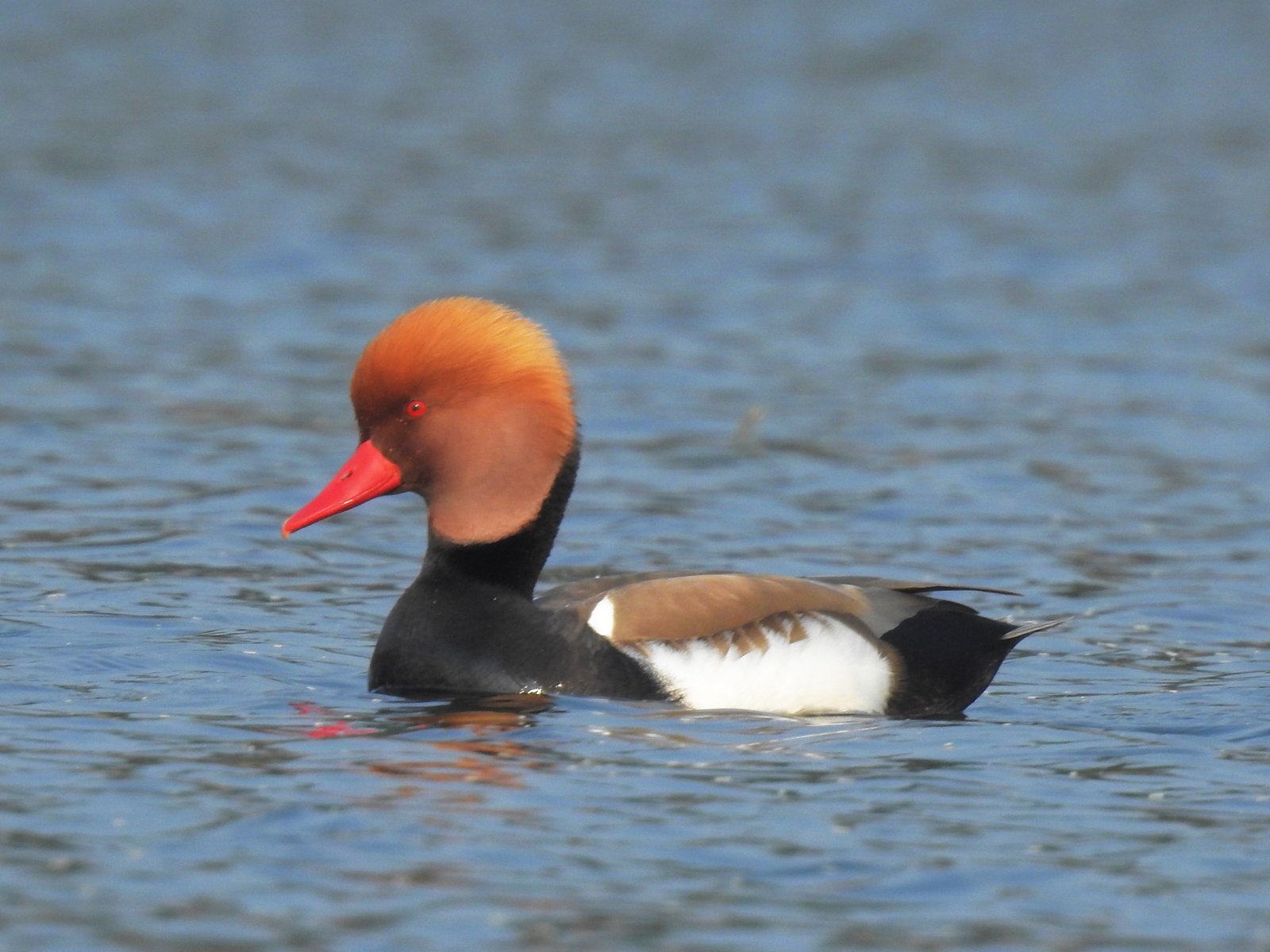
A bulky diving duck; the male has a round orange-red head and a coral-red bill and is spotted at once among Common Pochards and Tufted Ducks. In the region it is mainly a winter visitor to the larger freshwater lakes, from the Maghreb to the marshes of Iraq, in small and varying numbers.
Voice
Usually silent. In display the male gives a sneezing, rasping bait, the female a harsh, rattling kurr.
Recording: Philippe_Grange — CC0 · converted to mono · xeno-canto
Identification
About 55 cm, large and full-bodied with a big head. The male has a rounded rusty-orange head with a paler yellowish crown, a bright red bill and a red eye; breast, neck and undertail are black, the flanks white and the back brown. The female is plain grey-brown with a dark cap down to below the eye, contrasting pale grey cheeks and throat, and a dark bill with a pink tip. Males in eclipse resemble females but keep the red bill. In flight a broad white wingbar across almost the whole wing stands out.
Confusion species
The male Common Pochard (Aythya ferina) has a chestnut head, a dark bill with a pale band and grey flanks. The female recalls a female Common Scoter (Melanitta nigra) with its dark cap and pale cheeks, but that species is much darker, lacks a white wingbar and lives at sea. A female Red-crested Pochard is also told from a female Mallard (Anas platyrhynchos) by the pale cheeks and plain flanks.
Habitat
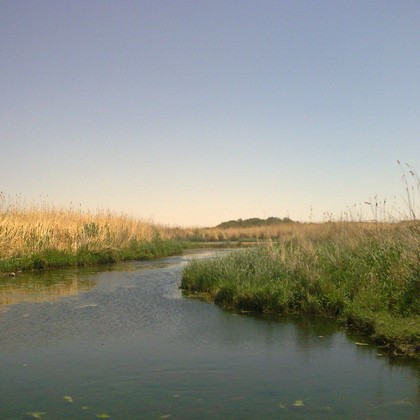
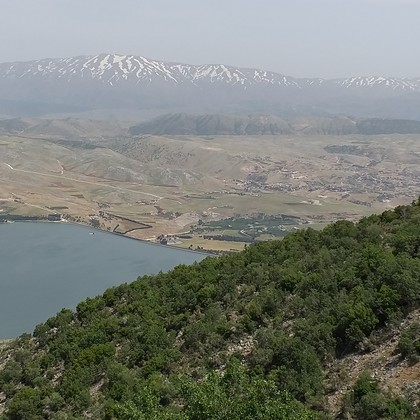
Large, fairly deep fresh or slightly brackish lakes with rich submerged vegetation, especially stoneworts, and reed fringes; in winter also reservoirs and coastal lagoons. It dives for aquatic plants but also dabbles and up-ends like a dabbling duck. It nests in dense waterside vegetation.
Where the bird is most at home, classified by the habitats of North Africa and the Middle East.
Range and movements
In winter on the large wetlands of north-west Africa: scarce in Morocco (including Sidi Bou Ghaba and Merja Zerga), in north-eastern Algeria around El Kala and in Tunisia on Lake Ichkeul among other sites. Breeding in the Maghreb is scarce and irregular. A scarce winter visitor to Egypt, Israel and Syria. In Iraq regular on the marshes and lakes along the Euphrates and Tigris; a rare visitor to Kuwait, Saudi Arabia and the Gulf states. Beyond the region from Spain and central Europe via the Black Sea and Turkey to Central Asia, with winterers reaching India.
- Resident
- Summer visitor (c. Apr–Sep)
- Winter visitor (c. Oct–Mar)
- Passage (Mar–Apr, Oct–Nov)
- dark = core range, pale = thinly spread
How and when to look
In winter search the large flocks of diving ducks on Ichkeul or the lakes near El Kala: a male with its fiery head can be picked out at a distance. Females are harder and stand out mainly by their pale cheeks; watch for birds that dabble at the surface rather than dive.
Conservation status
Not threatened. In Europe and Central Asia the population is large and stable to increasing. In the region its occurrence depends on the state of a handful of large wetlands; loss of aquatic plants through pollution, salinisation and drought, and hunting at wintering sites are the problems.
Scientific name
Netta rufina | (Pallas, 1773)
Pallas described the species in 1773 as Anas rufina; because it was later moved to another genus, the author and year stand in brackets. The genus Netta was introduced in 1829 by Kaup. Netta is Greek, from nētta 'duck'. rufina is Latin for 'golden-red', from rufus 'ruddy', after the rusty-red head of the male. The specimen the first description was based on came from the Caspian Sea.