All species › Waterfowl › Ducks, geese and swans › Common Pochard
Common Pochard | Aythya ferina
Tafeleend | Porrón europeo
The most widespread diving duck of the large lakes in winter, the male with a chestnut head, black breast and pale grey body. Large numbers move in winter to the wetlands of Tunisia, Algeria, the Nile Delta and Iraq; a small number breed in the Maghreb.
Voice
The female gives a harsh, growling krr-krr, especially when taking off. In display the male gives a soft, breathy whistle, wheeoo.
Recording: Stanislas Wroza — CC BY-NC-SA 4.0 · converted to mono · xeno-canto
Identification
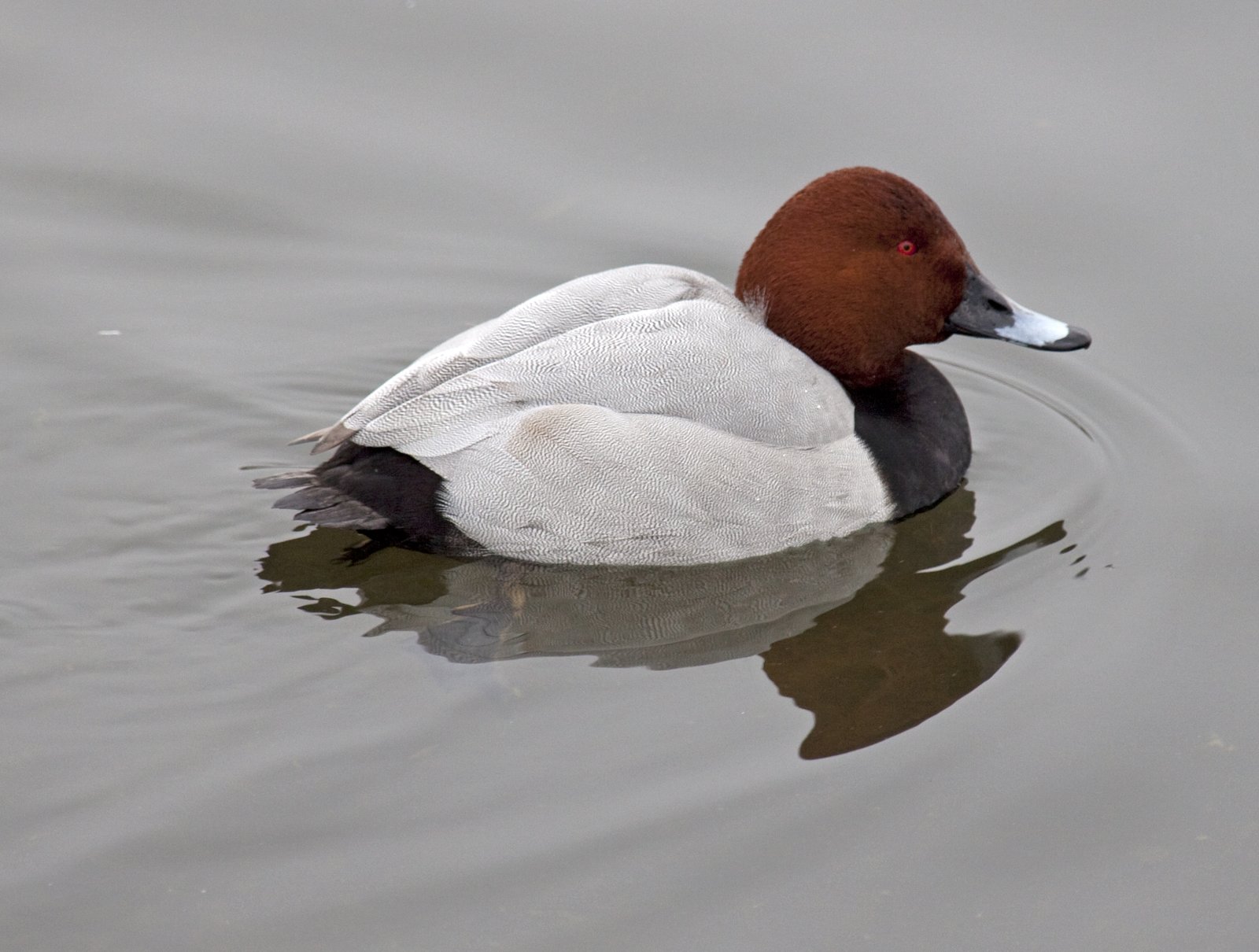
About 45 cm, with a long, gently sloping forehead and bill line that gives the head a triangular profile. The male has a chestnut-red head, a red eye, a black breast and rear and a pale grey back and flanks; the bill is dark with a pale grey band and a black tip. The female is grey-brown with a browner head and breast, a pale spectacle and a pale line behind the eye, and a pale throat. In flight there is an indistinct grey wingbar, not white as in most relatives.
Confusion species
The male Red-crested Pochard (Netta rufina) has an orange-red head, a red bill and white flanks. The female Ferruginous Duck (Aythya nyroca) is darker reddish brown with a white undertail and a white wingbar. From North America, Redhead (Aythya americana) and Canvasback (Aythya valisineria) can resemble a Common Pochard at distance, but neither has been recorded in the region. Hybrids with Tufted Duck or Ferruginous Duck occur.
Habitat
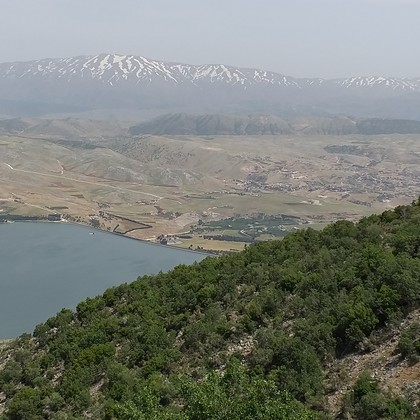
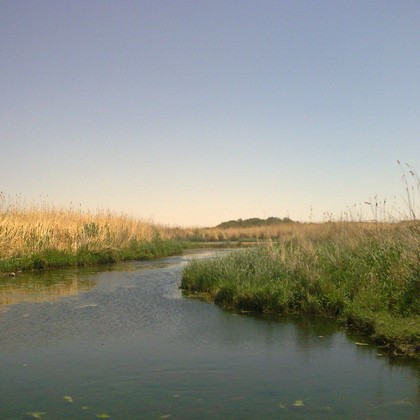
Open fresh and brackish lakes, reservoirs, coastal lagoons and large marshes with submerged vegetation. It dives for aquatic plants, seeds and invertebrates, often also at night, and rests by day in large flocks on open water. It nests in dense waterside vegetation on lakes with stable water levels.
Where the bird is most at home, classified by the habitats of North Africa and the Middle East.
Range and movements
In winter numerous in Tunisia, with Lake Ichkeul as the key site, and on the lakes near El Kala and other wetlands of northern Algeria and on lakes and reservoirs in Morocco. A small number breed in all these countries. In Egypt a winter visitor to the Nile Delta lakes; in Israel, Jordan, Lebanon and Syria fairly common in winter on lakes and fishponds. In Iraq numerous in the marshes and on the lakes along the Euphrates and Tigris; a scarce winter visitor to Kuwait and the Gulf states and rare further south on the Arabian Peninsula. Beyond the region it breeds from western Europe to Central Asia and Siberia and winters south to North Africa, the Sahel and India.
- Resident
- Summer visitor (c. Apr–Sep)
- Winter visitor (c. Oct–Mar)
- Passage (Mar–Apr, Oct–Nov)
- dark = core range, pale = thinly spread
How and when to look
On Ichkeul and on the large reservoirs of the Maghreb thousands of diving ducks sometimes gather in winter. Work through the flocks patiently: among the Common Pochards there are often Tufted Ducks, Ferruginous Ducks or Red-crested Pochards, and sometimes a rarer visitor.
Conservation status
Vulnerable. After a rapid decline across much of its breeding range the species has been listed as Vulnerable since 2015. In the region numbers depend on water levels and aquatic plants in a handful of large wetlands; drought, salinisation, pollution and hunting keep them down. Winter numbers on Ichkeul have fallen sharply since dams were built on the rivers that feed it.
Scientific name
Aythya ferina | (Linnaeus, 1758)
Linnaeus described the species in 1758 as Anas ferina; because it was later moved to another genus, the author and year stand in brackets. The genus Aythya was introduced in 1822 by Boie. Aythya is from Greek aithuia, an unidentified diving seabird mentioned by Aristotle and Hesychius. ferina is Latin for 'wild game', from ferus 'wild'. The specimen the first description was based on came from Sweden.