All species › Passerines › Buntings › Pine Bunting
Pine Bunting | Emberiza leucocephalos
Witkopgors | Escribano cabeciblanco
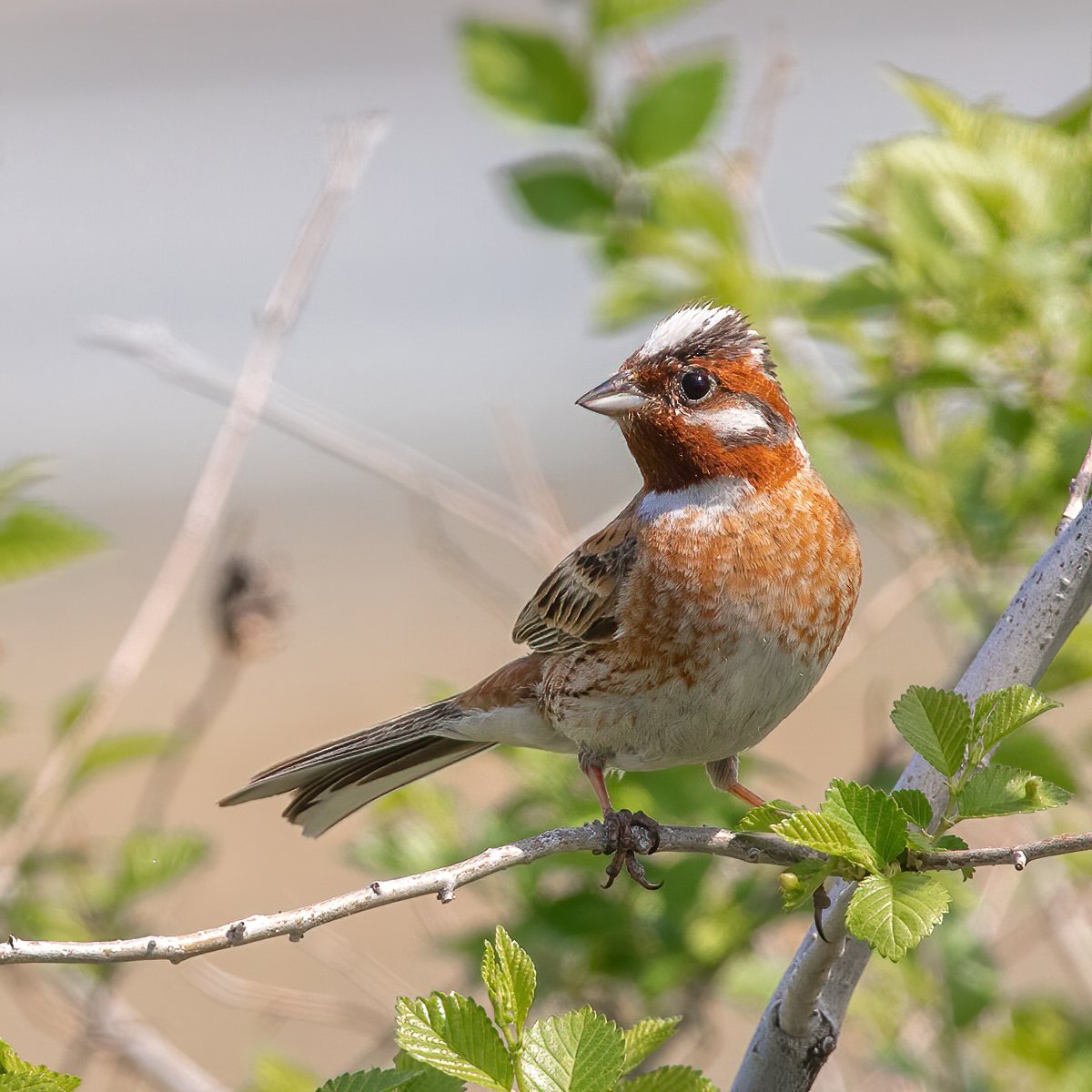
The Siberian counterpart of Yellowhammer, with a white rather than a yellow ground colour. A small part of the population winters in the Levant, where parties of a few to a few dozen birds frequent fields and orchards in the hills, often together with Yellowhammers.
Voice
Song and calls cannot be told from those of Yellowhammer: a thin series of equal notes ending in a drawn-out final note, rarely heard in the region. Call: a sharp tsik or tchit, slightly drier than Yellowhammer's but not a reliable feature.
Recording: Shuangqi Liu — CC BY-NC-SA 4.0 · converted to mono · xeno-canto
Identification
A large, long-tailed bunting with the same build as Yellowhammer, a chestnut rump and white outer tail feathers. The male has a white crown with a black side border, a chestnut supercilium and throat, a white cheek patch with a dark border and a white collar; breast and flanks are spotted chestnut on a white ground. In winter this pattern is subdued by brown feather tips. The female is grey-brown and streaked, without yellow: note the white belly, the white fringes to the primaries (yellow in Yellowhammer) and often a pale spot on the ear coverts. Hybrids with Yellowhammer occur and show intermediate patterns with some yellow.
Confusion species
The female closely resembles a female Yellowhammer (Emberiza citrinella) but lacks any yellow on face, belly and wing fringes; a bird with a hint of yellow may be a hybrid. Rock Bunting (Emberiza cia) has a grey head with black stripes and an unstreaked orange-brown belly. Female Reed Bunting (Emberiza schoeniclus) is smaller, with a grey-brown rump, a smaller bill and a clear malar stripe.
Habitat
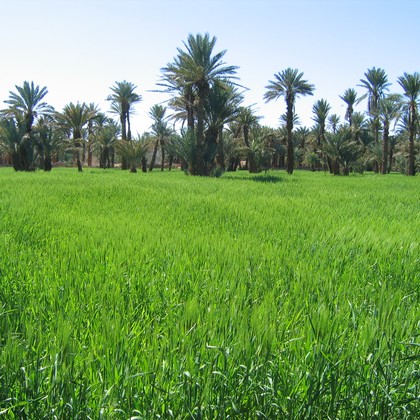
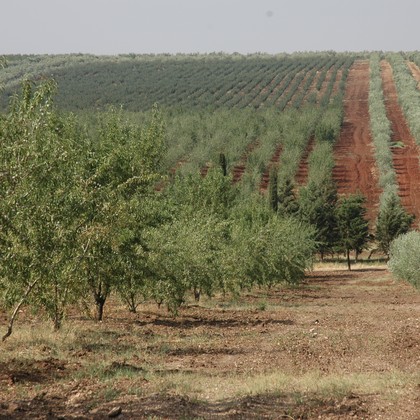
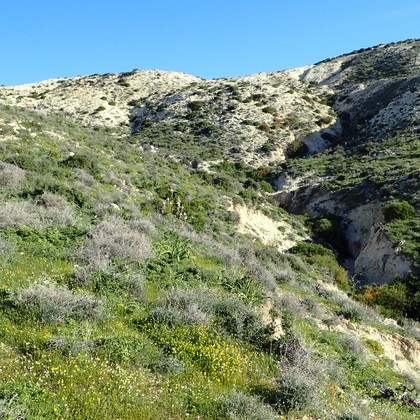
In winter open, small-scale farmland in hill country: stubble fields, fallow, weedy margins of orchards and vineyards and herbaceous steppe with scattered trees, often in mixed flocks with Yellowhammers, finches and Corn Buntings. Breeds in open conifer and birch woodland and forest edges of the taiga.
Where the bird is most at home, classified by the habitats of North Africa and the Middle East.
Range and movements
Israel and the West Bank: a scarce but fairly regular winter visitor, mainly in the hills around Jerusalem (Malha, Emek Tzurim, Nahal Hapirim, Har Homa) and in the north on the Golan Heights (Bnei Rasan, the Bashanit ridge) and in the orchards of Upper Galilee; in some winters also parties of up to fifteen birds near Be'er Sheva. Jordan, Lebanon and Syria: rare winter visitor. Iraq: winter visitor in the Kurdish north (including Darbandikhan Lake). A vagrant to Kuwait, Saudi Arabia, the United Arab Emirates and Oman, as well as Egypt and Morocco. Beyond the region it breeds from the Urals through Siberia to the Sea of Okhotsk and in Mongolia and northern China; it winters mainly in Central Asia, northern India and China, in small numbers west to Iran, Turkey and the Levant.
- Winter visitor (c. Oct–Mar)
- dark = core range, pale = thinly spread
How and when to look
From December to February search stubble and orchards in the hills around Jerusalem or on the Golan for Yellowhammer flocks and go through them bird by bird: the male stands out by its chestnut throat and white cheek patch, the female by its white rather than yellow primary fringes.
Conservation status
Not globally threatened (IUCN: Least Concern). In the region a scarce winter visitor at the western edge of the wintering range, with numbers varying from year to year.
Scientific name
Emberiza leucocephalos | Gmelin, 1771
Gmelin described the species in 1771 and placed it straight away in the genus where it still stands. The genus Emberiza was introduced in 1758 by Linnaeus. Emberiza comes from Old German Embritz, a name for a bunting. leucocephalos is Ancient Greek, from leukos, 'white', and kephalos, 'headed', after the male's white crown. The specimen the first description was based on came from Astrakhan, Russia.