All species › Passerines › Buntings › Black-Headed Bunting
Black-Headed Bunting | Emberiza melanocephala
Zwartkopgors | Escribano cabecinegro
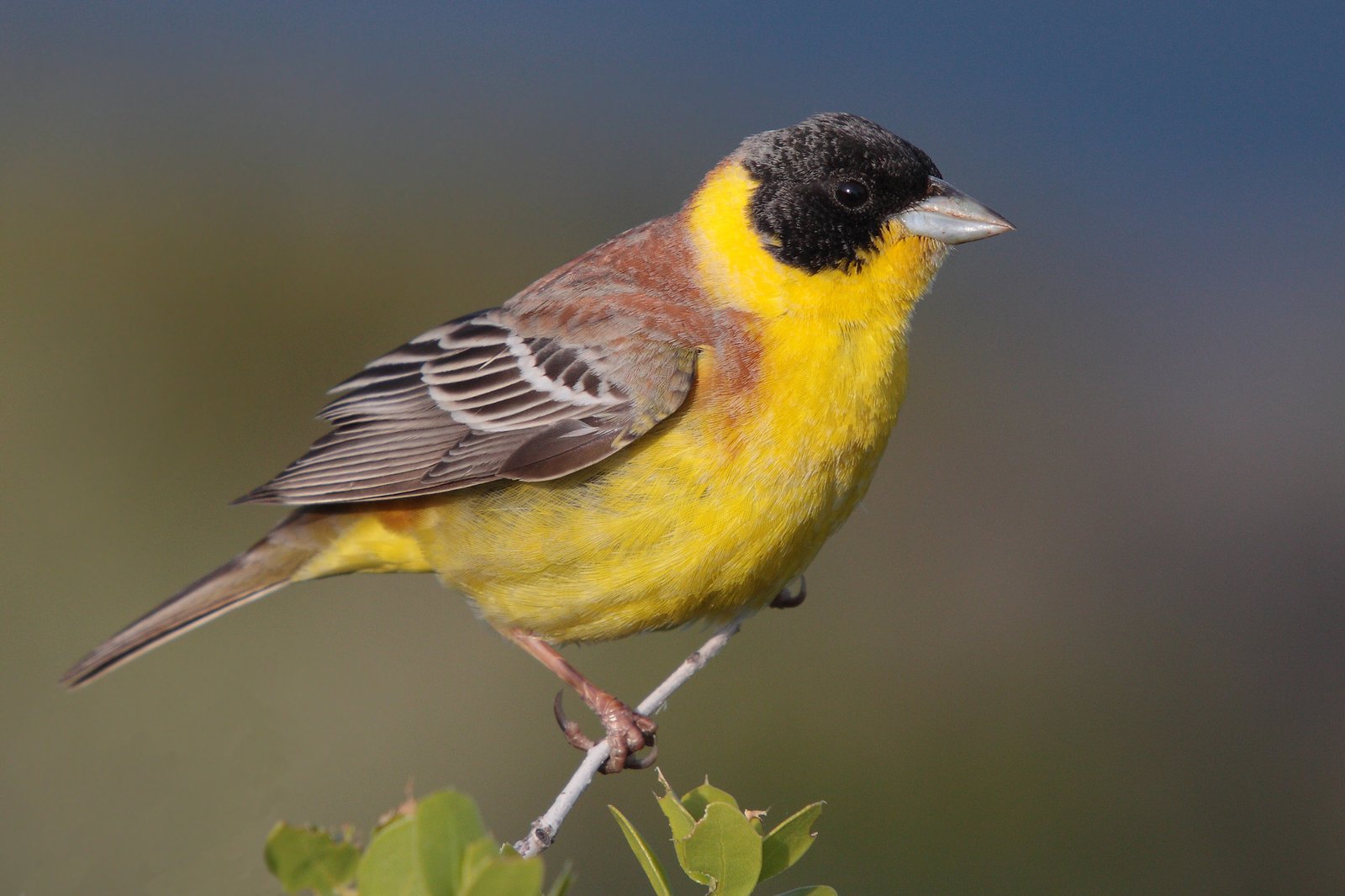
Black-headed Bunting is a large, long-tailed bunting that breeds in the Levant and northern Iraq and leaves eastwards in late summer for the Indian subcontinent. The male, with black cap, chestnut back and lemon-yellow underparts, sits on every wire and bush top of the hill country from Galilee to Kurdistan in May and June, and is then one of the most conspicuous songbirds in the region.
Voice
The song opens with a few scratchy, hesitant notes and moves into a loud, rather hoarse phrase that accelerates and ends with a flourish: tsrit-tsrit-tsheree-tsheree-tshuruee. It sings persistently from April into July from a wire, a post or the top of a bush or tree. The call is a hard, metallic tchup and a rolling tsrrt in flight.
Recording: András Schmidt — CC BY-NC-SA 4.0 · converted to mono · xeno-canto
Identification
16–17 cm. Large, with a heavy conical bill and a long tail without white sides. The breeding male has a black cap extending below the eye, yellow throat and neck sides, entirely lemon-yellow, unstreaked underparts and a chestnut back and rump; the wings are brown with pale fringes. In autumn the black is largely hidden by brown fringes. The female is pale sandy brown with faint head streaking, unstreaked off-white to yellowish underparts and usually yellowish undertail-coverts. Juveniles are plainer still, finely streaked on the crown.
Confusion species
The male is unmistakable; the female and juvenile are the challenge. Red-headed Bunting (Emberiza bruniceps), a passage migrant in the east of the region, is barely separable in these plumages: look at the rump, yellowish-green in Red-Headed and warmer sandy brown in Black-Headed, but do not rely on a single feature in a lone bird. Corn Bunting (Emberiza calandra) also lacks white in the tail, but is heavier, grey-brown and clearly streaked on the breast. Female Ortolan Bunting (Emberiza hortulana) and Cretzschmar's Bunting (Emberiza caesia) are smaller, with a pale eye-ring, a pink bill and white outer tail feathers. A female Spanish Sparrow (Passer hispaniolensis) is shorter-tailed and thicker-billed and lacks the yellow wash under the tail.
Habitat
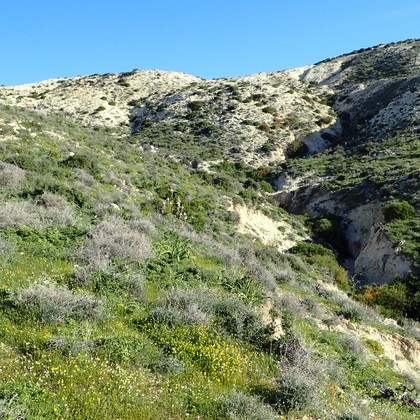
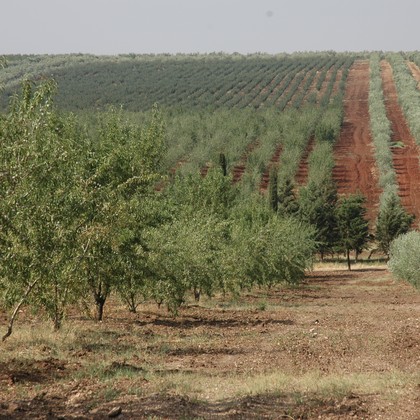
Open hill country with scattered bushes and trees: maquis and garrigue, olive and almond groves, vineyards, field edges with hedges and rough ground along roads, from sea level to about 1,800 m. On passage in all kinds of open country with bushes, including fields and gardens at the desert edge.
Where the bird is most at home, classified by the habitats of North Africa and the Middle East.

Range and movements
Breeds in northern and central Israel and in Samaria and Judea, in Lebanon, in western and northern Syria, in north-western Jordan and in the uplands of northern Iraq. In April and May it moves north through Iraq, Kuwait, eastern Saudi Arabia and the Gulf states, returning in August and September; in Oman and the United Arab Emirates it is a fairly scarce passage migrant, mainly in spring. In North Africa it is rare; in Egypt and Libya the odd bird turns up. Beyond the region it breeds from the Balkans and Turkey to the Caucasus and Iran and winters in western and central India.
- Summer visitor (c. Apr–Sep)
- Passage (Mar–Apr, Oct–Nov)
- dark = core range, pale = thinly spread
How and when to look
Drive through the hills of Galilee or the Golan in late April or May and watch the roadside wires: a singing male stands out from far away. Females on passage in the Gulf states are tricky; note the colour of rump and undertail and photograph the bird from above and below.
Conservation status
Not globally threatened (IUCN: Least Concern). Locally common in the region, but sensitive to the loss of small-scale farmland with hedges and bushes; still common in many places in the Levant.
Scientific name
Emberiza melanocephala | Scopoli, 1769
Scopoli described the species in 1769 and placed it straight away in the genus where it still stands. The genus Emberiza was introduced in 1758 by Linnaeus. Emberiza comes from Old German Embritz, a name for a bunting. melanocephala is Ancient Greek, from melas, 'black', and kephale, 'head'. The specimen the first description was based on came from Carniola, Slovenia.