All species › Passerines › Buntings › Ortolan Bunting
Ortolan Bunting | Emberiza hortulana
Ortolaan | Escribano hortelano
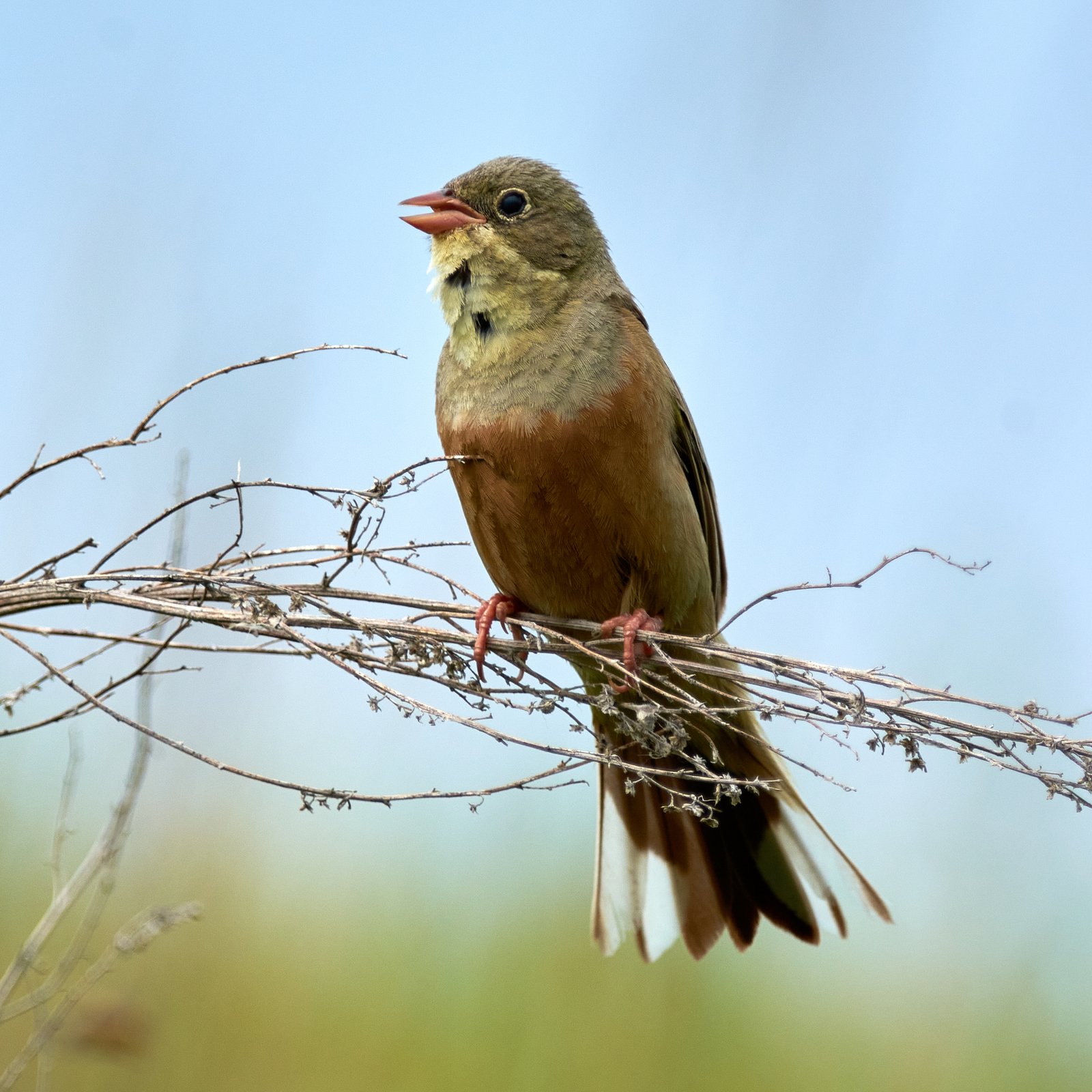
Ortolan Bunting is a softly coloured bunting with a grey-green head, a yellow eye-ring and a yellow throat, breeding locally in the region in the Atlas and the Levantine uplands. Passage matters far more: in spring and autumn large numbers of European and Asian birds cross the Sahara and Arabia to the Sahel and the Ethiopian highlands, and it is then one of the commonest buntings in oases and wadis.
Voice
The song consists of four to six equal, plaintive notes followed by two or three lower ones: sree sree sree sree – sroo sroo. It sounds wistful and carries far over open country, and can already be heard on spring passage. The call is a short, liquid plet or tchip and a thin tchew, often overhead from migrating birds.
Recording: Christian Kerihuel — CC BY-NC-SA 4.0 · converted to mono · xeno-canto
Identification
16–17 cm. Slim, long-tailed bunting with white outer tail feathers and a fairly pointed pink bill. The male has a grey-green head and breast band, a pale yellow throat and moustachial stripe, a distinct yellow eye-ring and warm orange-brown underparts; the back is brown with dark streaks. The female is duller, with fine streaks on crown and breast band, but keeps the yellow eye-ring and yellowish throat. Juveniles in autumn are brown and heavily streaked on the breast, and give themselves away mainly by the pale eye-ring, the pink bill and the pale yellow tinge to the throat.
Confusion species
Cretzschmar's Bunting (Emberiza caesia) has the same shape, eye-ring and pink bill, but a pure blue-grey head, a warm orange-brown throat and moustachial stripe, a whitish eye-ring and deeper rufous underparts. Grey-necked Bunting (Emberiza buchanani), a vagrant in the east, is paler, with a white eye-ring, a whitish throat and an unstreaked grey back. Cinereous Bunting (Emberiza cineracea) is larger, grey and white below, with a heavy grey bill. Rock Bunting (Emberiza cia) has bold black head stripes; a female Black-headed Bunting (Emberiza melanocephala) is larger and lacks white in the tail.
Habitat
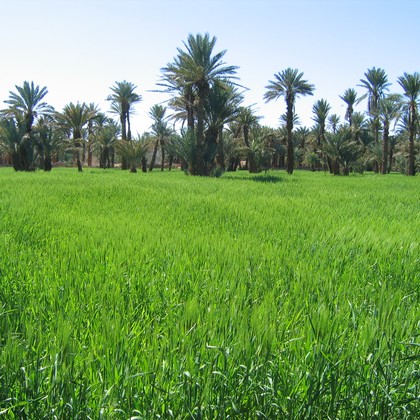
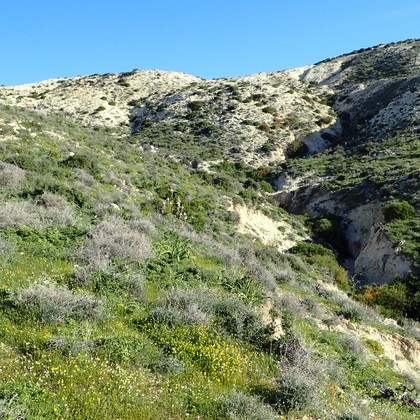
Breeds on warm, open slopes with fields, bushes and scattered trees: cereal fields, vineyards, almond and olive groves, terraces and open oak and juniper woodland, in the Atlas mostly between 1,200 and 2,300 m. On passage in all kinds of open country: fields, irrigated land, oases, wadis with bushes and stony plains.
Where the bird is most at home, classified by the habitats of North Africa and the Middle East.

Range and movements
Breeds locally in the Middle and High Atlas of Morocco and in northern Algeria, and in the east in Lebanon, on Mount Hermon and the Golan, in the mountains of Syria and in the uplands of northern Iraq. On passage throughout the region: in North Africa mainly along the coast and through the oases, in Egypt along the Nile and the Red Sea, and common in Israel, Jordan, Iraq, Kuwait and Saudi Arabia; scarcer in the Gulf states and Oman. Some winter in the highlands of south-western Saudi Arabia and Yemen. Beyond the region it breeds from Iberia and Scandinavia to Mongolia and winters in the Sahel and Ethiopia.
- Resident
- Summer visitor (c. Apr–Sep)
- Winter visitor (c. Oct–Mar)
- Passage (Mar–Apr, Oct–Nov)
- dark = core range, pale = thinly spread
How and when to look
Late April and early May are good in the green fields of the Negev, the Arava and the Kuwaiti farms: listen for the liquid plet and check small groups of buntings on the ground. In the Atlas it sings in May and June on sunny slopes with scattered trees above the villages.
Conservation status
Not globally threatened (IUCN: Least Concern), but strongly declined in Europe due to agricultural change and formerly also trapping. In the region a small and poorly known breeding population; its long-distance migration makes the species dependent on stopover sites in oases and farmland.
Scientific name
Emberiza hortulana | Linnaeus, 1758
Linnaeus described the species in 1758 and placed it straight away in the genus where it still stands. He introduced the genus Emberiza in that same work. Emberiza comes from Old German Embritz, a name for a bunting. hortulana comes from the Italian name for the bird, ortolana. The specimen the first description was based on came from Sweden.