All species › Passerines › Buntings › Yellowhammer
Yellowhammer | Emberiza citrinella
Geelgors | Escribano cerillo
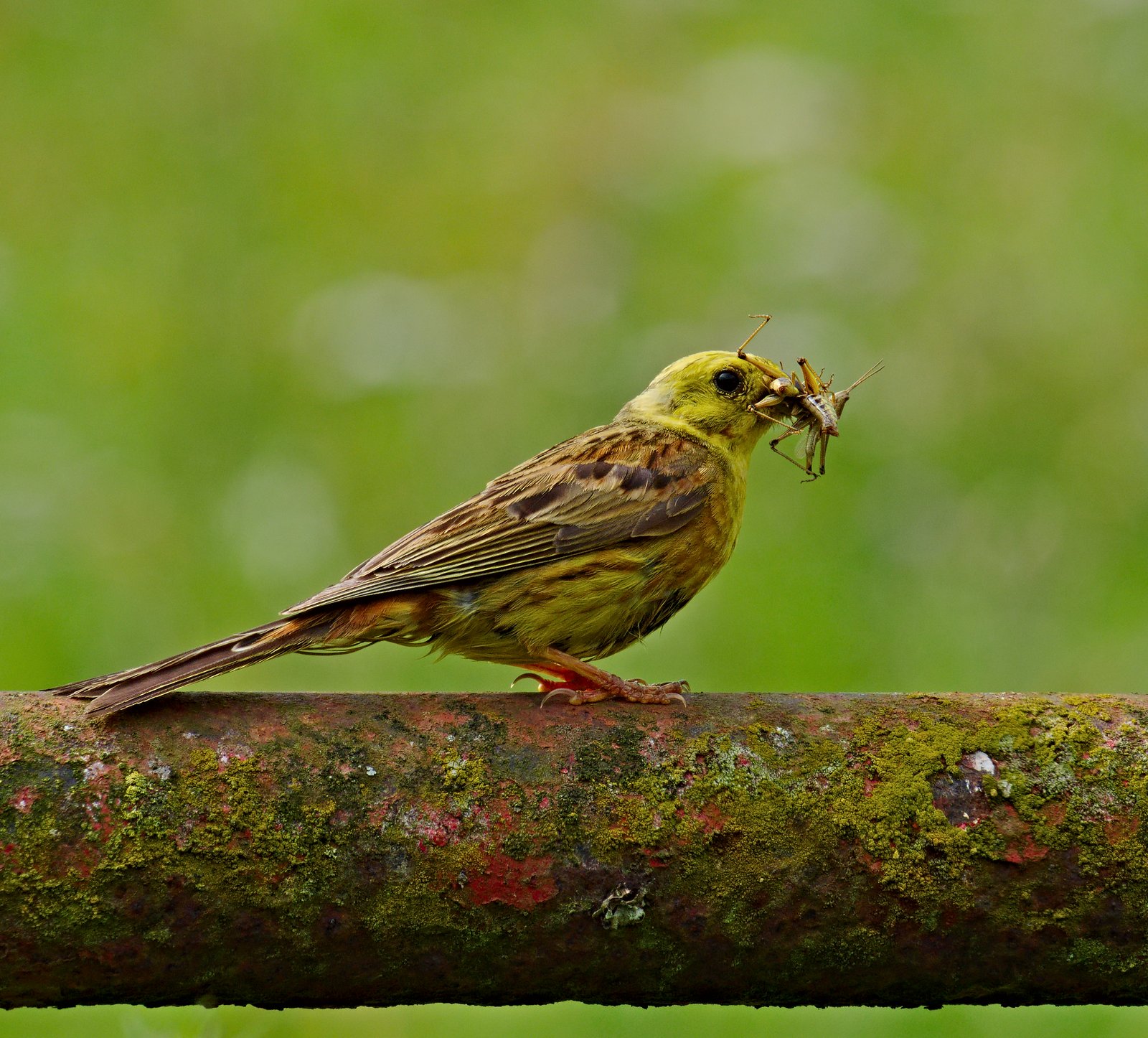
The familiar bunting of European farmland, with a sulphur-yellow head and a chestnut rump. In the region it is a winter visitor at the southern edge of its range: parties turn up from November to March in the cool hills of the Levant, on the Golan and around Jerusalem.
Voice
The song is a thin, metallic series of equal notes ending in a drawn-out note, zi-zi-zi-zi-zi-zi-zeeeh; in the region it is sometimes heard in February and March before departure. Call: a sharp, short tsik and a ringing tchoo.
Recording: Thierry THOMAS — CC BY-NC-SA 4.0 · converted to mono · xeno-canto
Identification
A large, slim, long-tailed bunting with white outer tail feathers and a warm chestnut rump. The male has a largely yellow head with some olive-brown markings, yellow underparts with chestnut streaks on breast and flanks, and a rufous, streaked mantle; in winter the yellow is subdued by brown feather tips. The female is duller, with a more streaked head and less yellow, but always keeps a yellow wash on throat and belly and yellow fringes to the primaries.
Confusion species
Pine Bunting (Emberiza leucocephalos) has the same build and chestnut rump but lacks yellow: the female has a white belly and white primary fringes; hybrids between the two occur. Cirl Bunting (Emberiza cirlus) has an olive-grey rump, and the male a black throat and eyestripe. Ortolan Bunting (Emberiza hortulana) and Cretzschmar's Bunting (Emberiza caesia) have a pale eye-ring, a pink bill and a plain head without yellow on the belly; in winter they are in Africa anyway.
Habitat
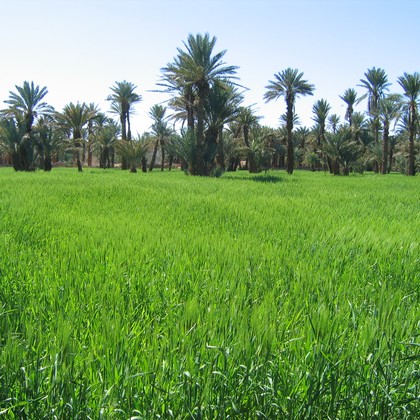
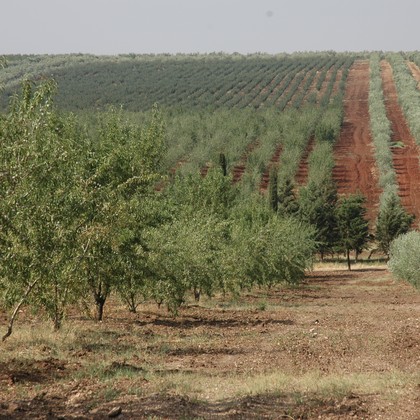
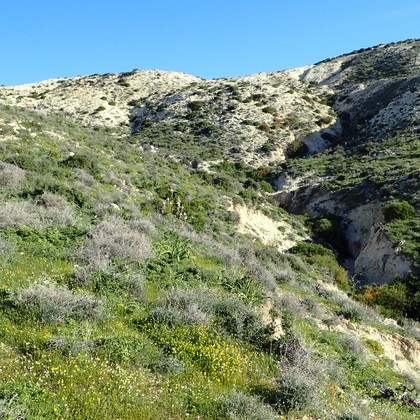
In winter open farmland in cool hill and mountain country: stubble fields, fallow, weedy margins of orchards, vineyards and olive groves, and herbaceous steppe with bushes, often in mixed flocks with finches, Corn Buntings and sometimes Pine Buntings. In Europe it breeds in small-scale farmland with hedges.
Where the bird is most at home, classified by the habitats of North Africa and the Middle East.
Range and movements
Israel and the West Bank: a fairly regular winter visitor in small numbers, mainly on the Golan Heights (Bnei Rasan, the Bashanit ridge, Mount Bental), in Galilee and in the hills around Jerusalem and Gush Etzion. Lebanon and Syria: winter visitor to the hills and mountains. Iraq: winter visitor in the Kurdish north. Jordan: rare winter visitor. A vagrant to Kuwait and the United Arab Emirates. In the Maghreb a rare winter visitor to northern Morocco, Algeria (including the high plateau around Bordj Bou Arréridj) and Tunisia. Beyond the region it breeds from the British Isles and northern Spain through Europe far into Siberia; northern and eastern birds move to southern Europe, Turkey, the Caucasus, Iran and Central Asia.
- Resident
- Winter visitor (c. Oct–Mar)
- Passage (Mar–Apr, Oct–Nov)
- dark = core range, pale = thinly spread
How and when to look
From December to February search stubble and orchards on the Golan or in the hills around Jerusalem for bunting flocks; the chestnut rump shows as soon as they flush. Check every flock carefully: a Pine Bunting may be among the Yellowhammers.
Conservation status
Not globally threatened (IUCN: Least Concern), but declined in much of Europe through agricultural intensification. In the region a winter visitor at the southern edge of the winter range, in varying numbers.
Scientific name
Emberiza citrinella | Linnaeus, 1758
Linnaeus described the species in 1758 and placed it straight away in the genus where it still stands. He introduced the genus Emberiza in that same work. Emberiza comes from Old German Embritz, a name for a bunting. citrinella is Italian for a small yellow bird. The specimen the first description was based on came from Sweden.