All species › Passerines › Leaf warblers › Hume's Warbler
Hume's Warbler | Phylloscopus humei
Humes bladkoning | Mosquitero de Hume
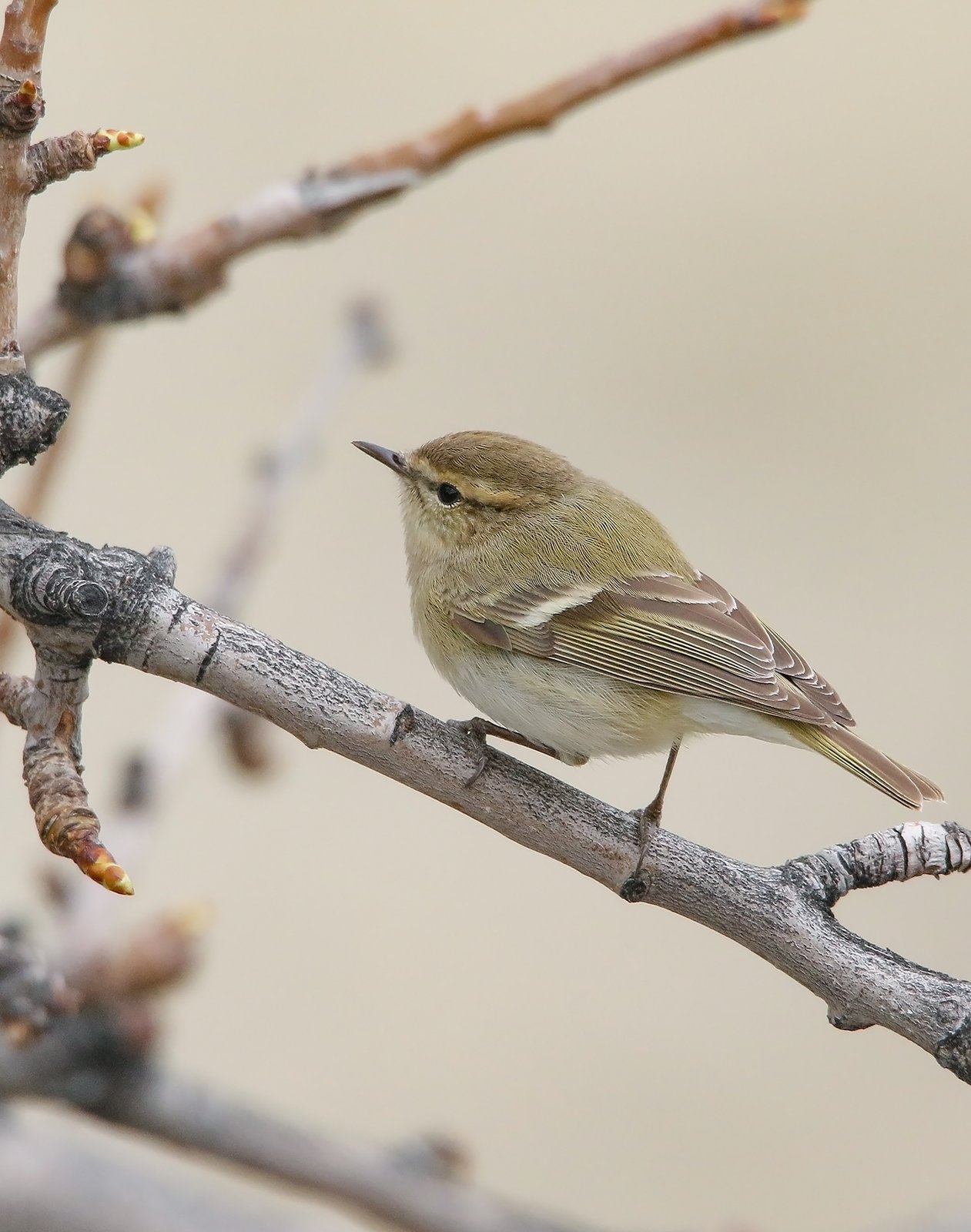
Hume's Warbler is the greyer, duller counterpart of the Yellow-browed Warbler from the mountains of Central Asia. Unlike that species it is a regular winter visitor in the east of the region: in the parks, gardens and acacia scrub of the Gulf states and Oman it is one of the commonest small songbirds in winter.
Voice
The call is a flat or slightly falling, disyllabic chwee-eet, or a dry, tit-like wesoo, less sharp and without the upward whiplash of Yellow-Browed; often heard in winter. The song, heard from late spring, is a descending buzzing dzzzzoo alternating with calls.
Recording: Peter Ericsson — CC BY-NC-SA 4.0 · converted to mono · xeno-canto
Identification
9.5–10.5 cm. Grey-green to grey-brown above and off-white to greyish-buff below, without a fresh olive tone. Long, off-white to pale buff supercilium and a dark eye-stripe. On the wing one clear pale bar across the greater coverts; the second, across the median coverts, is faint or absent. Tertials with pale edges. Bill almost entirely dark and legs dark brown to blackish. A pale crown stripe is absent or barely visible.
Confusion species
Yellow-browed Warbler (Phylloscopus inornatus) is fresher green, with a yellowish-white supercilium, two clear wing bars, an orange-pink bill base and pale legs, and a loud rising tsoo-eest. Plain Leaf Warbler (Phylloscopus neglectus) lacks a wing bar. Green Warbler (Phylloscopus nitidus) is larger and yellower. Pallas's Leaf Warbler (Phylloscopus proregulus) has a yellow crown stripe and a yellow rump.
Habitat
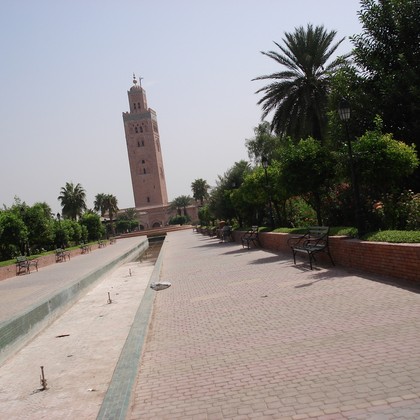
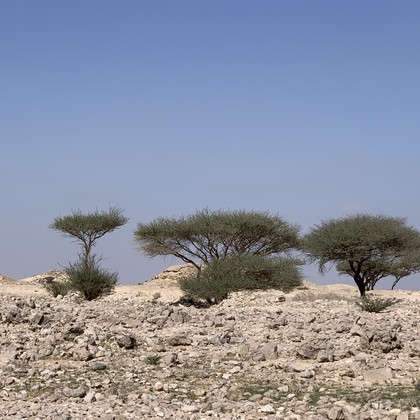
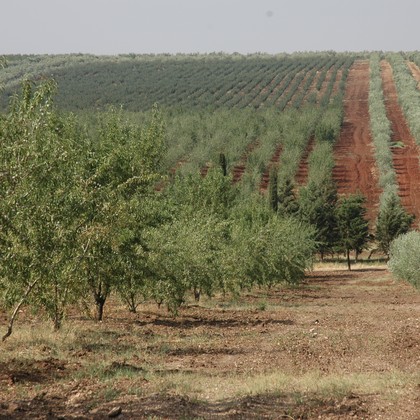
In winter in gardens, parks and urban greenery with flowering trees, golf courses, date-palm and other orchards and in acacia and prosopis scrub of the plains and wadis; often high in a tree among the foliage.
Where the bird is most at home, classified by the habitats of North Africa and the Middle East.
Range and movements
Fairly common winter visitor in the UAE, northern Oman, Bahrain, Qatar, Kuwait and eastern Saudi Arabia, and in Iraq; scarcer in central and western Saudi Arabia and Yemen. In Israel and Jordan a scarce winter visitor, mainly at Eilat and in the Arava; rare in Egypt and a vagrant to the Maghreb with a handful of records. Breeds in the mountains of Central Asia, from the Tian Shan and Altai to the western Himalayas, and winters mainly from northern India and Pakistan to South-East Asia.
- Winter visitor (c. Oct–Mar)
- Passage (Mar–Apr, Oct–Nov)
- dark = core range, pale = thinly spread
How and when to look
From November to March in the parks of Dubai, Abu Dhabi or Muscat, or in the gardens of Al Ain: follow the flat chwee-eet calls in a flowering tree. With any yellow-browed-type bird compare bill, legs and the number of wing bars.
Conservation status
Not globally threatened, with a large range and a stable population. In the Gulf states it benefits from the planting of parks and urban greenery.
Scientific name
Phylloscopus humei | (Brooks, 1878)
Brooks described the species in 1878 as Reguloides humei; because it was later moved to another genus, the author and year stand in brackets. The genus Phylloscopus was introduced in 1826 by Boie. Phylloscopus is Greek, from phullon 'leaf' and skopos 'seeker', from skopeō 'to watch': the bird that searches the foliage. humei honours Allan Octavian Hume (1829–1912), British civil servant in India and ornithologist. The specimen the first description was based on came from north-western Pakistan.