All species › Passerines › Leaf warblers › Dusky Warbler
Dusky Warbler | Phylloscopus fuscatus
Bruine boszanger | Mosquitero sombrío
The Dusky Warbler is a dark, compact leaf warbler from Siberia and northern China that winters in South and South-East Asia. In this region only a few birds reach the far western edge of its winter range: in the UAE and Oman it is a rare but nearly annual winter visitor, elsewhere a vagrant. It gives itself away mainly by its hard call from dense, low cover.
Voice
The call makes the species: a hard, dry, smacking tchek or tak, like two pebbles knocked together, monotonously repeated from cover. The song, rarely heard in winter quarters, is a series of full, trilling notes.
Recording: Bo Shunqi 薄顺奇 — CC BY-NC-SA 4.0 · converted to mono · xeno-canto
Identification
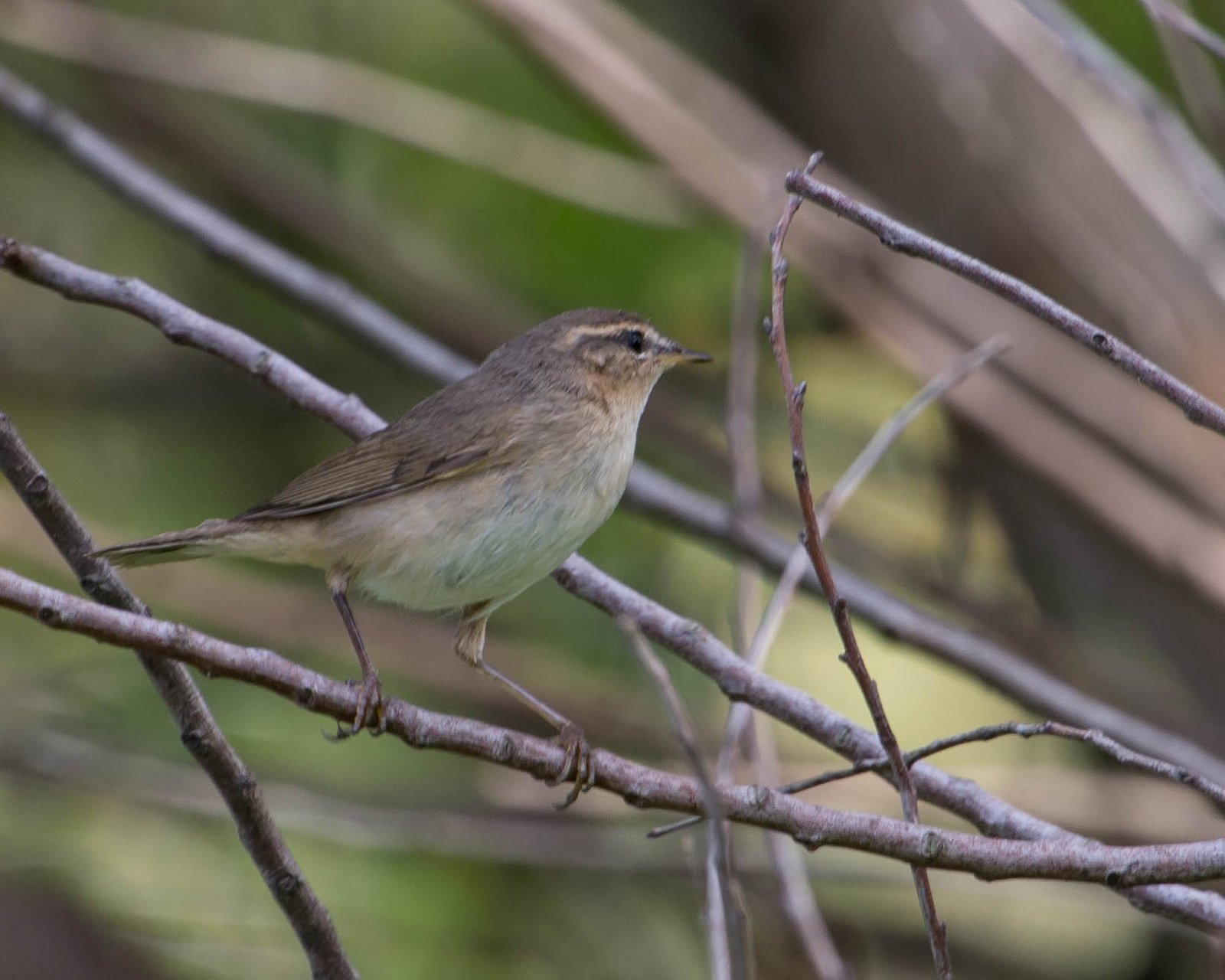
11–12 cm. Compact and short-winged, with a round head, a fine, pointed bill and a short primary projection. Upperparts uniform dark grey-brown, with no green or olive; underparts off-white with a warm buff wash on the flanks and undertail coverts. The supercilium is long and sharp, broadest and warmest (orange-buff) in front of the eye, whiter behind it; below it a clear dark brown eye-stripe. Legs brownish-pink, fairly slender. No wing bar.
Confusion species
Radde's Warbler (Phylloscopus schwarzi), not yet reliably recorded in the region, has a thick, blunt bill, heavy orange-pink legs and a supercilium that is broadest behind the eye. Common Chiffchaff (Phylloscopus collybita) and Mountain Chiffchaff (Phylloscopus sindianus) are greyer or more olive, with a less sharp supercilium, black legs and a soft, whistled call. Small reed warblers have a longer tail and bill and a flat-crowned head.
Habitat
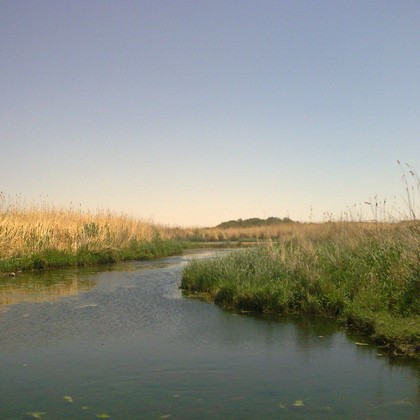
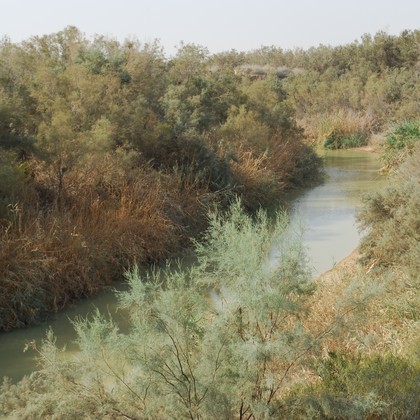
Dense, low vegetation near water: edges of reedbeds and marshes, tamarisk scrub, rank growth along ditches and ponds, sewage works and damp park edges. Forages low and often on the ground, with nervous tail movements.
Where the bird is most at home, classified by the habitats of North Africa and the Middle East.
Range and movements
In the UAE and northern Oman a rare winter visitor seen in most years, mainly in the marshes and sewage-treatment areas around Dubai, Abu Dhabi and the Batinah coast. Elsewhere a vagrant: a few records from Israel, Bahrain, Saudi Arabia and Kuwait (two); hardly any in North Africa. Breeds from western Siberia and the Altai to eastern Siberia and northern China and winters from Nepal and north-eastern India to southern China and South-East Asia.
- Winter visitor (c. Oct–Mar)
- Passage (Mar–Apr, Oct–Nov)
- dark = core range, pale = thinly spread
How and when to look
From November to March listen along reed fringes and tamarisk thickets in the wetlands of the UAE, such as Al Wathba and Ras al-Khor, or at sewage-treatment plants, for a repeated hard tchek. Patience pays: the bird usually only emerges from cover after a while.
Conservation status
Not globally threatened, with a large range and population. In the region a rare but nearly annual winter visitor at the western edge of its winter range; the number of records in the Gulf states is increasing, probably partly due to more observers.
Scientific name
Phylloscopus fuscatus | (Blyth, 1842)
Blyth described the species in 1842 as Phillopneuste fuscata; because it was later moved to another genus, the author and year stand in brackets. The genus Phylloscopus was introduced in 1826 by Boie. Phylloscopus is Greek, from phullon 'leaf' and skopos 'seeker', from skopeō 'to watch': the bird that searches the foliage. fuscatus is Latin for 'darkened', from fuscus 'dark', after the uniformly brown plumage. The specimen the first description was based on came from the area around Calcutta.