All species › Passerines › Crows and jays › House Crow
House Crow | Corvus splendens
Huiskraai | Corneja india
A bold, noisy urban crow from South Asia that has travelled across the Indian Ocean on ships and has established itself in almost every port city around Arabia. The species is not native to the region and is controlled in many places, because it displaces native birds, raids nests and is a nuisance.
Voice
A flat, nasal, dry kaa-kaa, higher and less grating than Carrion Crow, in short series; also rattling alarm calls and much muttering and clicking in flocks. Deafening around roost trees at dawn and dusk.
Recording: David Darrell-Lambert — CC BY-NC-SA 4.0 · converted to mono · xeno-canto
Identification
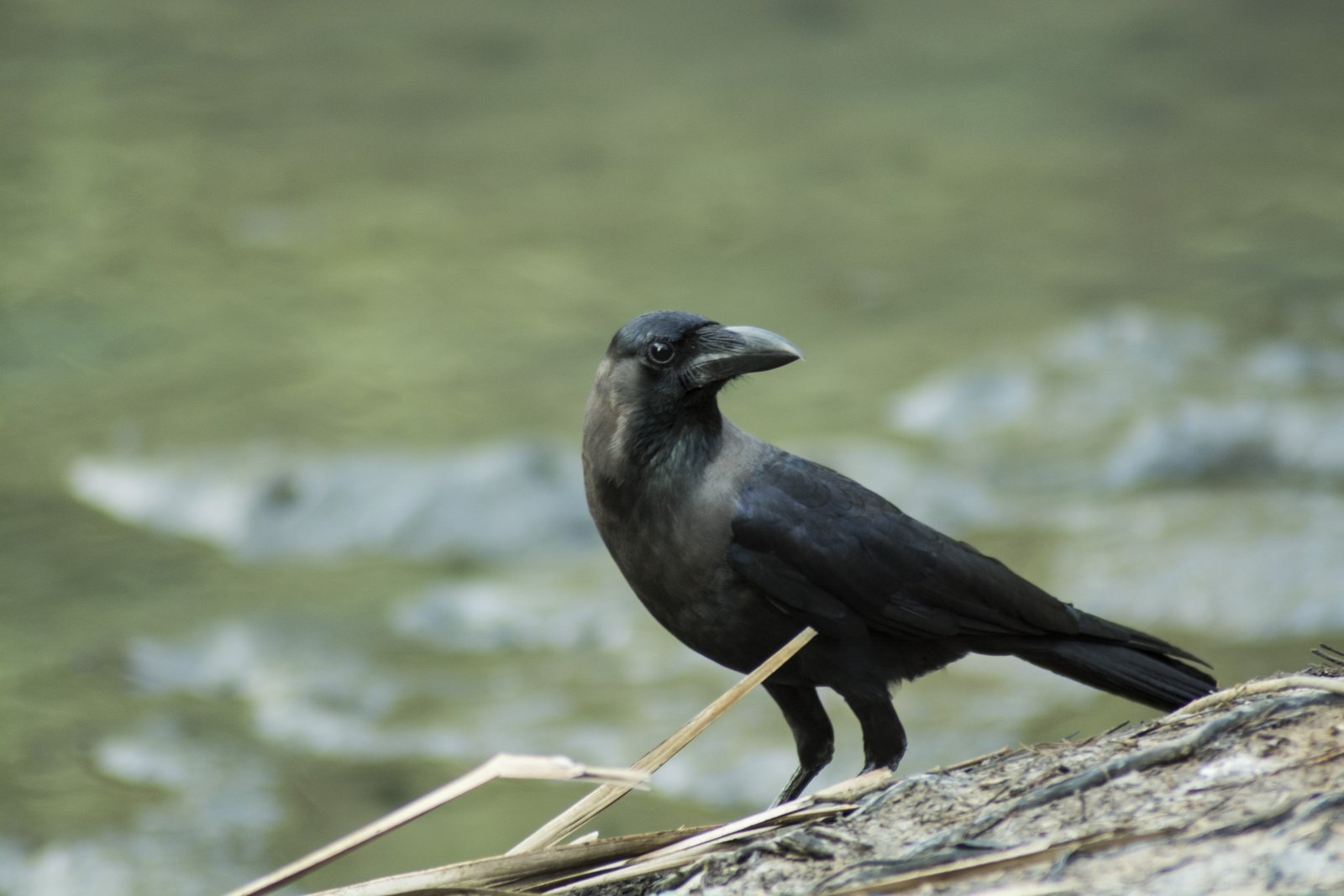
Slimmer and smaller than Carrion Crow, with long legs, a high, steep forehead and a long, fairly straight bill. Black with a green to purple gloss; nape, hindcrown, breast and upper belly ash-grey to greyish-brown, like a shawl around the black forehead, face and throat. In flight narrow, fairly long wings and a long, rounded tail, with a lighter, quicker wingbeat than Carrion Crow. Juveniles are duller, with less clearly demarcated grey.
Confusion species
Carrion Crow (Corvus corone), in its hooded form in Egypt and the Levant, is larger and bulkier, with grey across the whole back and belly and a black head without a grey nape. Eurasian Jackdaw (Coloeus monedula) is smaller and has a pale eye. Brown-necked Raven (Corvus ruficollis) is much larger and all black with a brown wash. Common Mynas (Acridotheres tristis) and Asian Koels (Eudynamys scolopaceus), also urban birds in the Gulf states, are smaller and differently coloured, but the koel uses House Crows as hosts.
Habitat
Strictly tied to people: ports, coastal towns, markets, fish markets, rubbish dumps, parks and gardens, plantations and mangrove edges. Roosts in large flocks in town trees and feeds on the tideline, at fish landing sites and on refuse. Seldom far from the coast or from buildings.
Where the bird is most at home, classified by the habitats of North Africa and the Middle East.

Range and movements
Exclusively introduced. In Yemen at Aden since the 1840s and from there along the coast, including Al Hudaydah and Al Mukalla; eradicated from Socotra in 2009. In Saudi Arabia at Jeddah since 1978 (later tens of thousands of birds), at Yanbu since 1986 and at Haql on the Gulf of Aqaba since 1989, and on the Gulf coast at Ras Tanura and Dammam since the 1980s. In Oman common to abundant along the coast, in the United Arab Emirates very common on both coasts, in Qatar local (especially Halul Island), in Bahrain resident and in Kuwait scarce. In Egypt established since about the 1970s in the towns along the Suez Canal and the Gulf of Suez; in Israel at Eilat since the late 1970s and in Jordan at Aqaba. In Iraq at most scarce in the south. Its native range extends from Iran and Pakistan across the Indian subcontinent to Myanmar; it has also been introduced elsewhere around the Indian Ocean (East Africa, Djibouti, Sudan), and ships carry it as a vagrant as far as Europe.
- Resident
- Summer visitor (c. Apr–Sep)
- Winter visitor (c. Oct–Mar)
- Passage (Mar–Apr, Oct–Nov)
- dark = core range, pale = thinly spread
How and when to look
Any port in the Gulf states or on the Red Sea is a good place; the roosts in parks in Dubai, Muscat and Jeddah draw large numbers of birds. Report establishment at new sites to local authorities or bird organisations, as early action works.
Conservation status
Not globally threatened. In the region an invasive introduced species that is actively controlled at several sites (successfully on Socotra; partly at Ras Tanura and Jeddah); it displaces native species, raids nests of songbirds and terns and is a pest for agriculture and public health.
Scientific name
Corvus splendens | Vieillot, 1817
Vieillot described the species in 1817 and placed it straight away in the genus where it still stands. The genus Corvus was introduced in 1758 by Linnaeus. Corvus is the Latin word for 'raven'. splendens is Latin for 'gleaming, glittering', after the sheen of the plumage. The specimen the first description was based on came from Bengal.