All species › Passerines › Crows and jays › Pied Crow
Pied Crow | Corvus albus
Schildraaf | Cuervo pío
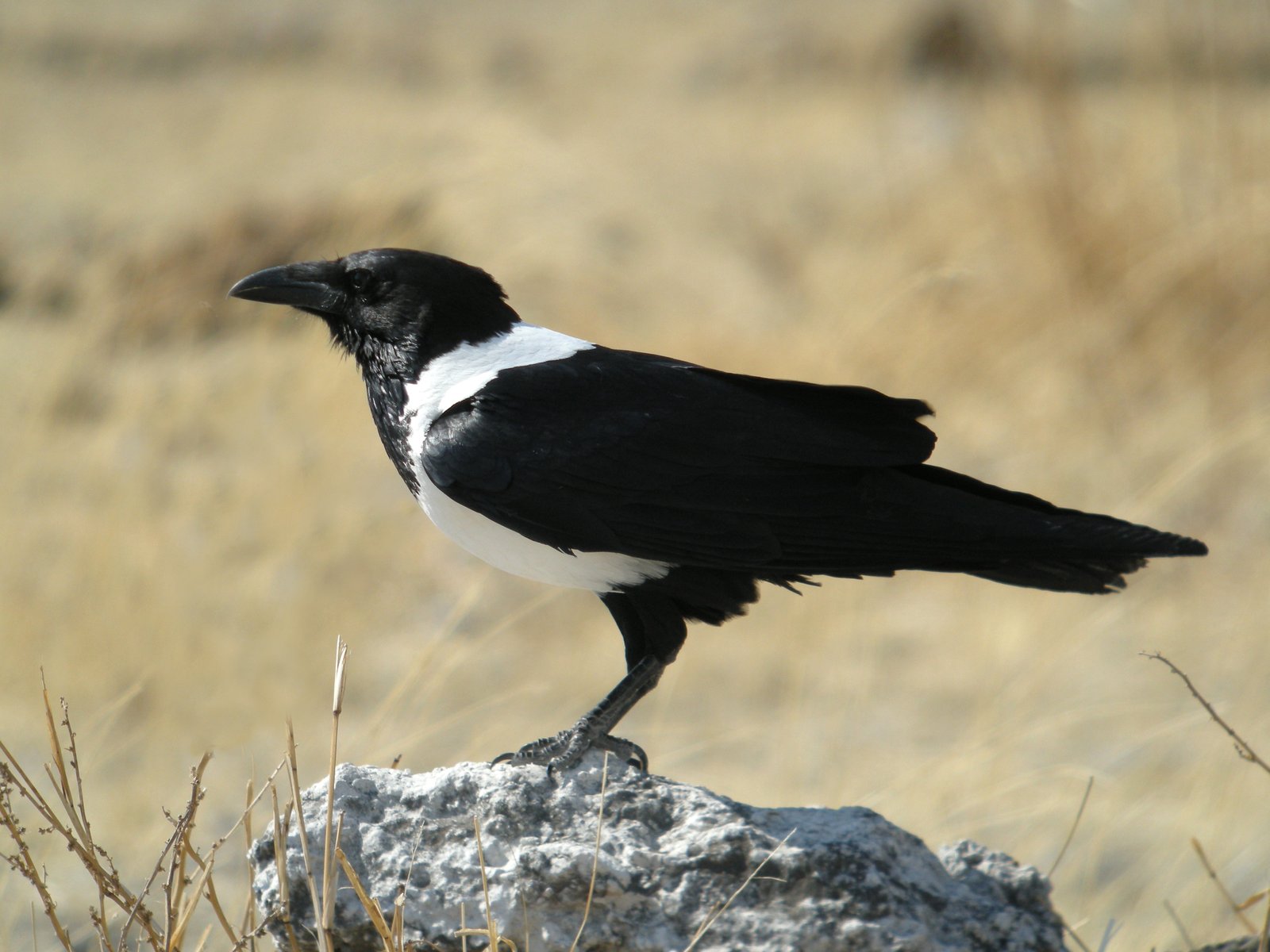
The common crow of sub-Saharan Africa, black with a bright white breast and neck band, and therefore unmistakable. In the region it is a vagrant: in recent years birds have turned up occasionally in Morocco and Algeria, possibly heralding an expansion from the Sahel and Mauritania, but sometimes perhaps as ship-assisted birds.
Voice
A harsh, hoarse kraak or karr, often in series, rougher and lower than House Crow; also clucking and grunting sounds at the nest.
Recording: African Bioacoustics Community — CC BY-NC-SA 4.0 · converted to mono · xeno-canto
Identification
A robust crow with a heavy, curved bill. Glossy black, with a broad white breast shield that continues via the flanks into a white band across the hindneck and upper mantle; head, throat and upper breast are black, as are wings, tail and belly. In flight the white breast shield between the black head and black lower belly is immediately obvious, as is the fairly long, rounded tail. Juveniles are duller, with the white dirtier and brownish.
Confusion species
In the region confusion is only possible with a hybrid between Pied Crow and Brown-necked Raven (Corvus ruficollis), which shows less and more irregular white; such hybrids are known from the Horn of Africa. Carrion Crow (Corvus corone) in its hooded form has grey rather than white, covering the whole back and belly rather than a band across breast and neck. House Crow (Corvus splendens) is smaller and slimmer and has a grey, not white, shawl. Somali Crow (Corvus edithae), outside the region, is all black.
Habitat
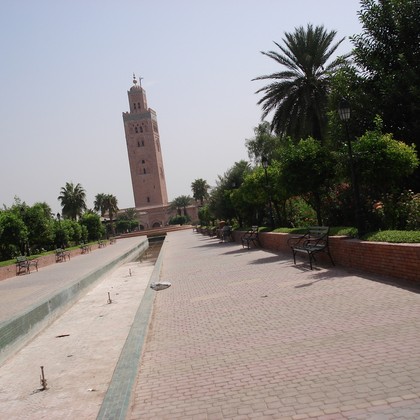
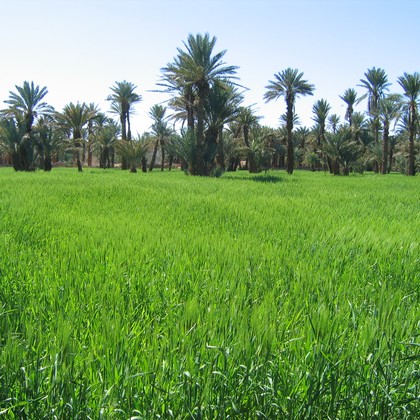
In Africa mainly open country with trees, villages, towns, roads and rubbish dumps; it follows people and benefits from refuse and from pylons as nest sites. The vagrants in Morocco were seen at rubbish dumps, in palm groves, on the coast and near villages.
Where the bird is most at home, classified by the habitats of North Africa and the Middle East.
Range and movements
Within the region only as a vagrant. In Morocco a few records: near Fnideq in the north (March 2015), in a palm grove near Mhamid on the edge of the Sahara (November 2015), near Tarfaya and the Khnifiss lagoon in the south (January 2017, probably the same bird) and at Oum Azza southeast of Rabat (May 2017); according to Moroccan observers some birds elsewhere in the country stayed at the same site for a long time. In Algeria one bird at Laghouat on the northern edge of the Sahara (April 2023). There are no well-documented records from Arabia or Egypt. Beyond the region common over almost all of sub-Saharan Africa, from Mauritania and Senegal to Sudan, Eritrea and Somalia and south to the Cape and Madagascar; in South Africa and the Sahel it is spreading along roads and power lines.
How and when to look
A Pied Crow in North Africa stands out among the ravens and gulls at a rubbish dump; photograph it and report the sighting, as every record helps to establish whether the species is spreading north from the south.
Conservation status
Not globally threatened and increasing in much of Africa. In the region a vagrant without breeding records; the origin of the North African birds (natural spread or ship-assisted) is uncertain.
Scientific name
Corvus albus | Müller, 1776
Müller described the species in 1776 and placed it straight away in the genus where it still stands. The genus Corvus was introduced in 1758 by Linnaeus. Corvus is the Latin word for 'raven'. albus is Latin for 'white' — for the white breast and collar of this otherwise black crow. The specimen the first description was based on came from Senegal.