All species › Passerines › Hypocolius › Grey Hypocolius
Grey Hypocolius | Hypocolius ampelinus
Zijdestaart | Hipocolio
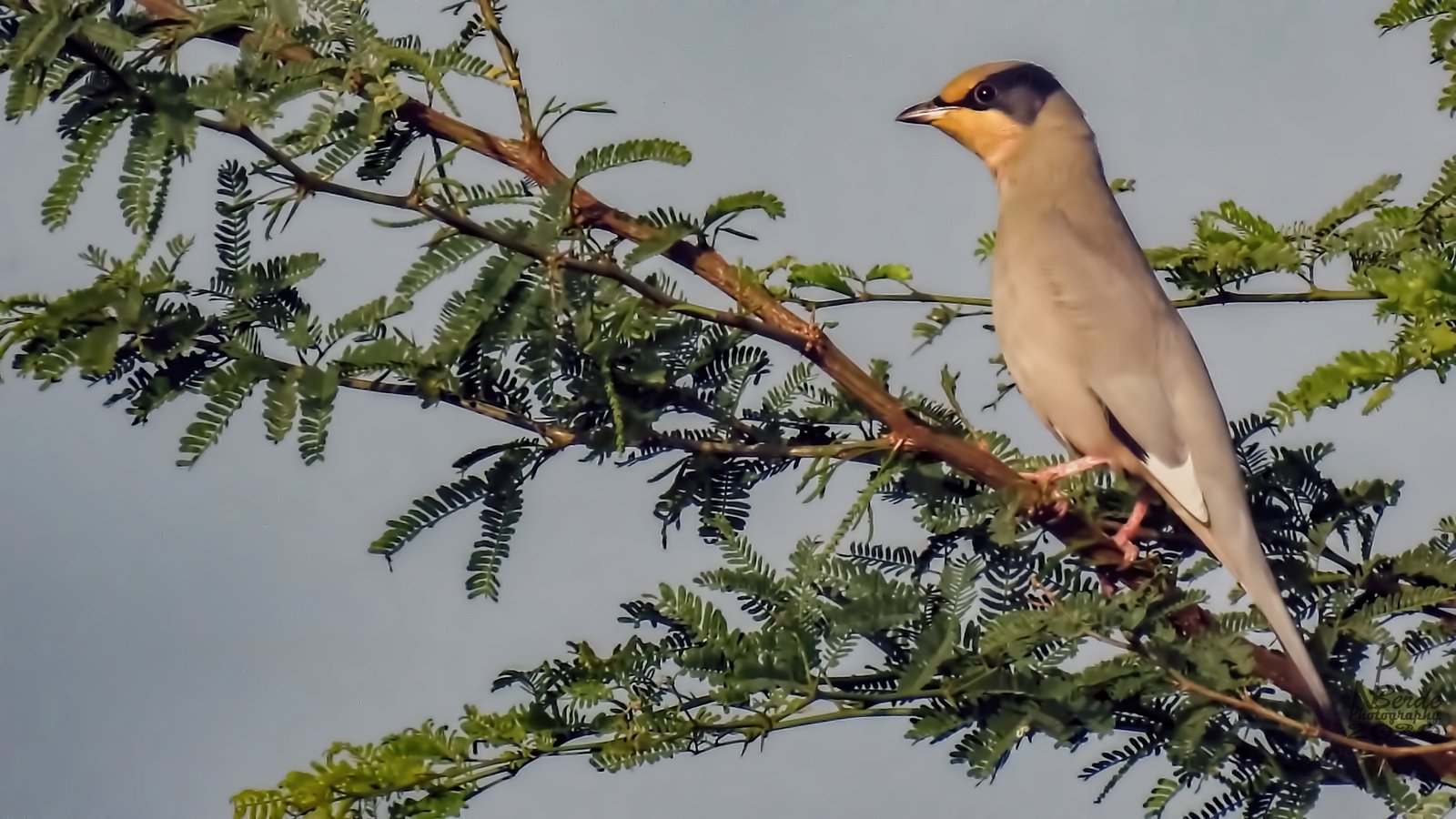
The Grey Hypocolius is the only member of its family: a slender, sleek grey bird with a long tail, with something of a waxwing and a shrike in its behaviour. The Gulf states and eastern Arabia are the best place in the world to see it in winter, at traditional roosts in date-palm groves and scrub.
Voice
Often the first sign of its presence: a soft, mewing, liquid tre-tur-tur and a whistled wheeu, especially at the roost and in flight; also a short, hard kirr. The song is a monotonous, quiet twittering.
Recording: Viral joshi — CC BY-NC-SA 4.0 · converted to mono · xeno-canto
Identification
25 cm. Slim, with a small crest, a long tail and a short, slightly hooked bill. The male is soft blue-grey with a sandy wash on breast and belly, a black mask running from the bill through the eye to a band around the nape, a black terminal tail band, and black primaries with white tips that form a striking white patch in flight. The female is plainer sandy grey-brown with a pale throat and no black mask; she too has a dark tail tip, and her primaries are grey with black-and-white tips. Juveniles resemble the female. Often moves unobtrusively inside dense bushes, but perches on top at roosts and when sunning.
Confusion species
Bohemian Waxwing (Bombycilla garrulus), which does not occur in the region, has a similar silhouette but is pinkish brown with a yellow tail tip. Great Grey Shrike (Lanius excubitor) also has a black mask, but it does not continue around the nape, and it has a black tail with white sides and a heavy hooked bill. Females can recall a small babbler, but babblers are browner, with rounded wings and quite different calls.
Habitat
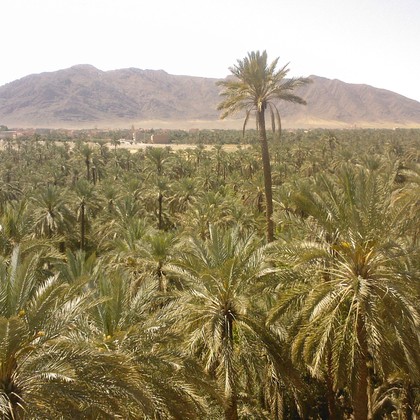
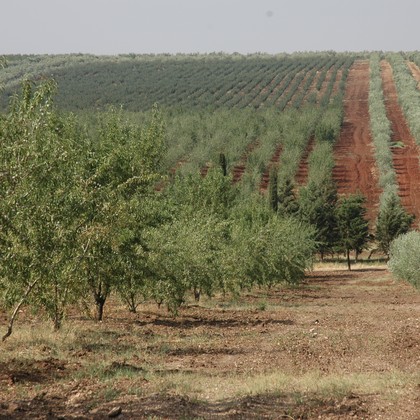
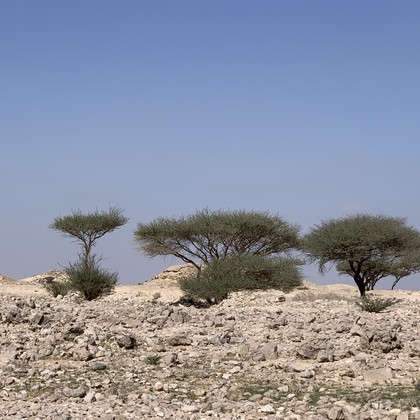
Semi-desert with dense bushes and trees: date-palm groves, farms and plantations, oases, wadis with Salvadora, Ziziphus and Prosopis, and gardens. In winter feeds mainly on fruit and berries, especially of Salvadora persica, and roosts in groups of tens to hundreds in dense bushes. Breeds in palm groves and stands of trees along rivers.
Where the bird is most at home, classified by the habitats of North Africa and the Middle East.
Range and movements
Breeds in southern Iraq, in the date-palm groves and riverine woodland along the Tigris and Euphrates, and since 2014 in small numbers in Kuwait (first breeding for the Arabian Peninsula, at Jahra). Winters in eastern Saudi Arabia (including the Al-Hasa oasis and around Haradh, where flocks of hundreds occur), Bahrain, Qatar, the United Arab Emirates and northern Oman; in Kuwait mainly a passage migrant in spring and autumn, sometimes also in summer. Rare but fairly regular in southern Israel, a vagrant to Egypt. Beyond the region it breeds in southern Iran, Turkmenistan, western Afghanistan and Pakistan, and also winters in southern Iran, Pakistan and north-western India.
- Resident
- Summer visitor (c. Apr–Sep)
- Winter visitor (c. Oct–Mar)
- Passage (Mar–Apr, Oct–Nov)
- dark = core range, pale = thinly spread
How and when to look
The well-known roosts are the classic approach: in Bahrain at Jasra, in the Emirates the plantations at Ghantoot between Dubai and Abu Dhabi, in Oman at Qatbit and Muntasar and in Qatar the farms at Irkhaya. Arrive towards sunset or just after sunrise and listen for the mewing calls.
Conservation status
Not globally threatened. The world population is not large and the species locally depends on a few wintering areas and roosts; the loss of old palm groves, farms and Salvadora scrub, partly to development in the Gulf states, is a threat. It has recently spread as a breeder to Kuwait.
Scientific name
Hypocolius ampelinus | Bonaparte, 1850
Bonaparte described the species in 1850 and placed it straight away in the genus where it still stands. He introduced the genus Hypocolius in that same work. Hypocolius is formed from Greek hupo 'nearly, close to' and the genus name Colius, the mousebirds, which the bird resembles in build and bearing. ampelinus is Greek for 'of the vine', after the resemblance to the waxwings, formerly placed in Ampelis. The specimen the first description was based on came from the coast of Ethiopia.