All species › Passerines › Laughingthrushes › Arabian Babbler
Arabian Babbler | Argya squamiceps
Arabische babbelaar | Turdoide árabe
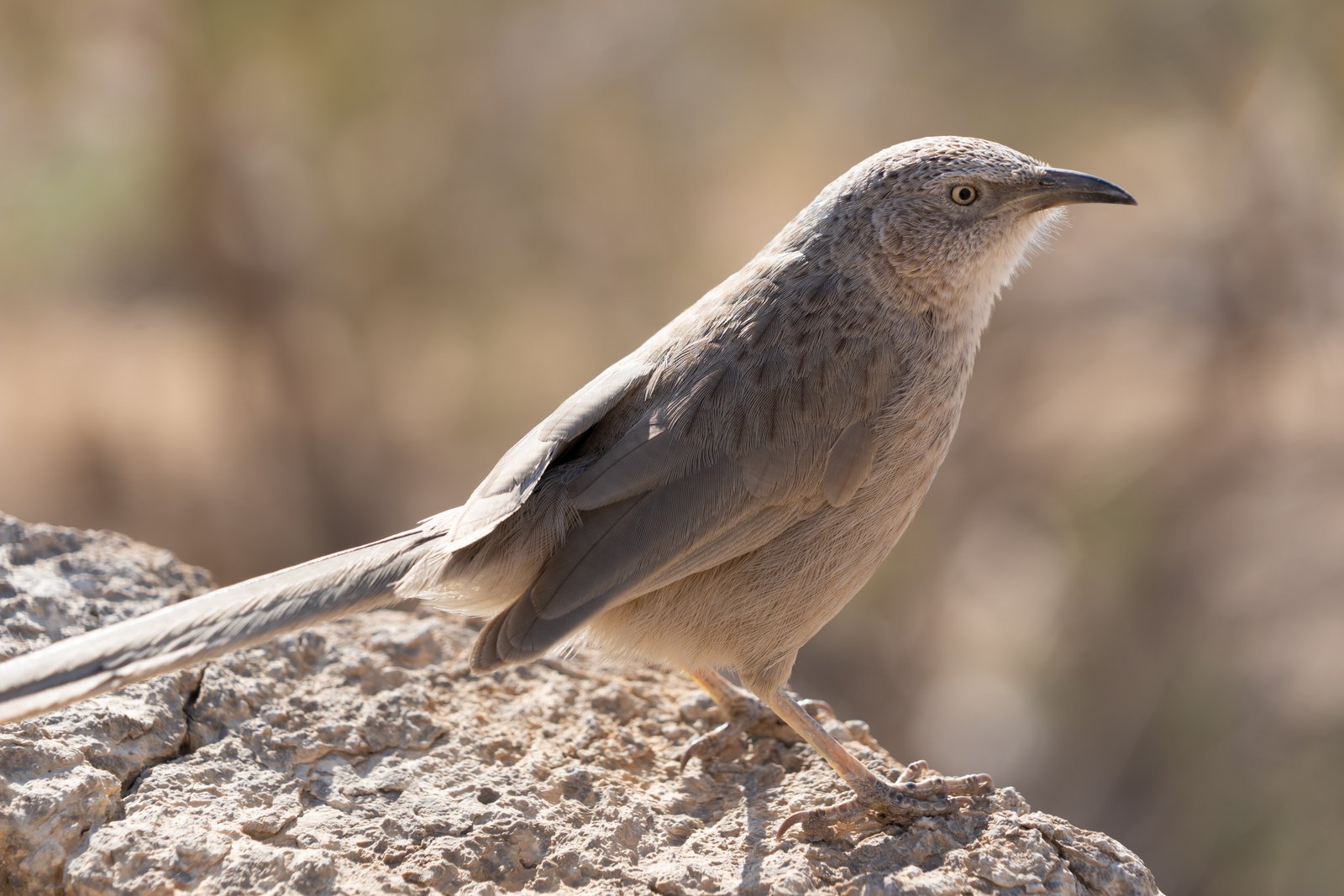
The Arabian Babbler is the large, long-tailed social bird of the wadis and acacia plains of Arabia and the Levant. It lives in permanent family groups with a strict hierarchy that jointly defend a territory and raise each other's young; Amotz Zahavi's long-term study in the Arava made the species famous.
Voice
Noisy: high, piercing whistles peeeu and a rapidly repeated pee-pee-pee-pee, often in chorus by the whole group; when alarmed a hard, rattling cherrr. At dawn groups sometimes sing for long periods in duet.
Recording: David Darrell-Lambert — CC BY-NC-SA 4.0 · converted to mono · xeno-canto
Identification
26–29 cm. Large and slim, with short rounded wings and a very long, graduated tail. Upperparts greyish brown to sandy brown, crown and forehead finely scaled grey; underparts paler buff with a whitish throat and no clear streaking. Bill fairly long, slightly decurved, dark in adults (paler, yellow at the base, in young birds); iris pale. The form yemensis of south-west Arabia is darker and browner, muscatensis of Oman and the Emirates paler and greyer. Flies low and undulating with rapid wingbeats and glides from bush to bush.
Confusion species
Fulvous Babbler (Argya fulva) is almost wholly confined to North Africa within the region; it is plainer sandy, without scaling on the crown, and has a dark eye. Afghan Babbler (Argya huttoni) of southern Iraq and Kuwait is smaller and clearly streaked. Female Grey Hypocolius (Hypocolius ampelinus) are also long-tailed, but sleeker, with a shorter black bill.
Habitat
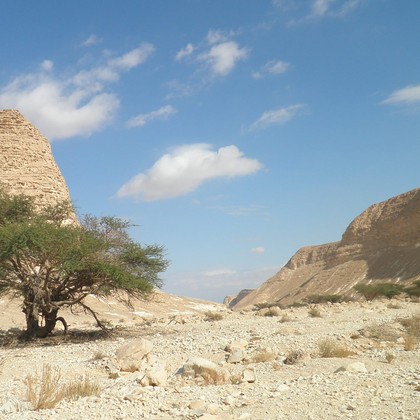
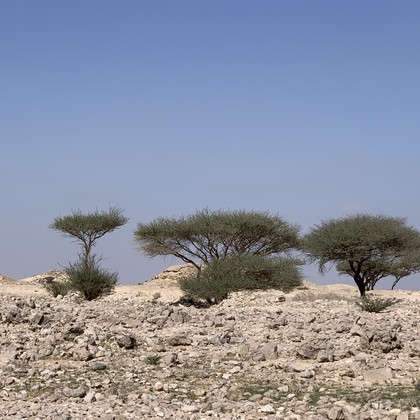
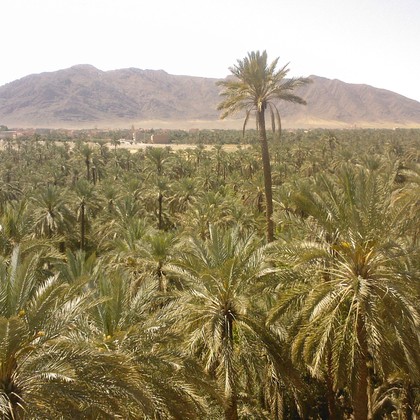
Wadis with acacias, tamarisk and Ziziphus, thorn scrub of the Arabian plains, the edges of oases and date-palm groves and, in the Emirates and Oman, also parks, golf courses and gardens. In Yemen and Asir into the mountains at about 2000 m. Forages in groups of three to twenty on the ground for insects, lizards and seeds, and also takes fruit.
Where the bird is most at home, classified by the habitats of North Africa and the Middle East.
Range and movements
In the Levant in the Arava, around the Dead Sea, in the Negev and the Jordan Valley in Israel, Jordan and the West Bank, and in eastern Sinai. On the Arabian Peninsula in western Saudi Arabia along the Hejaz and Asir, scattered in the centre, and throughout Yemen outside the high desert; in Oman in the north (Hajar Mountains and Batinah) and in Dhofar; in the United Arab Emirates mainly in the east and around Al Ain, but now also in green areas along the coast. Absent from Kuwait, Bahrain and Qatar. Not found outside the region: an Arabian-Levantine endemic.
- Resident
- Summer visitor (c. Apr–Sep)
- Winter visitor (c. Oct–Mar)
- Passage (Mar–Apr, Oct–Nov)
- dark = core range, pale = thinly spread
How and when to look
In Israel the groups around the Arava kibbutzim, such as Hatzeva and Yotvata, and at Ein Gedi by the Dead Sea are tame and easy to see. In the Emirates Mushrif Park in Dubai and the Al Ain oasis are reliable; in Oman the wadis of the Hajar Mountains and Ayn Razat in Dhofar.
Conservation status
Not globally threatened and common in most of its range. Locally benefits from irrigation, planting and gardens, as in the Emirates; elsewhere it suffers from the felling of acacias and overgrazing of wadis.
Scientific name
Argya squamiceps | (Cretzschmar, 1827) (GBIF: Turdoides squamiceps)
Cretzschmar described the species in 1827 as Malurus squamiceps; because it was later moved to another genus, the author and year stand in brackets. The genus Argya was introduced in 1831 by Lesson. Argya was formed by René Lesson from Latin argutus 'noisy'. squamiceps combines Latin squama 'scale' and -ceps '-headed': 'scaly-headed'. The specimen the first description was based on came from Aqaba, Jordan.