All species › Passerines › Kinglets › Common Firecrest
Common Firecrest | Regulus ignicapilla
Vuurgoudhaantje | Reyezuelo listado
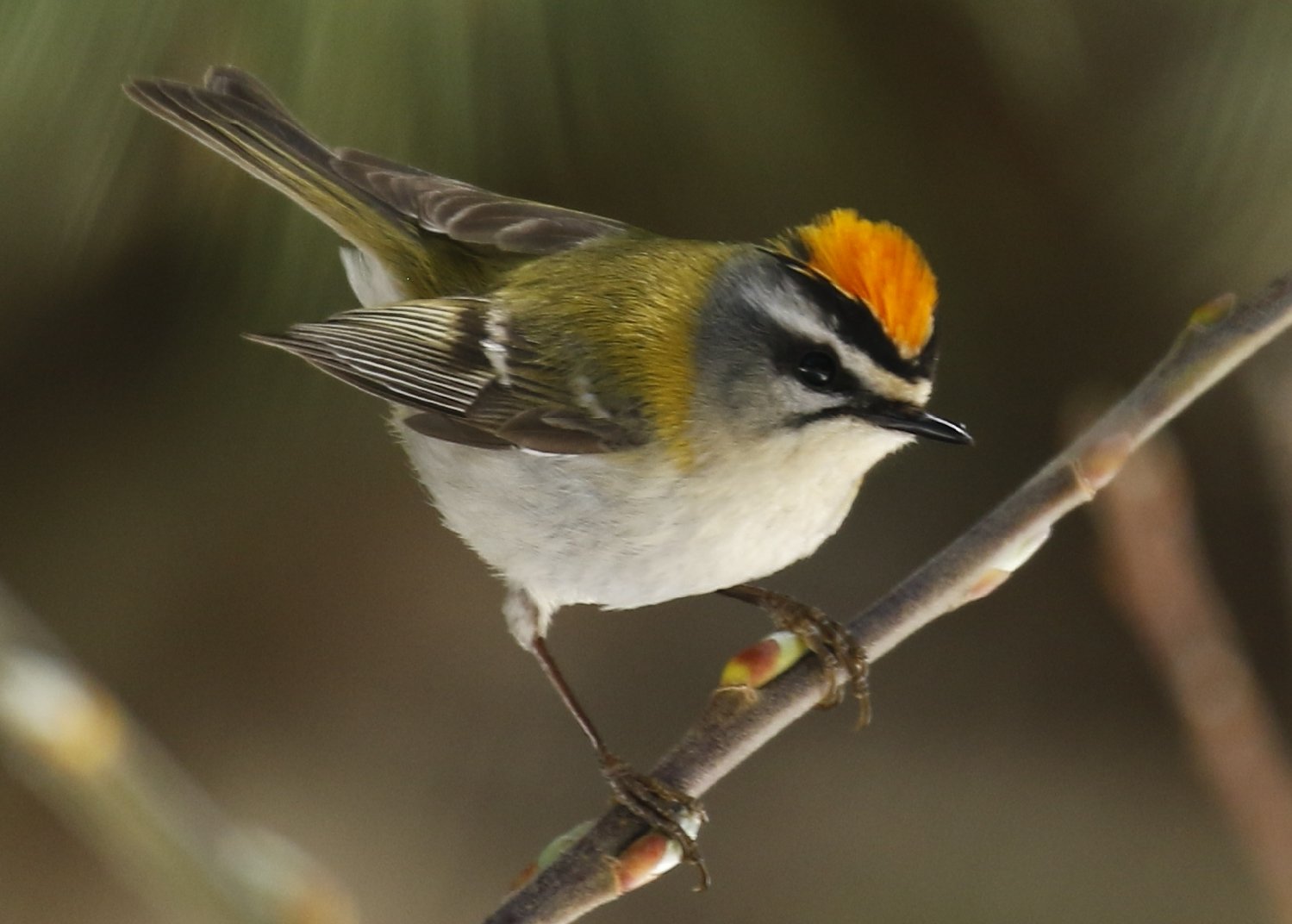
The Common Firecrest, with the Goldcrest, is the region's smallest bird. In the mountain forests of the Maghreb it is a common resident and the only crest that breeds here; in the Levant it appears only in winter in small numbers.
Voice
The call is a high zi or zizizi, slightly lower and sharper than Goldcrest's. The song is a short, fast series of high, even notes that accelerates and swells, zi-zi-zi-zi-zizizizirrr, without the terminal flourish of Goldcrest.
Recording: Philippe Grange — CC0 · converted to mono · xeno-canto
Identification
9–10 cm. Tiny and rotund, with a fine bill. Upperparts bright green with a bronze wash on the neck sides, underparts white to greyish white; two white wingbars. The face is boldly marked: a broad white supercilium, a black eye-stripe and a narrow dark moustachial stripe. The crown stripe is orange-red in the male, yellow in the female, bordered black on both sides. Juveniles lack the crown stripe but already show the face pattern. The North African form is balearicus, slightly paler below.
Confusion species
Goldcrest (Regulus regulus) has a plain face without white supercilium and black eye-stripe, with a dark eye in a pale ring, and is duller green without the bronze neck patch. Pallas's Leaf Warbler (Phylloscopus proregulus) and Yellow-browed Warbler (Phylloscopus inornatus) have a pale crown stripe or supercilium but are larger and longer-tailed, without an orange or yellow crown.
Habitat
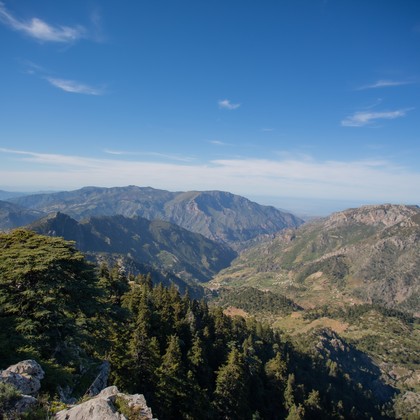
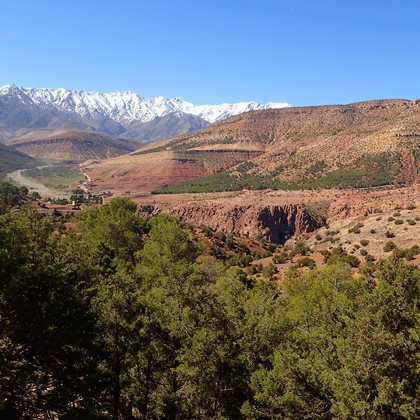
In North Africa mainly mountain forest: Atlas cedar, holm and cork oak, Algerian fir and mixed forest with juniper, from about 500 to above 2000 m; also in maquis and taller scrub. In winter also lower in olive groves, gardens and scrub. In the Levant in winter in conifer forest, maquis and gardens.
Where the bird is most at home, classified by the habitats of North Africa and the Middle East.
Range and movements
In Morocco common in the Rif, Middle Atlas and High Atlas and in the forests of the north-west. In Algeria in the north, in the Tell Atlas, Kabylia and the Aurès. In Tunisia in the mountain forests of the north, especially the Kroumirie. In the Levant a scarce winter visitor to Lebanon, Syria and northern Israel, with a few records further south. Beyond the region the species breeds in western and central Europe, the Balearics, Turkey and the Caucasus.
- Resident
- Summer visitor (c. Apr–Sep)
- Winter visitor (c. Oct–Mar)
- Passage (Mar–Apr, Oct–Nov)
- dark = core range, pale = thinly spread
How and when to look
In the cedar forests around Ifrane and Azrou in the Middle Atlas the Firecrest can be heard almost everywhere; follow the high zizizi to the outermost twigs. In Tunisia Aïn Draham is a good site.
Conservation status
Not globally threatened. Common in the mountain forests of the Maghreb, although old cedar and oak forests are declining through logging, overgrazing and wildfires.
Scientific name
Regulus ignicapilla | (Temminck, 1820)
Temminck described the species in 1820 as Sylvia ignicapilla; because it was later moved to another genus, the author and year stand in brackets. The genus Regulus was introduced in 1800 by Cuvier, GLCFD. Regulus is Latin for 'little king', a diminutive of rex 'king', after the golden crown stripe. ignicapilla is Latin, from ignis 'fire' and capillus 'hair of the head', after the fiery crown stripe. The specimen the first description was based on came from France, Belgium and Germany.