All species › Flamingos › Flamingos › Greater Flamingo
Greater Flamingo | Phoenicopterus roseus
Flamingo | Flamenco común
The large pink wader of chotts, sebkhas and lagoons. From the Gulf of Gabès to the Persian Gulf thousands of Greater Flamingos filter shallow salt water, and when a salt lake fills after a wet winter a colony of thousands of pairs can suddenly appear.
Voice
Goose-like: a nasal, bleating ka-ha and a low grunting chatter in feeding flocks that carries far over flat water. Passing flocks call constantly.
Recording: BİLGEHAN ERGAN — CC BY-NC-SA 4.0 · converted to mono · xeno-canto
Identification
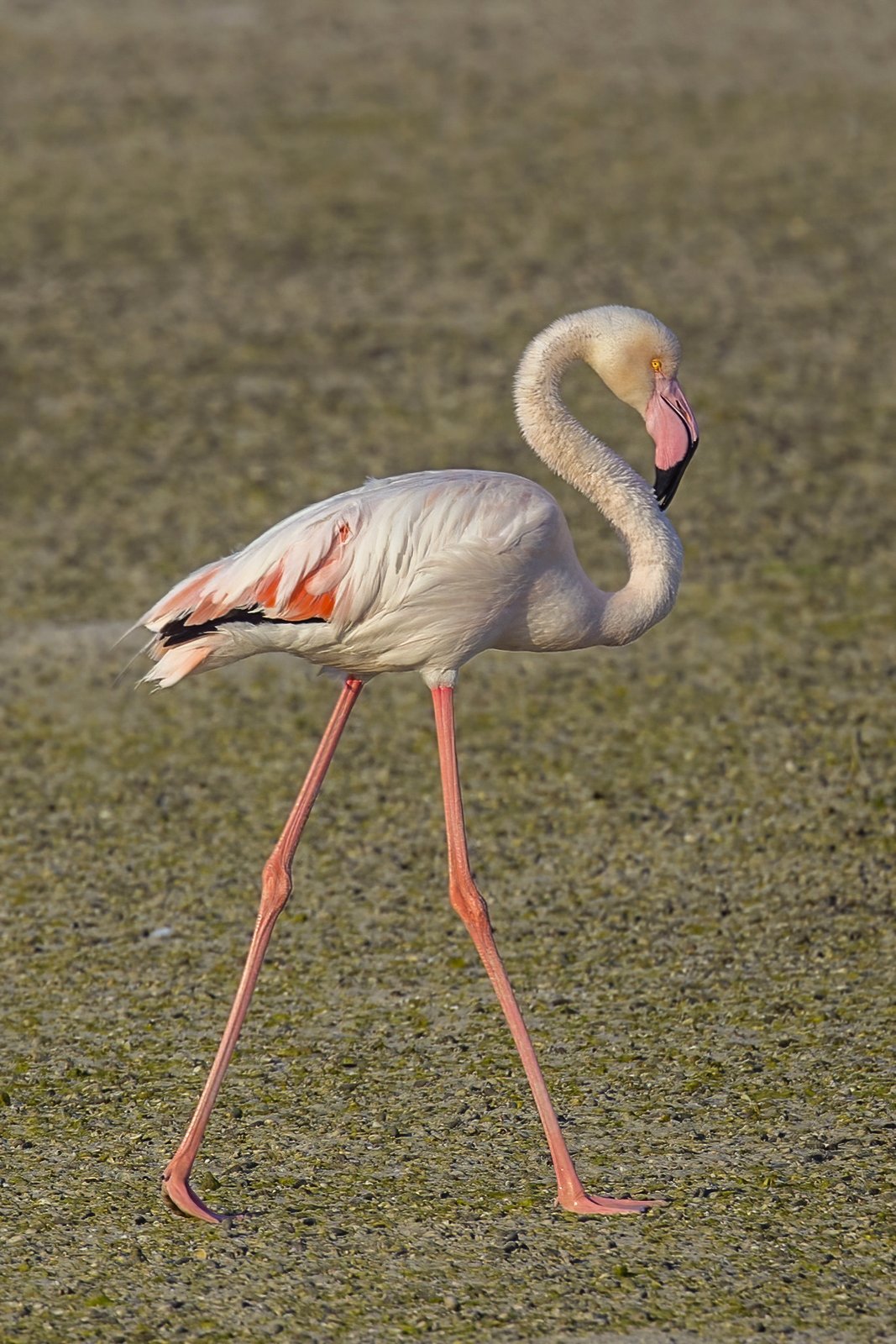
Very large, extremely long-legged and long-necked, pale pinkish white with crimson coverts and black flight feathers that stand out in flight. Bill pale pink with a sharply defined black tip and a strong bend; legs pink. Flies with neck and legs outstretched in long lines or Vs. Juveniles are grey-brown with grey bill and legs and turn pink only after several years.
Confusion species
Lesser Flamingo (Phoeniconaias minor) is clearly smaller and deeper pink, with a dark crimson bill that looks entirely black at distance and dark red legs; it sometimes occurs singly among Greater Flamingo flocks. Juveniles in flight may recall herons or storks, but the bent bill and the long outstretched neck and legs make the silhouette unique.
Habitat
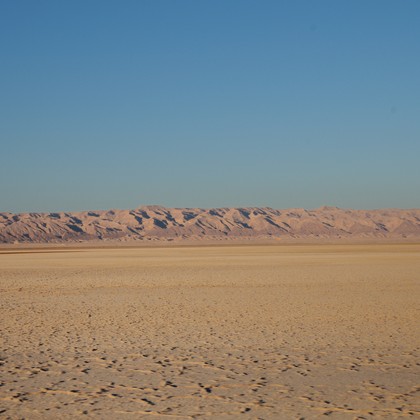
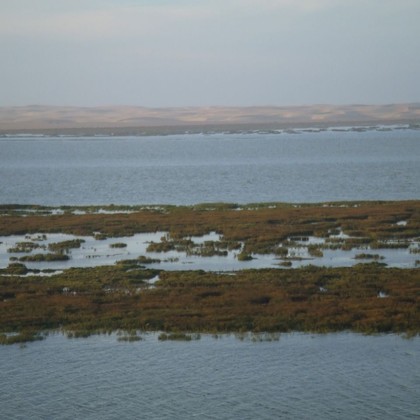
Shallow saline and brackish water without vegetation: chotts, sebkhas, coastal lagoons, saltpans, tidal flats and estuaries, also sewage lagoons and artificial lakes in the Gulf states. Filters brine shrimp (Artemia), insect larvae and mud with the head upside down. Breeds on mud cones on islets out of reach of ground predators, and depends on a stable water level to do so.
Where the bird is most at home, classified by the habitats of North Africa and the Middle East.
Range and movements
Breeding colonies lie in Algeria on the salt lakes of the Hauts Plateaux and the northern Sahara (including Ezzemoul, Chott Chergui and Safioune near Ouargla), in Tunisia in the saltpans of Monastir and Sfax among others, and in the United Arab Emirates at Al Wathba near Abu Dhabi; elsewhere, as in Morocco, it breeds only rarely. Outside the breeding season numerous along the coasts of Morocco (Merja Zerga, Khnifiss, Dakhla Bay), Tunisia (Gulf of Gabès), Libya and Egypt (the Nile Delta lakes and Bardawil), on the Red Sea, in Yemen, in Oman (especially Barr al Hikman), along the whole Persian Gulf from Kuwait to Abu Dhabi and in southern Iraq. Beyond the region from the Mediterranean through Turkey and Iran to India and over much of Africa.
- Resident
- Summer visitor (c. Apr–Sep)
- Winter visitor (c. Oct–Mar)
- Passage (Mar–Apr, Oct–Nov)
- dark = core range, pale = thinly spread
How and when to look
Barr al Hikman in Oman and the Gulf of Gabès in winter, Al Wathba in the breeding season and the Gulf coast of Kuwait, Bahrain and Abu Dhabi all year offer close views. Come early or late in the day, before heat haze makes the image shimmer. In a large flock always check every bird with a dark bill: a Lesser Flamingo may be among them.
Conservation status
Not threatened. Because birds in the region breed on a handful of salt lakes and only after good rains, a single dry year or one disturbance costs a whole breeding season. Coastal development in the Gulf states, reclamation of lagoons, hunting and disturbance by vehicles on the sebkhas are the main pressures. North African birds belong to a single population with those of the whole Mediterranean.
Scientific name
Phoenicopterus roseus | Pallas, 1811
Pallas described the species in 1811 and placed it straight away in the genus where it still stands. The genus Phoenicopterus was introduced in 1758 by Linnaeus. Phoenicopterus is Greek, from phoinix 'crimson' and pteron 'feather', thus 'red-feathered'. roseus is Latin for 'rose-coloured', after the pale pink plumage. The specimen the first description was based on came from the Ural River.