All species › Flamingos › Flamingos › Lesser Flamingo
Lesser Flamingo | Phoeniconaias minor
Kleine flamingo | Flamenco enano
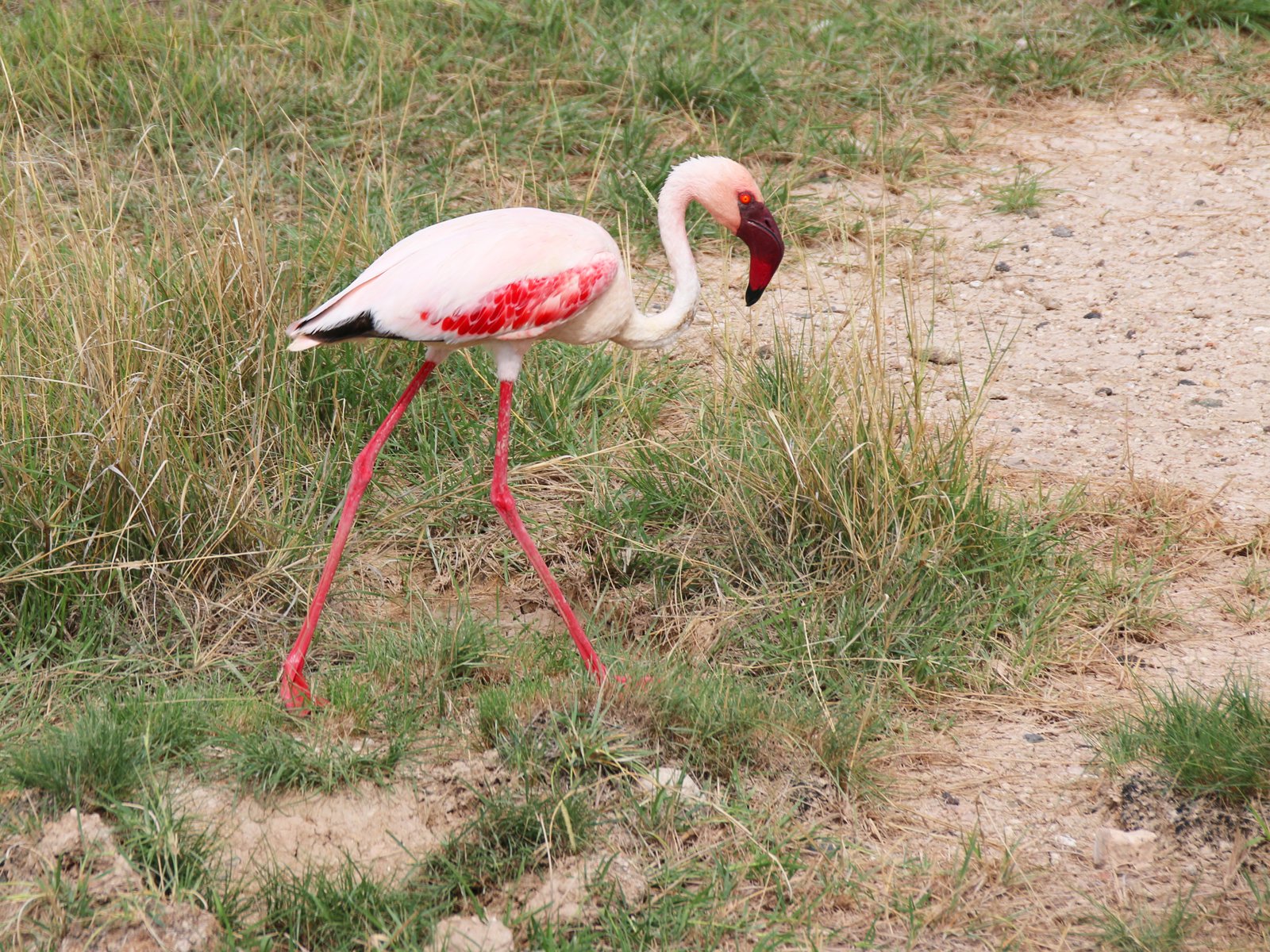
The smallest flamingo, with a dark bill that looks black at distance. In the region a visitor from the large African populations, usually turning up in small numbers among Greater Flamingos. In summer 2025 a breeding pair was found for the first time in North Africa, in a Greater Flamingo colony in the Monastir saltpans in Tunisia.
Voice
A high murmuring kwirrik and a goose-like honking, higher than in Greater Flamingo. Larger groups produce a continuous murmur.
Recording: Boyancé — CC BY-NC-SA 4.0 · converted to mono · xeno-canto
Identification
Clearly smaller and more compact than Greater Flamingo, with shorter neck and legs. Adults deeper pink, with crimson blotches on the coverts and black flight feathers. The bill is dark crimson with a black tip and looks uniformly dark at distance; eye and eye-ring red, legs dark red. Juveniles are grey-brown with a dark bill. Feeds with the bill tip just below the surface, walking or swimming.
Confusion species
Greater Flamingo (Phoenicopterus roseus) is much larger and paler, with a pink bill with only a black tip and pink legs. In a mixed flock look above all at bill colour and the smaller, pinker build; young Greater Flamingos have a grey, not dark, bill. Captive flamingos of other species can escape from parks and zoos; check for rings.
Habitat
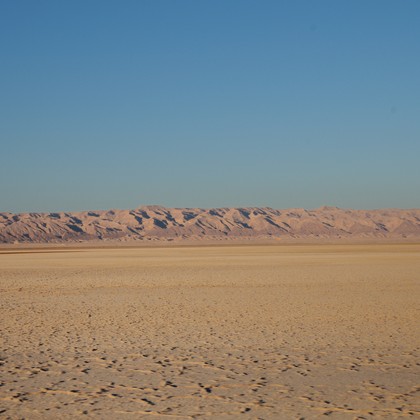
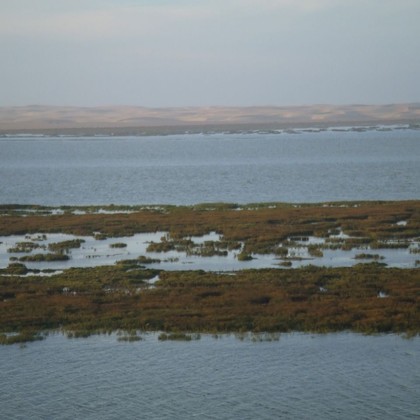
Shallow saline and brackish lagoons, saltpans, tidal flats and sebkhas, often with Greater Flamingos. Food is almost exclusively blue-green algae (Arthrospira) and diatoms, filtered from the surface layer with fine lamellae.
Where the bird is most at home, classified by the habitats of North Africa and the Middle East.
Range and movements
In Morocco a scarce but fairly regular visitor, mainly in the south (Khnifiss, Dakhla Bay) and at Merja Zerga, probably from West Africa. In Tunisia and eastern Algeria seen increasingly often since 2019, with the first breeding attempt in 2025 at Monastir; these birds probably come from East Africa. On the southern Red Sea irregular in Yemen (the Tihama and the Aden lagoons) and on the Saudi coast near Jizan, where more than a hundred birds were seen together in 2018. Rare in Egypt, Oman and the United Arab Emirates. Beyond the region in the Rift Valley lakes of East Africa, southern Africa, West Africa and in India and Pakistan.
- Resident
- Winter visitor (c. Oct–Mar)
- Passage (Mar–Apr, Oct–Nov)
- dark = core range, pale = thinly spread
How and when to look
Check every large flamingo flock systematically for dark bills, best in the southern lagoons of Morocco, the Tunisian saltpans or the coast near Jizan. Light is best early or late in the day, when birds also stand closer to the shore.
Conservation status
Near threatened. Worldwide the species breeds on a handful of lakes, so one failed breeding season affects a large part of the population. Water abstraction, soda extraction, disturbance of colonies and collisions with power lines are the main pressures. Numbers in the region are small, but the recent increase in North Africa and the breeding attempt in Tunisia make the saltpans there important.
Scientific name
Phoeniconaias minor | (Geoffroy Saint-Hilaire, 1798)
Geoffroy Saint-Hilaire described the species in 1798 as Phoenicopterus minor; because it was later moved to another genus, the author and year stand in brackets. The genus Phoeniconaias was introduced in 1869 by Gray. Phoeniconaias comes from the Greek phoinix, 'crimson', and naias, 'water nymph' — a 'crimson water nymph', for the pink colour and the bird's tie to water. minor is Latin for 'smaller', distinguishing it from the larger, more widespread flamingo. The specimen the first description was based on came from Senegal.