All species › Gamebirds › Pheasants and partridges › Gray Francolin
Gray Francolin | Ortygornis pondicerianus
Grijze frankolijn | Francolín gris
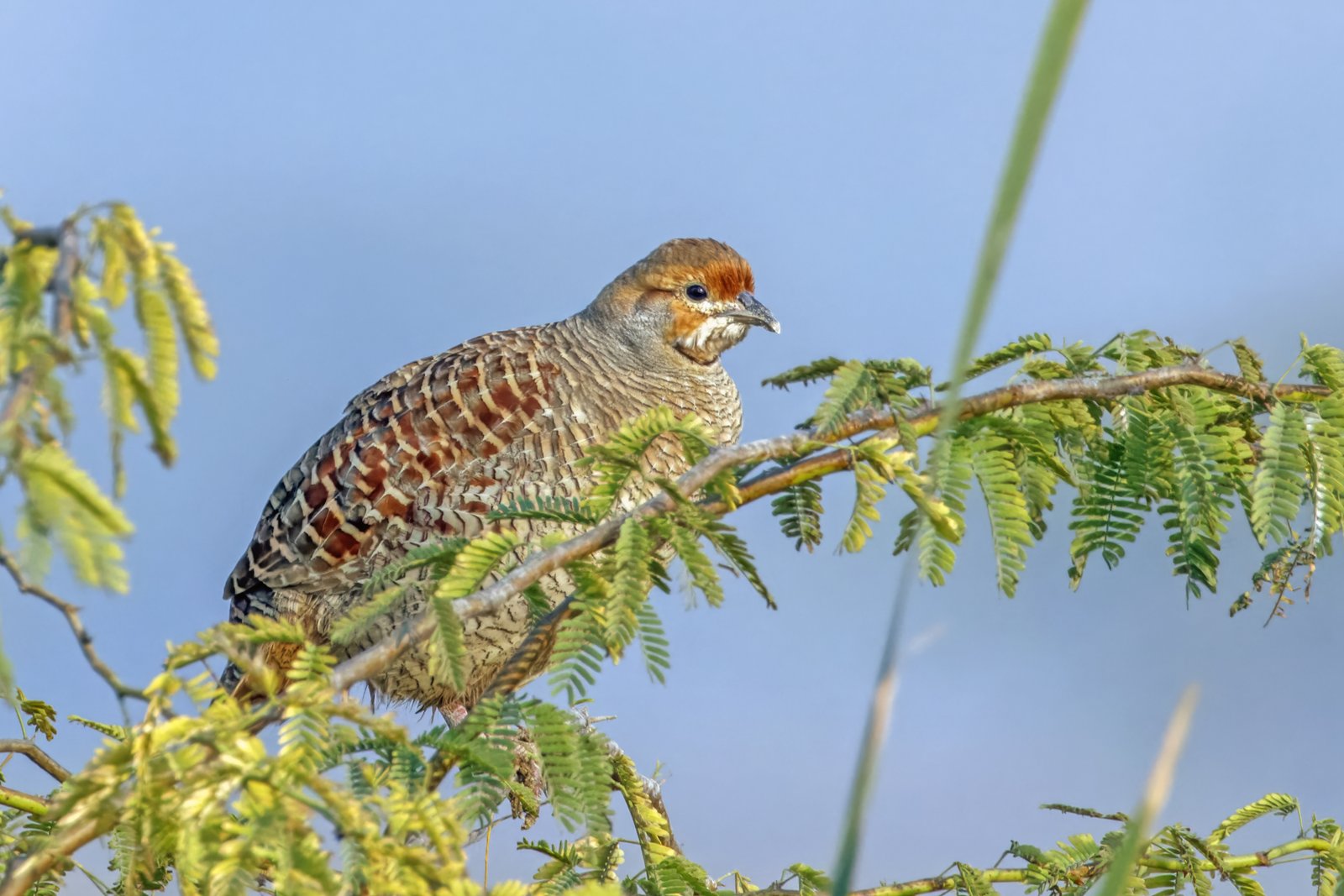
A greyish-brown, finely barred gamebird of the dry plains around the Persian Gulf that makes itself known mainly by ear: the male's loud, shrill refrain rings out at dawn over golf courses, date gardens and thorn plains from Bahrain to Oman. Being at ease in man-made landscapes, it is one of the best-known gamebirds of the Gulf states.
Voice
Very loud and distinctive: a series starting with a few grating notes and running into a repeated, shrill ka-teet-er, ka-teet-er, ka-teet-er, often answered by another male. Heard mainly just after sunrise and towards evening, from a bank, a wall or a low bush. When alarmed a sharp kirr-kirr.
Recording: David Darrell-Lambert — CC BY-NC-SA 4.0 · converted to mono · xeno-canto
Identification
About 32 cm, compact and short-tailed. The whole body is greyish brown with dense, fine cross-barring in black and cream, the upperparts marked with chestnut and cream. The throat is plain buff to creamy orange, bordered by a narrow, broken dark line; the face is warm rufous with a pale supercilium. In flight the tail shows rufous outer feathers. Bill dark, legs reddish. The male has one or two spurs on each tarsus; the female is a little smaller, duller and usually spurless. Juveniles are vaguely spotted rather than barred.
Confusion species
Black Francolin (Francolinus francolinus) is in this region mainly a bird of Iraq and the Levant and meets Gray Francolin only in southern Iraq and Kuwait. Its male is black with a white cheek patch and a chestnut collar; the female is warmer brown, more heavily spotted and has a rufous nape patch that Gray Francolin lacks. Sand Partridge (Ammoperdix heyi) and See-see Partridge (Ammoperdix griseogularis) are smaller, sandy and lack the fine all-over barring, and live on rocky slopes rather than flat land. Common Quail (Coturnix coturnix) is much smaller and streaked.
Habitat
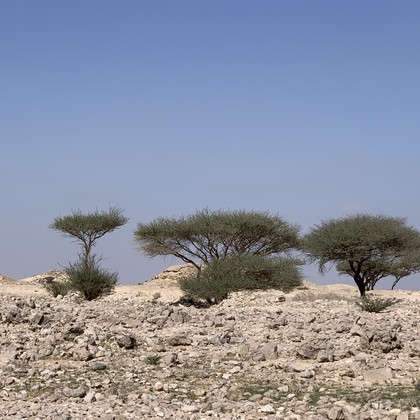
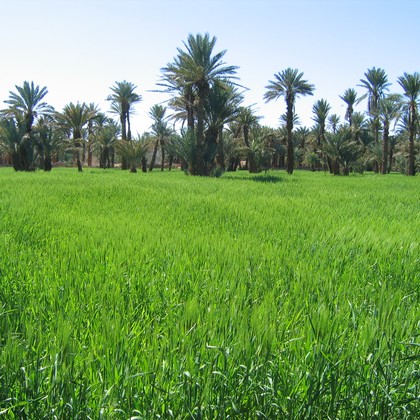
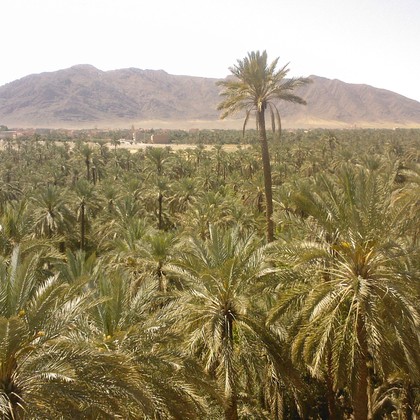
Open, dry country with scattered bushes and some cover: thorn plains with Prosopis and acacia, coastal plains, field edges and irrigated farmland, date gardens and orchards, and in the Gulf states also parks, villa gardens and golf courses. Lives in pairs or small families on the ground, prefers running to flying and roosts in a bush or low tree. Eats seeds, shoots and insects, especially termites.
Where the bird is most at home, classified by the habitats of North Africa and the Middle East.
Range and movements
Within the region in eastern Arabia: Bahrain, Qatar, the United Arab Emirates and northern Oman, extending along the coast of eastern Saudi Arabia (for example around Salwa), with a population in southern Iraq. Arabian birds are assigned to the subspecies O. p. mecranensis of the Makran coast. Whether the species is native to Arabia or was introduced by people is not well established; in the Gulf states birds have certainly been released, and numbers have risen sharply with the spread of gardens and irrigation. Beyond the region from south-eastern Iran through Pakistan and India to Sri Lanka; introduced elsewhere, including Hawaii.
- Resident
- Winter visitor (c. Oct–Mar)
- dark = core range, pale = thinly spread
How and when to look
In Dubai, Abu Dhabi or on Bahrain, visit a large park, a golf course or the edges of farmland just after sunrise: listen for the call, then scan the banks and grassy edges. In town the birds are often surprisingly tame and walk calmly across lawns; in open country they run into the bushes when approached.
Conservation status
Not threatened and common over a large range. In the Gulf states it is increasing thanks to planting and irrigation. Hunting and trapping for the cage-bird trade and for cock-fighting matter locally but do not threaten the species.
Scientific name
Ortygornis pondicerianus | (Gmelin, 1789)
Gmelin described the species in 1789 as Tetrao pondicerianus; because it was later moved to another genus, the author and year stand in brackets. The genus Ortygornis was introduced in 1853 by Reichenbach. Ortygornis comes from the Greek ortux, 'quail', and ornis, 'bird' — 'quail-bird'. pondicerianus means 'of Pondicherry' (Puducherry), India. The specimen the first description was based on came from Puducherry, India.