All species › Passerines › Nuthatches › Eurasian Nuthatch
Eurasian Nuthatch | Sitta europaea
Boomklever | Trepador azul
In the region the Eurasian Nuthatch is a bird of the cool mountain forests: the cedar and oak forests of the Atlas and Rif in the Maghreb, and the oak forests of Kurdistan in northern Iraq. It is entirely absent from the desert and the lowlands, and as a true resident it does not migrate anywhere. Loud, inquisitive and the only bird in those forests that climbs head-first down a trunk.
Voice
Loud, clear and far-carrying. The usual call is a strong, often doubled tweet-tweet, accelerating into a rattling series when excited; in alarm a shrill tsirrrr. The song, mainly January to April, consists of series of clear whistles, slow pyoo-pyoo-pyoo or fast and trilling wiwiwiwiwi.
Recording: Beatrix Saadi-Varchmin — CC BY-NC-SA 4.0 · converted to mono · xeno-canto
Identification
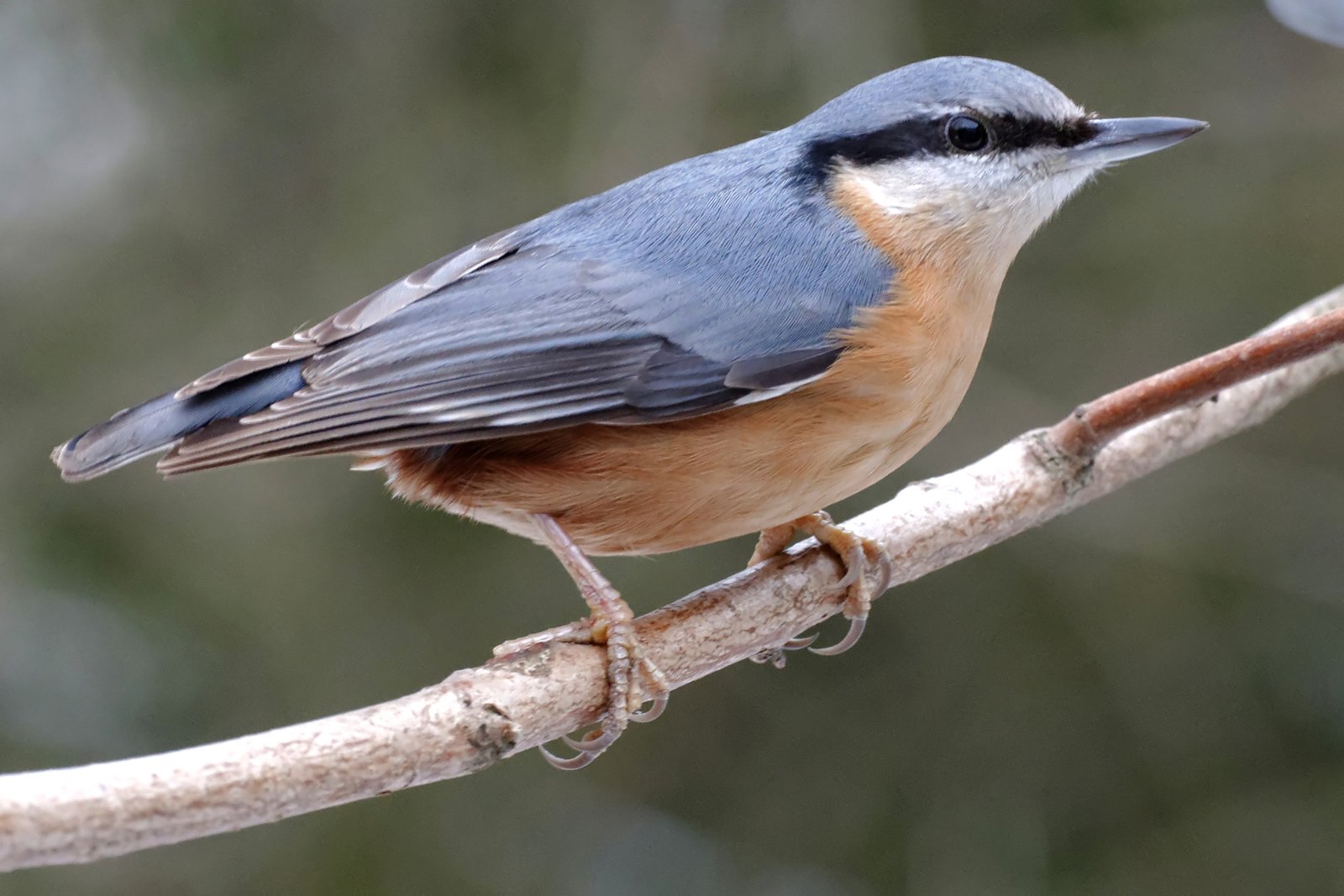
12–14.5 cm. Compact, with a large head, short tail and straight, pointed bill. Upperparts blue-grey, with a black eyestripe from bill to side of neck; throat and cheeks white. The North African form hispaniensis is pale ochre-buff below with rufous flanks and undertail-coverts, darkest in the male; the form persica in northern Iraq is much whiter below, with rufous only on flanks and undertail. The tail has white spots on the outer feathers, visible when spread.
Confusion species
Algerian Nuthatch (Sitta ledanti) is smaller, has a black forecrown with a broad white supercilium and lacks rufous flanks; it lives in Lesser Kabylia, beyond the range of Eurasian Nuthatch. Western Rock Nuthatch (Sitta neumayer) and Eastern Rock Nuthatch (Sitta tephronota) are paler grey, lack white tail spots and live on rocks, although forest and rock meet in northern Iraq. Short-toed Treecreeper (Certhia brachydactyla) is brown and streaked, climbs only upward using its tail as a prop and has a decurved bill.
Habitat
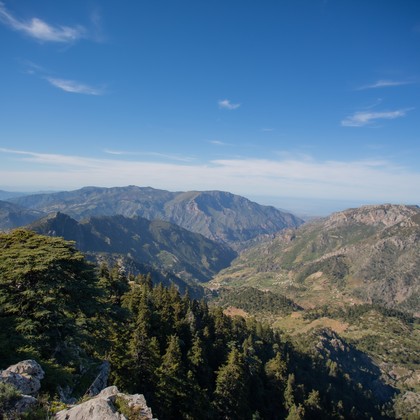
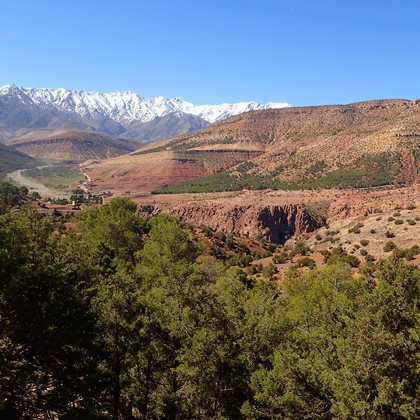
Mature broadleaved and mixed forest with old trees: in the Maghreb cedar, oak and cork oak forest, also with Atlas fir and pine, up to about 2,400 m in the High Atlas; in northern Iraq the oak forests of the Kurdish uplands. Locally in large old parks and orchards within forest. Eats insects and spiders, and in winter nuts, acorns and seeds, which it wedges into bark crevices to hack open. Nests in a tree hole whose entrance it reduces with mud.
Where the bird is most at home, classified by the habitats of North Africa and the Middle East.
Range and movements
In North Africa the form hispaniensis: in Morocco in the Rif, Middle Atlas, High Atlas and the forests of the northern interior (including Tazekka and the Maâmora forest), in northern Algeria in the forests of the Tell Atlas, and in northern Tunisia in the Kroumirie and Mogods. In the Middle East only the form persica in the oak forests of Kurdistan in northern Iraq, adjoining the Zagros in Iran; occurrence in the far north of Syria is possible but poorly documented. Absent from Libya, Egypt, Arabia and the southern Levant. Beyond the region from Europe and Turkey across the whole temperate zone of Asia to Japan.
- Resident
- Summer visitor (c. Apr–Sep)
- Winter visitor (c. Oct–Mar)
- Passage (Mar–Apr, Oct–Nov)
- dark = core range, pale = thinly spread
How and when to look
In the cedar forests around Ifrane and Azrou in the Middle Atlas the Eurasian Nuthatch is one of the loudest birds; the picnic sites at the 'Cèdre Gouraud' are a classic spot, where it can be seen together with African Blue Tit and Levaillant's Woodpecker. In Tunisia in the cork oak forests around Aïn Draham.
Conservation status
Not globally threatened. In North Africa tied to forest with old trees, and therefore sensitive to logging, forest fires and overgrazing that thin out the Atlas cedar forests; numbers in Morocco have declined locally but the species is still widespread there. Little is known about the Iraqi birds.
Scientific name
Sitta europaea | Linnaeus, 1758
Linnaeus described the species in 1758 and placed it straight away in the genus where it still stands. He introduced the genus Sitta in that same work. Sitta is the Ancient Greek name sittē for the nuthatch. europaea is Latin for 'European', after the wide range across the continent. The specimen the first description was based on came from Sweden.