All species › Passerines › Wallcreepers › Wallcreeper
Wallcreeper | Tichodroma muraria
Rotskruiper | Treparriscos
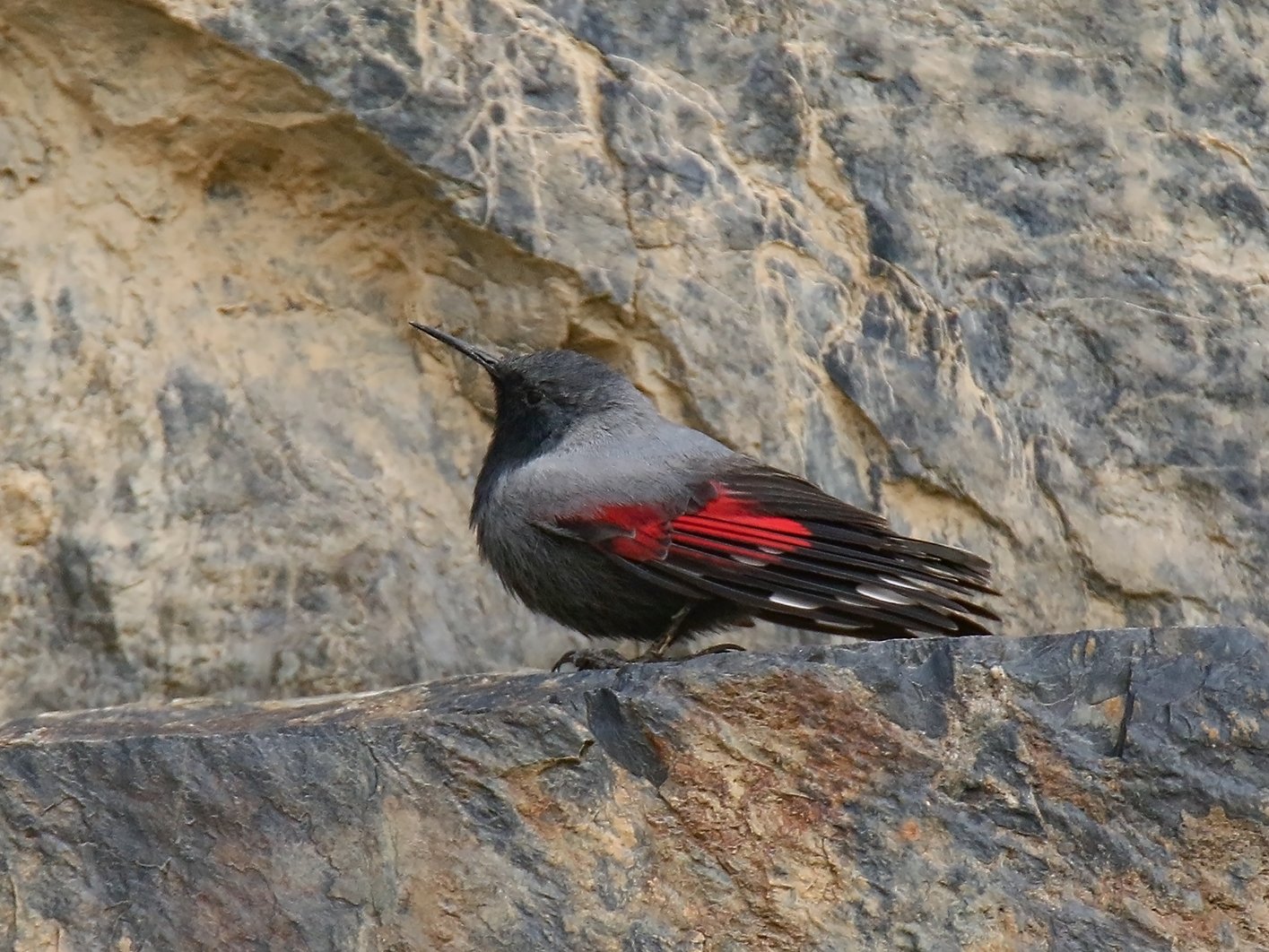
The Wallcreeper is one of the most sought-after birds of the Palearctic mountains: a grey rock bird with crimson wings that flutters like a butterfly over cliffs. In the region it is mainly a winter visitor to the cliffs and gorges of the Levant, with a small breeding population in the high mountains of Iraqi Kurdistan.
Voice
Rather silent in winter. The call is a thin, high tsee or tweee. The song consists of drawn-out, high, rising whistles, too-tee-tooooo-tseeu, with a characteristic final upward flourish.
Recording: Magnus Hellström — CC BY-NC-SA 4.0 · converted to mono · xeno-canto
Identification
15.5–17 cm. Compact, with a short tail, broad rounded wings and a long, thin, decurved bill. Upperparts ash-grey; the wings are black with a broad crimson band across the coverts and the bases of the flight feathers and with two rows of white spots on the primaries. In winter throat and breast are whitish grey; in breeding plumage the male has a black throat and breast, the female a smaller dark throat patch or a pale throat. Climbs rock faces in jerky hops, constantly flicking the wings open; flight fluttering and butterfly-like.
Confusion species
There is little to confuse it with. Western Rock Nuthatch (Sitta neumayer) and Eastern Rock Nuthatch (Sitta tephronota) share the cliffs but are blue-grey and white, with a straight bill and no red in the wing. A fleeting butterfly-like bird against a rock face may first suggest a Eurasian Hoopoe (Upupa epops), but that has black-and-white wings and a crest.
Habitat
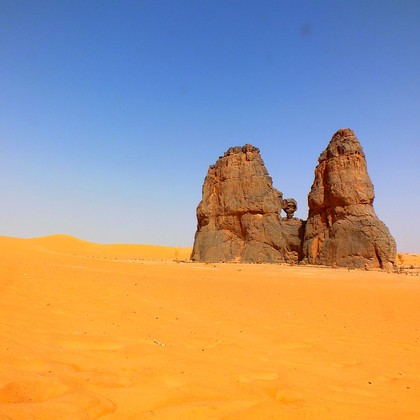
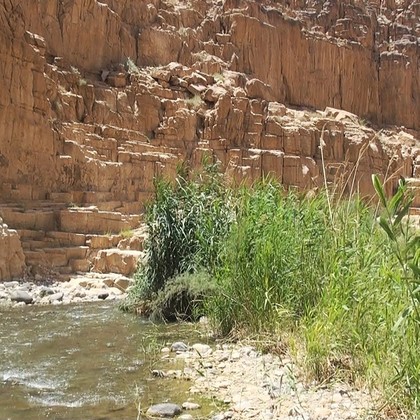
In the breeding season sheer rock faces and gorges in high mountains, often near water, from about 1500 m. In winter lower: cliffs, gorges, quarries, ruins and sometimes buildings, down to sea level and even below it along the Dead Sea. Searches crevices for insects and spiders.
Where the bird is most at home, classified by the habitats of North Africa and the Middle East.
Range and movements
Breeds in small numbers in the high mountains of Iraqi Kurdistan, on the edge of the Zagros and Taurus ranges. In winter a scarce but regular visitor to Israel and the West Bank, with regular sites on Mount Hermon, the Arbel cliffs and Nahal Amud in Galilee, the gorges of the Judean Desert (such as Wadi Qelt) and the cliffs at Ein Gedi and the Dead Sea; also in Lebanon and western Syria, rare in Jordan. In Morocco a rare vagrant. Beyond the region the species breeds from the Pyrenees and the Alps through the Balkans, Turkey, the Caucasus and Iran to the Himalaya and western China.
- Resident
- Summer visitor (c. Apr–Sep)
- Winter visitor (c. Oct–Mar)
- Passage (Mar–Apr, Oct–Nov)
- dark = core range, pale = thinly spread
How and when to look
The Arbel cliffs above the Sea of Galilee and the rock faces at Ein Gedi are the classic winter sites in Israel; birds often stay on the same cliff for weeks. Scan a cliff slowly with binoculars and watch for the red flash of the wings.
Conservation status
Not globally threatened. As a breeder of inaccessible rock faces it faces few threats; in the region it is scarce, and the number of winter visitors varies from year to year.
Scientific name
Tichodroma muraria | (Linnaeus, 1766)
Linnaeus described the species in 1766 as Certhia muraria; because it was later moved to another genus, the author and year stand in brackets. The genus Tichodroma was introduced in 1811 by Illiger. Tichodroma is Greek, from teikhos 'wall' and dromos 'runner', after the bird that climbs up rock faces. muraria is Medieval Latin for 'of walls', from Latin murus 'wall'. The specimen the first description was based on came from southern Europe.