All species › Passerines › Nuthatches › Algerian Nuthatch
Algerian Nuthatch | Sitta ledanti
Algerijnse boomklever | Trepador de Kabilia
The Algerian Nuthatch is the only bird species found solely in Algeria, and one of the most recent discoveries among the birds of Europe and North Africa: it was found by Jean-Paul Ledant on Djebel Babor in Lesser Kabylia in 1975 and described a year later. A small, quiet nuthatch of cool mountain forests of cedar, fir and oak, with a tiny and fragmented range.
Voice
Nasal and repetitive. The usual call is a series of short, tinny notes, wit-wit-wit, and a drawn-out, plaintive tchaay, the most distinctive sound. The song is a rapid series of five to ten identical nasal notes, dju-dju-dju-dju, in spring the best way to find the species.
Recording: Karim Haddad — CC BY-NC-SA 4.0 · converted to mono · xeno-canto
Identification
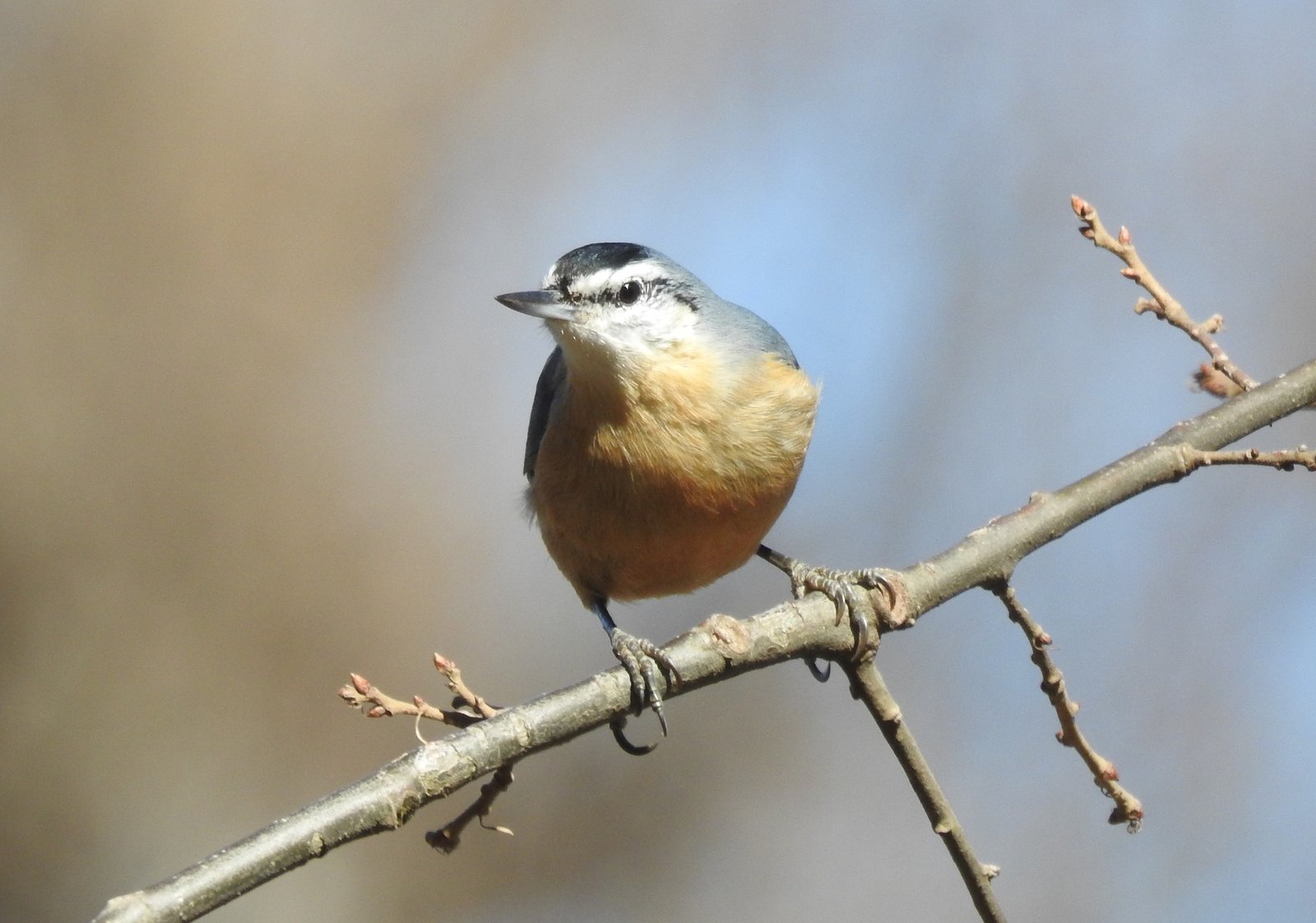
11.5–12.5 cm. Small and compact, with a fairly short tail and a straight, pointed bill. Upperparts blue-grey; underparts warm pinkish buff, warmest in the male. The male has a black forecrown contrasting sharply with a broad white supercilium and a black eyestripe; in the female the forecrown is grey and the eyestripe duller. Chin and throat whitish. Like every nuthatch it also climbs head-first down trunks.
Confusion species
In its own forests there is no second nuthatch: Eurasian Nuthatch (Sitta europaea) does not reach Lesser Kabylia, is larger, lacks the black cap and white supercilium and has rufous flanks. Krüper's Nuthatch (Sitta krueperi) of Turkey and Lesbos is very similar but has a rufous breast patch; it does not occur in the region. Short-toed Treecreeper (Certhia brachydactyla) shares the forest but is brown and streaked, climbs only upward using its stiff tail and has a thin decurved bill. Coal Tit (Periparus ater) and African Blue Tit (Cyanistes teneriffae) are just as small but do not climb on bark.
Habitat
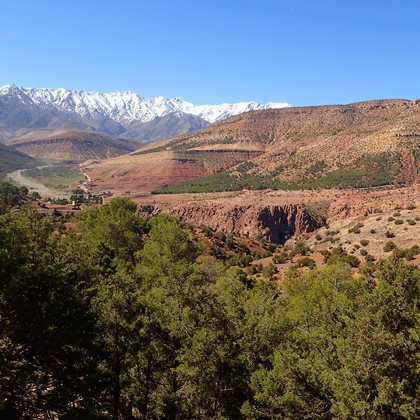
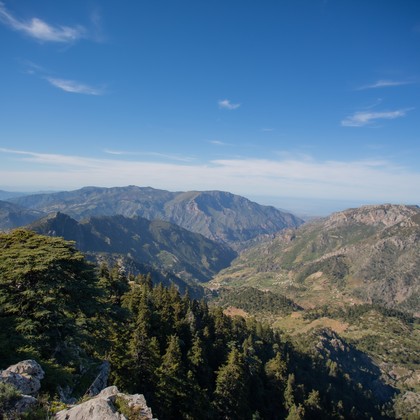
Cool, humid mountain forest between about 350 and 2,000 m: on Djebel Babor mixed forest of Atlas Cedar, Algerian Fir (Abies numidica) and oak; in the lower forests of Guerrouch, Tamentout and Djimla mainly Algerian and Afares Oak (Quercus canariensis, Q. afares) and Cork Oak. Searches trunks and branches for insects and spiders and caches seeds in autumn (mainly of cedar and fir). Nests in a tree hole, often an old woodpecker hole.
Where the bird is most at home, classified by the habitats of North Africa and the Middle East.
Range and movements
Only in north-eastern Algeria, in the mountains of Lesser Kabylia (the Babors) in the provinces of Béjaïa, Jijel and Sétif. Known from Djebel Babor (1975), the Guerrouch forest in and around Taza National Park (1989), and the Tamentout and Djimla forests (1990); in 2018 a fifth site was found in the Ghabet Ezzen forest between Chahna and Oudjana (Jijel), some 10 km north of Djimla. Found nowhere else in the world.
- Resident
- Summer visitor (c. Apr–Sep)
- dark = core range, pale = thinly spread
How and when to look
The Guerrouch forest in Taza National Park, near Jijel, is the most accessible site and holds the largest population; in April and May listen early in the morning for the song and the nasal tchaay in the crowns of old oaks. Djebel Babor itself is higher and rougher, with cedar and fir on the summit.
Conservation status
Endangered. The world population is estimated at no more than a few thousand birds, spread over a handful of isolated forests, and is declining. Threats are forest fires, logging, overgrazing by livestock that eat the regeneration of cedar and fir, and in the longer term warming that shrinks the cool mountain forests. Only part of the habitat is protected, including in Taza National Park.
Scientific name
Sitta ledanti | Vielliard, 1976
Vielliard described the species in 1976 and placed it straight away in the genus where it still stands. The genus Sitta was introduced in 1758 by Linnaeus. Sitta is the Ancient Greek name sittē for the nuthatch. ledanti honours the Belgian naturalist Jean-Paul Ledant, who found the bird in Kabylia in October 1975 and called it la Sittelle kabyle. The specimen the first description was based on came from Djebel Babor, Algeria.