All species › Birds of prey › Hawks, eagles and kites › Dark Chanting Goshawk
Dark Chanting Goshawk | Melierax metabates
Donkere zanghavik | Azor lagartijero oscuro
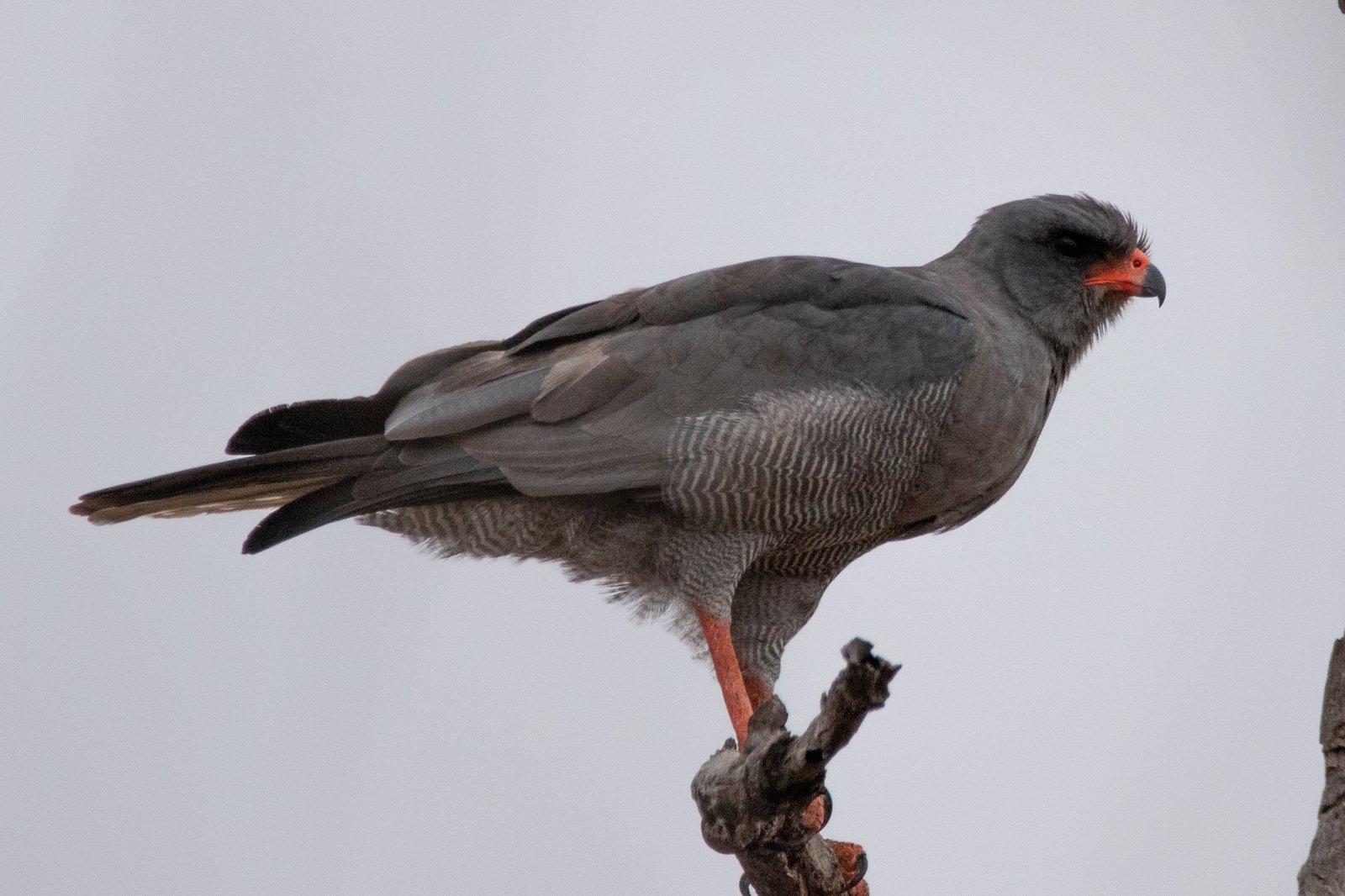
The Dark Chanting Goshawk is a medium-sized, grey raptor with long red legs, which sits upright on a pole or treetop and owes its name to its whistled, singing call. In the region the form ignoscens lives in south-western Arabia; the Moroccan form theresae has not been seen since 2007 and is thought to be extinct.
Voice
Mainly in the breeding season an accelerating series of whistled, melodious notes, klee-u klee-u kloo-kloo-kloo-kloo, from a perch or in flight; also a high peee-u.
Recording: Robert Davis — CC BY-NC-SA 4.0 · converted to mono · xeno-canto
Identification
43–51 cm, wingspan 95–110 cm. The adult has a slate-grey head, breast and upperparts, a finely grey-and-white barred belly and a finely grey-barred rump. The cere and long legs are orange-red, the eye dark. In flight the black primaries contrast with the grey arm and upperwing coverts; the long, rounded tail is blackish with a white tip and white bars on the outer feathers. Females average larger than males. The juvenile is brown with a streaked breast, a rufous-barred belly, a barred tail and yellowish legs.
Confusion species
Gabar Goshawk (Micronisus gabar) has the same colours, but is much smaller, with a bright white rump. Male Pallid Harrier (Circus macrourus) is also grey with black wingtips, but slim and long-winged, with pale underparts, and hunts in a low glide. Young birds can resemble a young Long-legged Buzzard (Buteo rufinus), but that has shorter legs and a pale, unbarred tail.
Habitat
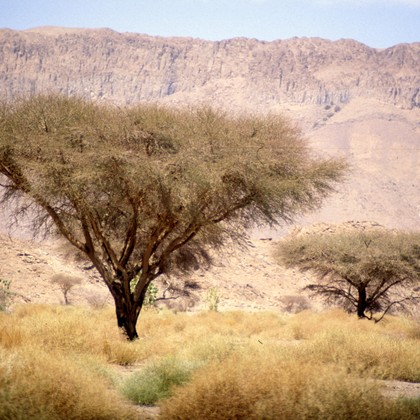
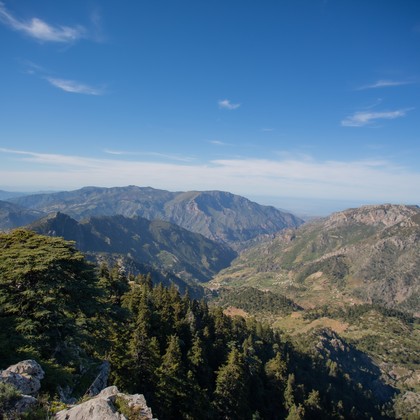
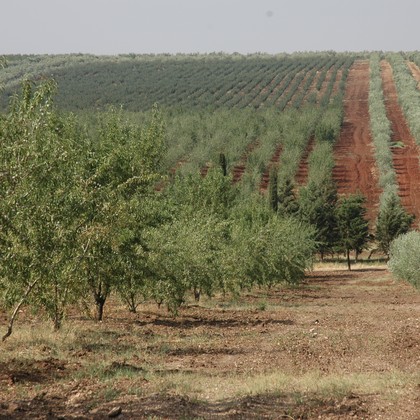
Open woodland and savanna with scattered trees, in Arabia acacia woodland, wooded wadis and the foothills of the escarpment with fields and orchards; in Morocco argan woodland and old olive groves. Sits upright on a lookout for long periods and drops onto lizards, rodents, large insects and small birds on the ground.
Where the bird is most at home, classified by the habitats of North Africa and the Middle East.
Range and movements
In Arabia a fairly scarce resident in western Yemen and south-western Saudi Arabia, in the Tihama, the foothills of the Asir mountains and the wooded wadis. In Morocco the form theresae was confined to the argan woodland of the Souss Valley and the nearby foothills of the Anti-Atlas; in the 1980s a few dozen pairs remained. The last proven breeding was in 1979 in an old olive grove; an immature in 1999 points to breeding around the turn of the century, and after that adults were seen in the Souss only in 2000, 2006 and 2007. Despite years of searching the form has not been found since. Beyond the region widespread in sub-Saharan Africa.
- Resident
- Summer visitor (c. Apr–Sep)
- Winter visitor (c. Oct–Mar)
- Passage (Mar–Apr, Oct–Nov)
- dark = core range, pale = thinly spread
How and when to look
In the Tihama and the foothills of the Asir mountains look for a grey raptor sitting upright on a treetop or telegraph pole. Any record from the Souss in Morocco is extremely important and deserves good documentation with photographs.
Conservation status
Not threatened and widespread in Africa. The Moroccan form has probably been lost through changing land use, clearance of argan woodland and hunting. The isolated Arabian population is vulnerable to woodland clearance in the Tihama and the foothills.
Scientific name
Melierax metabates | Heuglin, 1861
Heuglin described the species in 1861 and placed it straight away in the genus where it still stands. The genus Melierax was introduced in 1840 by Gray. Melierax comes from the Greek melos, 'song', and hierax, 'hawk' — for the melodious, piping calls of chanting goshawks in the breeding season. metabates comes from the Greek metabatēs, 'leaper, vaulter', from meta, 'change', and batēs, 'treader' (from bainō, 'to walk'). The specimen the first description was based on came from the White Nile between 6° and 7° N, South Sudan.