All species › Birds of prey › Hawks, eagles and kites › Shikra
Shikra | Tachyspiza badia
Shikra | Gavilán chikra
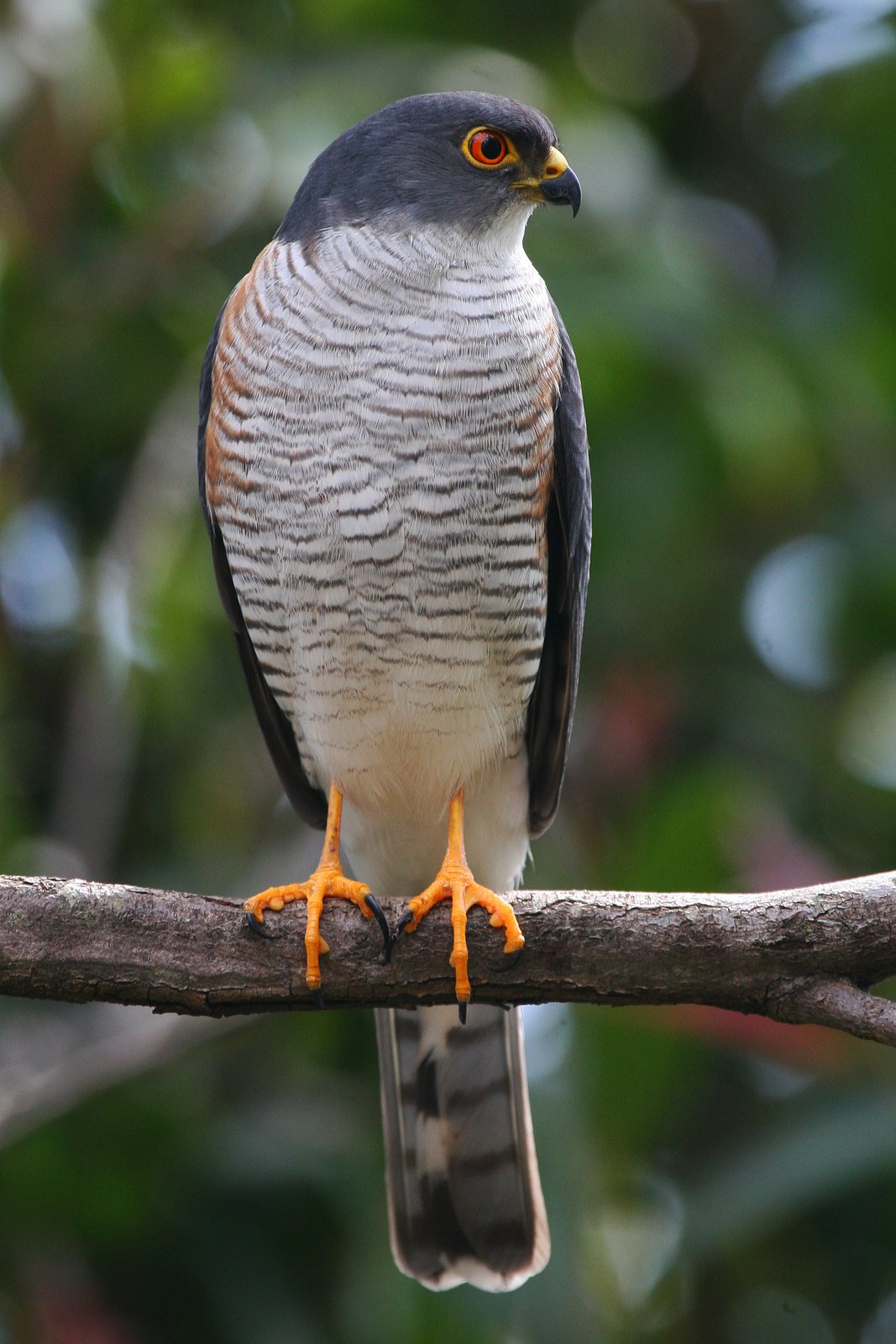
The Shikra is a small, pale hawk of open woodland, acacia savanna and oases, which takes lizards, large insects and small birds from a sheltered lookout. Two forms occur in the region: the African race sphenurus is a scarce resident in southwest Arabia, the Asian race cenchroides a scarce passage migrant and winter visitor in eastern Arabia and Kuwait.
Voice
Fairly vocal around the territory, with a high, double kee-wik and a fast series keek-keek-keek, sharper and higher than that of Eurasian Sparrowhawk. Migrants and wintering birds are usually silent.
Recording: isaac kilusu — CC BY-NC-SA 4.0 · converted to mono · xeno-canto
Identification
30–36 cm, wingspan 58–70 cm. A small, compact hawk with fairly short, rounded wings and a medium-length tail. The adult male is pale blue-grey above, with a grey cheek without a supercilium, a white throat with a faint dark mesial stripe and fine rufous-orange barring on breast and flanks; the eye is red-orange. In flight the white underwing stands out, with only dark tips to the outer primaries. The central tail feathers are plain grey, the outer ones carry narrow dark bars. The female is slightly larger and browner grey above, with a yellow to orange eye. The juvenile is brown above and has teardrop-shaped brown streaks on the white underparts and a clear dark throat stripe. The Asian race is paler and greyer than the African one.
Confusion species
Levant Sparrowhawk (Tachyspiza brevipes) is very similar and migrates through the same area; it is slightly larger and longer-winged, with a more pointed hand and sharply black wingtips, and the male is darker slate-grey above with a dark eye. Eurasian Sparrowhawk (Accipiter nisus) has a clear white supercilium, a tail barred across its full width and, in the male, orange cheeks. Gabar Goshawk (Micronisus gabar) in southwest Arabia has a white rump, red legs and a finely barred grey breast. In flight Common Cuckoo (Cuculus canorus) can resemble a Shikra, but has pointed wings and a small head.
Habitat
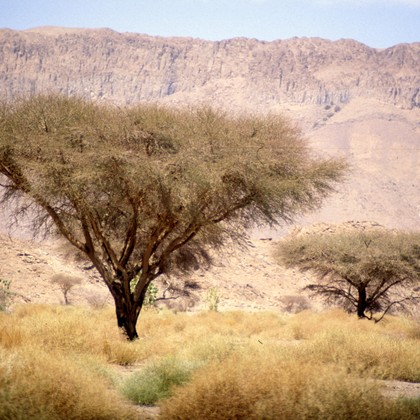
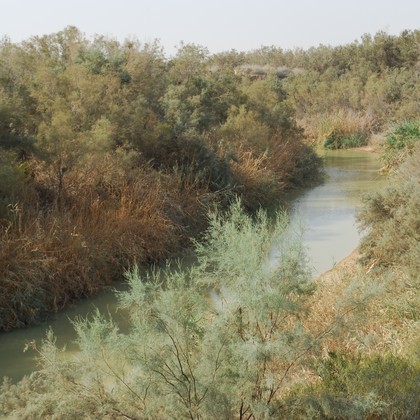
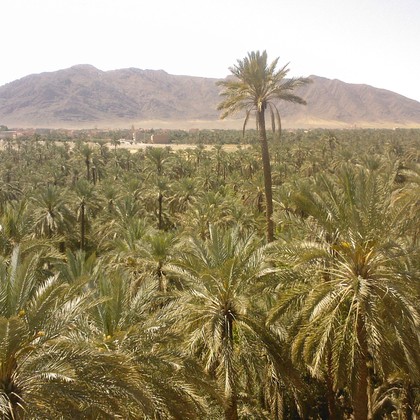
In southwest Arabia in acacia savanna, wooded wadis and riverine woodland in the Tihama and the lower slopes of the Asir mountains, also in orchards and around villages. On passage and in winter in oases, farms with trees, parks and gardens. Hunts from a hidden perch in a tree for lizards, large insects, small birds and rodents, which it usually takes on the ground.
Where the bird is most at home, classified by the habitats of North Africa and the Middle East.
Range and movements
The African race sphenurus is a scarce resident in western Yemen and southwest Saudi Arabia, in the Tihama and the foothills of the Asir mountains. The Asian race cenchroides is a scarce passage migrant and winter visitor in Kuwait (for example at Al-Abraq, mainly in October and early November, with a few birds staying until April or May), eastern Saudi Arabia, the United Arab Emirates and Oman. In Iraq the species was first confirmed during fieldwork in 2015–2020 at Ad-Daghara in Al-Qadisiyah province. Beyond the region widespread in sub-Saharan Africa, and from Iran and Central Asia to India and Southeast Asia.
- Resident
- Summer visitor (c. Apr–Sep)
- Winter visitor (c. Oct–Mar)
- dark = core range, pale = thinly spread
How and when to look
In southwest Arabia the Shikra often sits quietly in an acacia along a wadi; look for a small, pale hawk dropping low to the ground. In Kuwait and eastern Arabia the oases and farms with trees in October are the best places. An adult male is paler and plainer than a Eurasian Sparrowhawk, without a supercilium.
Conservation status
Not threatened; a common raptor over much of Africa and Asia. The small Arabian population is little studied and vulnerable to the felling of acacia woodland and the spread of farming and building in the Tihama.
Scientific name
Tachyspiza badia | (Gmelin, 1788)
Gmelin described the species in 1788 as Falco badius; because it was later moved to another genus, the author and year stand in brackets. The genus Tachyspiza was introduced in 1844 by Kaup. Tachyspiza is Greek, from takhus 'fast' and spizias 'hawk'. badia comes from the Latin badius, 'chestnut-brown' — for the rufous-barred underparts. The specimen the first description was based on came from Sri Lanka.