All species › Waterfowl › Ducks, geese and swans › Common Shelduck
Common Shelduck | Tadorna tadorna
Bergeend | Tarro blanco
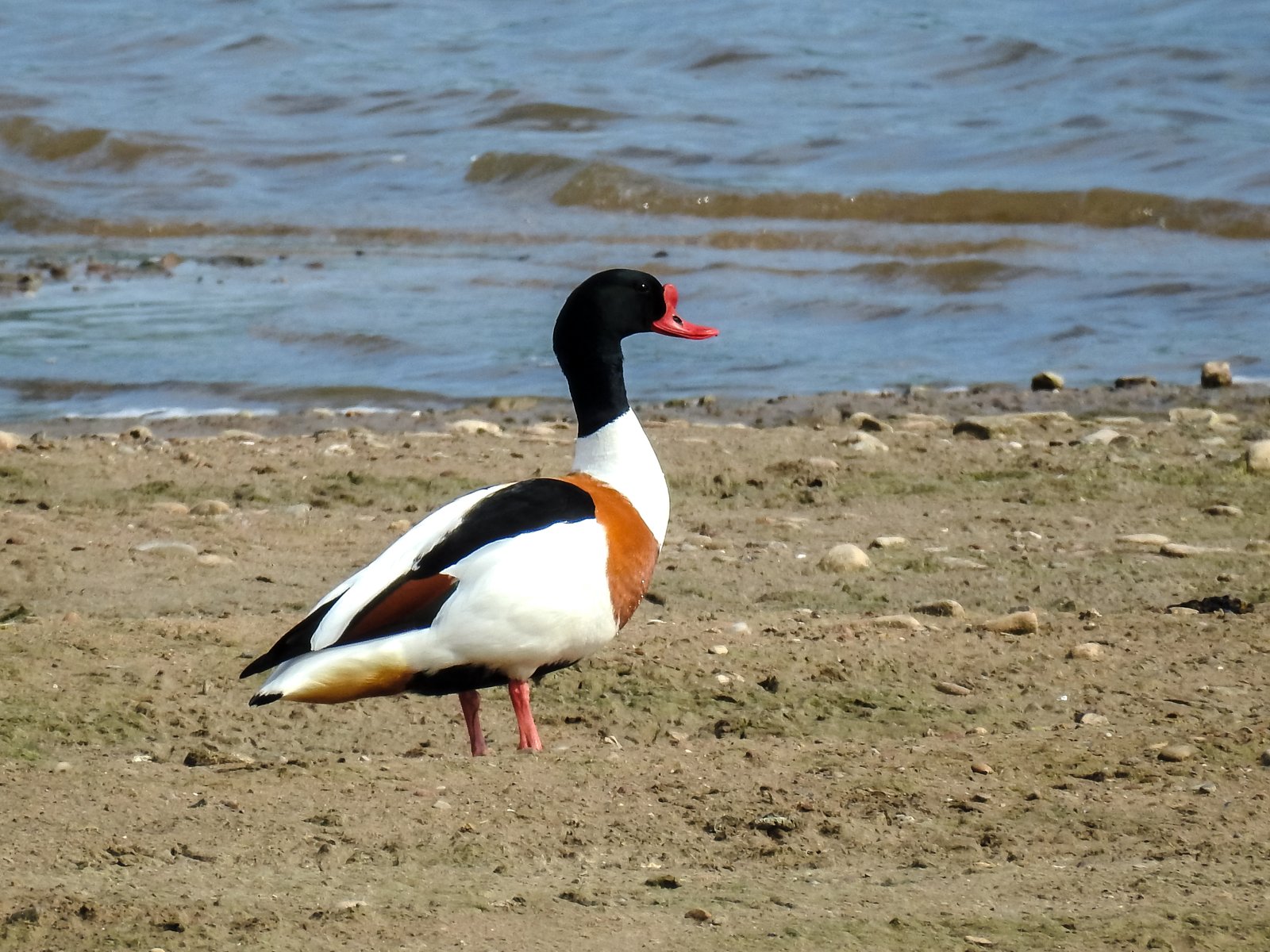
The Common Shelduck is a large, goose-like duck of salt and brackish waters, in a bright pied plumage of white, green-black and chestnut. Within the region it is chiefly a winter visitor to lagoons, saltpans and sebkhas, with large numbers in Tunisia.
Voice
The male gives a high, whistling shwee-shwee-shwee, especially in display; the female a nasal, rapid cackling ga-ga-ga-ga-ga and a lower aahk.
Recording: Jarek Matusiak — CC BY-NC-SA 4.0 · converted to mono · xeno-canto
Identification
About 62 cm, white with a green-black head and neck, a broad chestnut band across the breast, black scapulars and a dark stripe down the centre of the belly. The bill is bright red and the legs pink. In the breeding season the male has a conspicuous red knob at the base of the bill; the female is slightly smaller and duller, with white spots at the bill base and a narrower breast band. Juveniles are grey-brown and white, without a breast band, with a white foreneck and a flesh-coloured bill. In flight white with black primaries and green-glossed secondaries.
Confusion species
Virtually unmistakable. A male Northern Shoveler (Spatula clypeata) also shows a green head, white breast and chestnut, but is much smaller, with the chestnut on the flanks and a broad dark bill. Juvenile shelducks can suggest a small goose in flight, but the black-and-white wing pattern is clearly that of a duck.
Habitat
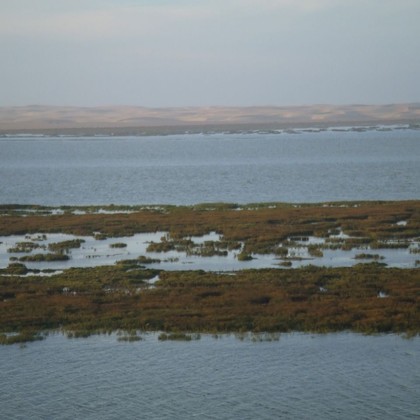
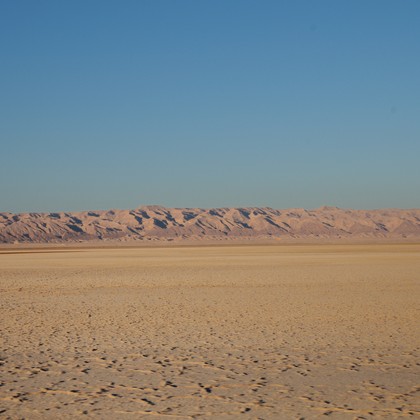
Salt and brackish waters with muddy margins: lagoons, tidal flats, saltpans, sebkhas and chotts, also fishponds and settling pools. It sweeps its bill from side to side to filter small snails (especially mudsnails), small crustaceans and other small bottom life from the mud. It nests in burrows, such as rabbit holes, or under dense bushes.
Where the bird is most at home, classified by the habitats of North Africa and the Middle East.
Range and movements
Breeds in small numbers in Tunisia and Algeria, at salt lakes and lagoons on the coast and on the high plateaus; only sporadically in Morocco. A numerous winter visitor to Tunisia, especially around the Lake of Tunis and the Gulf of Gabès; further wintering along the coasts of Algeria and Libya, in the Nile Delta and on Lake Bardawil in Egypt, in Israel and in Iraq, and more scarcely on the Persian Gulf in Kuwait, Bahrain, Qatar, eastern Saudi Arabia and the United Arab Emirates; a vagrant further south in Arabia. Beyond the region it breeds along the coasts of north-west Europe and in Central Asia, wintering to the Mediterranean and south-east Asia.
- Resident
- Summer visitor (c. Apr–Sep)
- Winter visitor (c. Oct–Mar)
- Passage (Mar–Apr, Oct–Nov)
- dark = core range, pale = thinly spread
How and when to look
In winter on the Lake of Tunis or the Sfax saltpans, where flocks of hundreds feed on the mud. At low tide the species is also easy to see with a telescope on the Gulf of Gabès. The white plumage shows up from a great distance.
Conservation status
Not threatened and stable or increasing over much of its range. Sensitive to the loss and disturbance of lagoons and saltpans, and to oil pollution along the coast.
Scientific name
Tadorna tadorna | (Linnaeus, 1758)
Linnaeus described the species in 1758 as Anas Tadorna; because it was later moved to another genus, the author and year stand in brackets. The genus Tadorna was introduced in 1822 by Boie. Tadorna comes through French tadorne from an older, probably Celtic name for a pied waterfowl. The specific name repeats the genus name. The specimen the first description was based on came from Sweden.