All species › Birds of prey › Hawks, eagles and kites › Cinereous Vulture
Cinereous Vulture | Aegypius monachus
Monniksgier | Buitre negro
The Cinereous Vulture is the largest raptor in the region and one of the heaviest flying birds in the world: a blackish-brown giant with broad, straight wings. In North Africa and the Middle East it is only a scarce winter visitor and wanderer, but young birds from the recovering Spanish population increasingly cross the Strait of Gibraltar.
Voice
Almost silent; at carcasses rasping and hissing, and a hoarse, gurgling croak in squabbles.
Recording: Thomas SIGNEAU — CC BY-SA 4.0 · converted to mono · xeno-canto
Identification
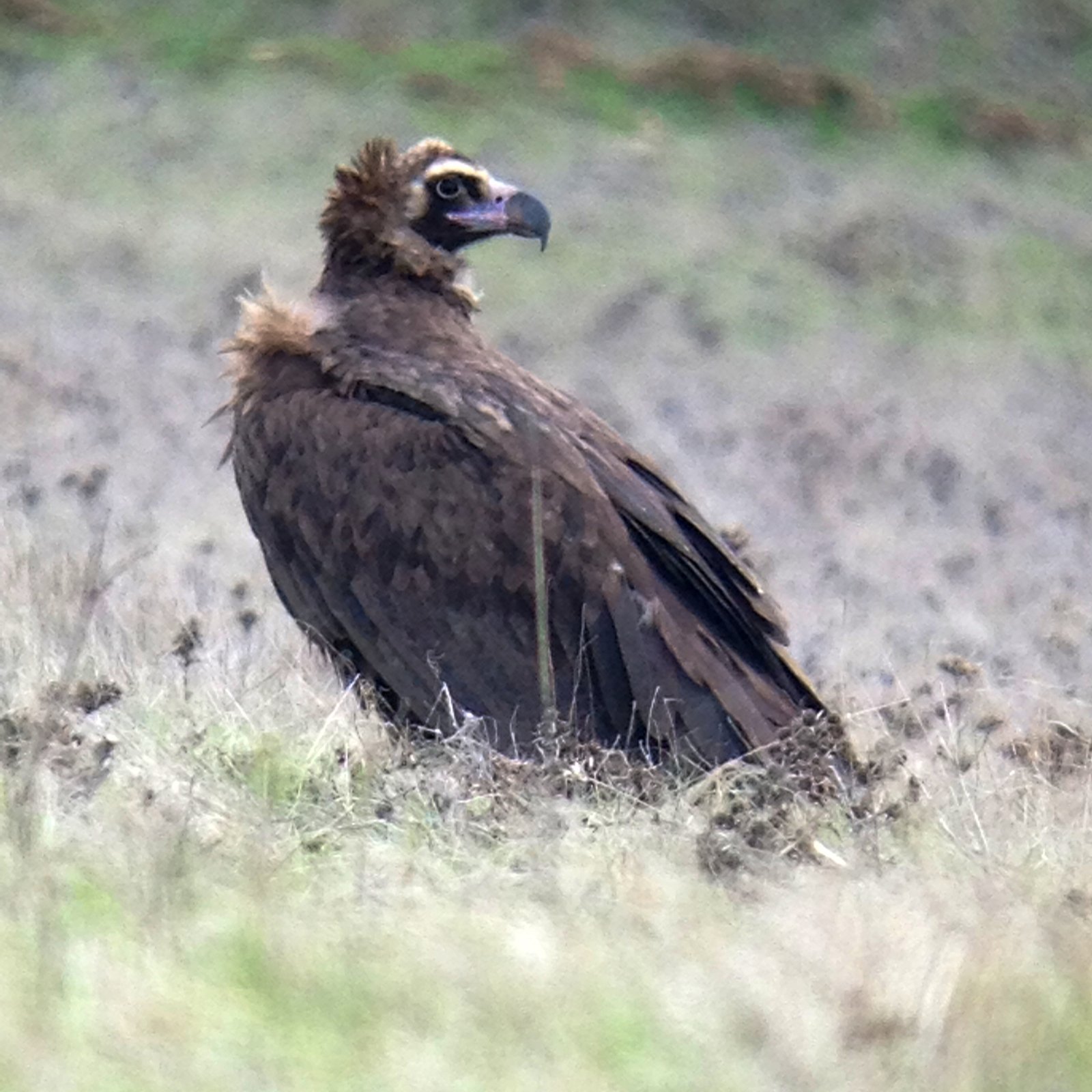
100–115 cm, wingspan 250–295 cm. Uniformly blackish-brown with a bare, bluish-grey to pink head with a dark mask around eye and bill, and a dark brown, woolly neck ruff. The bill is massive, with a bluish to pink cere. In flight a plank: long, broad, straight-edged wings with seven deeply spread fingers, held flat or with slightly drooping hands, and a short, slightly wedge-shaped tail. The juvenile is more evenly black, with a darker head and a pink cere.
Confusion species
Griffon Vulture (Gyps fulvus) is sandy brown with dark flight feathers and holds its wings in a shallow V. Lappet-faced Vulture (Torgos tracheliotos) is just as large, but has a bare, pink to red head with skin folds, white thighs and a narrow white band along the leading edge of the underwing. A dark young Rueppell's Griffon (Gyps rueppelli) has a long, downy neck and pale bands on the underwing. Golden Eagle (Aquila chrysaetos) is much smaller, with a longer tail and a clearly protruding head.
Habitat
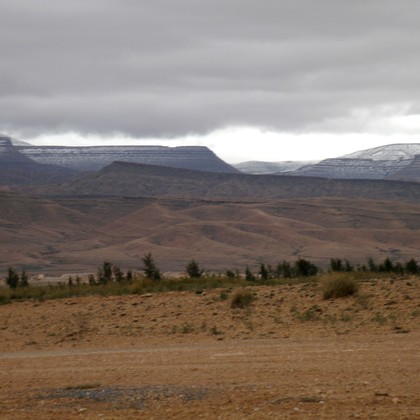
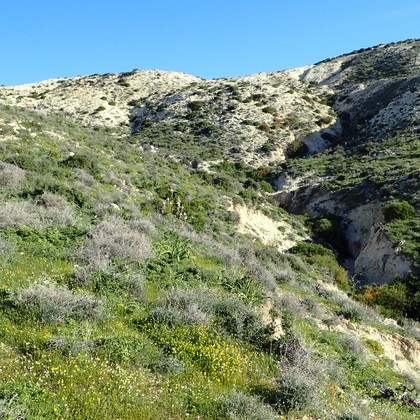
Forages over open steppe, high plateaus and hill country with livestock, and over mountains; rests on rocks and in tall trees. Joins Griffon Vultures at carcasses and feeding stations, where as the largest and strongest it tears open hide and sinews.
Where the bird is most at home, classified by the habitats of North Africa and the Middle East.

Range and movements
In Morocco a rare but increasing visitor to the north (Jbel Moussa and the Rif mountains), originating from the Spanish population; very rare elsewhere in the Maghreb. In the Middle East a scarce winter visitor to Israel, Jordan, Syria, Iraq and northern and western Saudi Arabia, with occasional birds reaching the Emirates, Oman and Yemen; in Egypt mainly in Sinai. Breeds from Spain, Greece and Turkey through the Caucasus and Iran to Mongolia and Korea.
- Resident
- Summer visitor (c. Apr–Sep)
- Winter visitor (c. Oct–Mar)
- Passage (Mar–Apr, Oct–Nov)
- dark = core range, pale = thinly spread
How and when to look
In winter check feeding stations and large carcasses in the Negev and on the Golan for a black, plank-shaped silhouette among the Griffon Vultures. In northern Morocco look for it in spring and autumn among the migrating Griffon Vultures at Jbel Moussa.
Conservation status
Near Threatened. After a century of decline through poison and shooting, populations in Spain and France are recovering, but in the east of the range the species is still declining. In the region poisoned bait, collisions with power lines and the scarcity of carcasses are the main threats.
Scientific name
Aegypius monachus | (Linnaeus, 1766)
Linnaeus described the species in 1766 as Vultur Monachus; because it was later moved to another genus, the author and year stand in brackets. The genus Aegypius was introduced in 1809 by De Savigny. Aegypius is Greek (aigupios), the name of a vulture-like bird of prey; according to Aelian the aegypius was halfway between a vulture (gyps) and an eagle. monachus is Latin for 'monk', after the bald head and the ruff of neck feathers, which recall a monk's cowl. The specimen the first description was based on came from Arabia.