All species › Birds of prey › Hawks, eagles and kites › Crested Honey-Buzzard
Crested Honey-Buzzard | Pernis ptilorhynchus
Aziatische wespendief | Abejero oriental
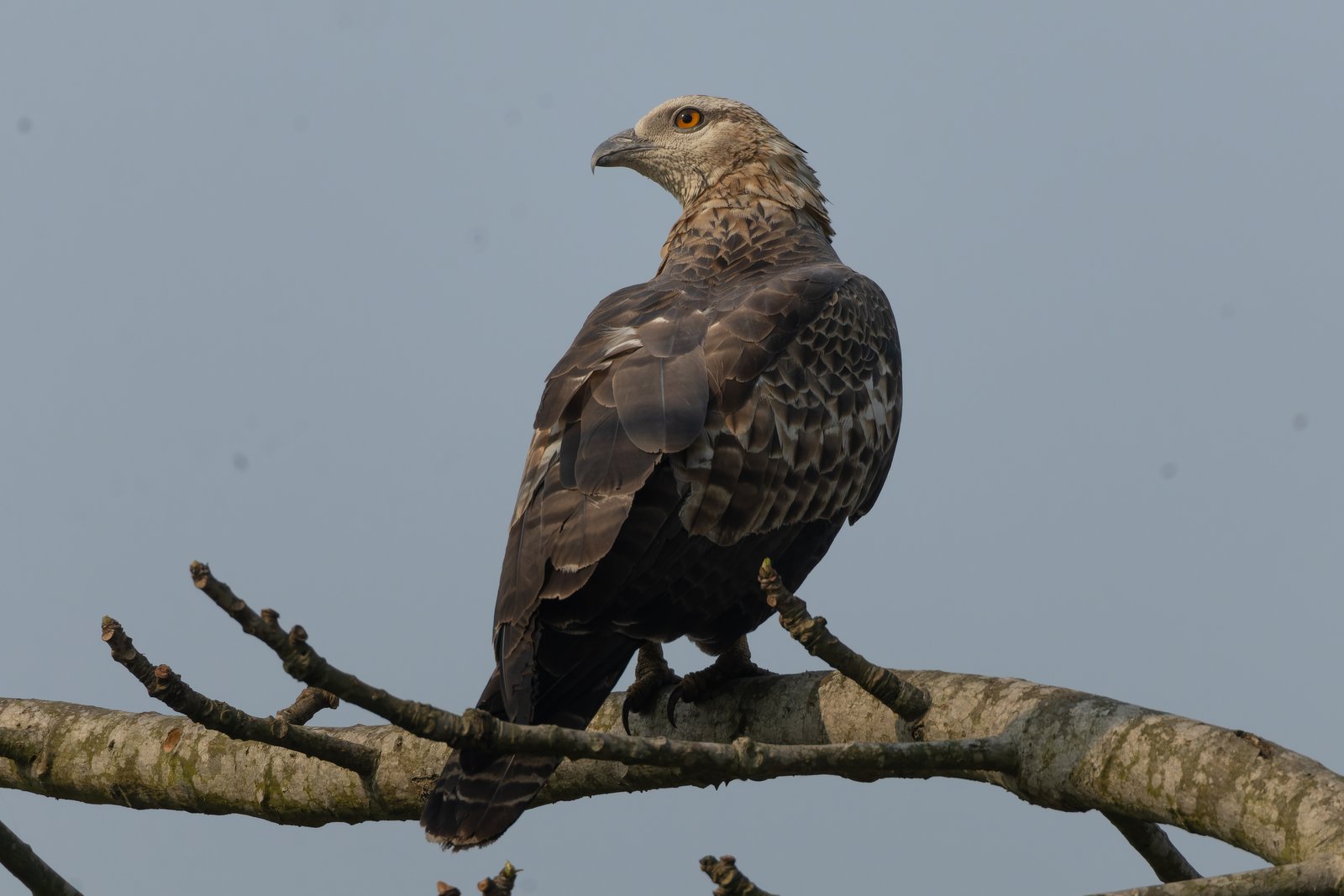
The Crested Honey-Buzzard is the eastern counterpart of the European Honey-Buzzard, larger and broader-winged. The northern form orientalis from Siberia and East Asia winters mainly in South-East Asia, but a growing number head west to the Middle East; in the Emirates and Oman it is now a regular, if scarce, winter visitor to parks and irrigated fields.
Voice
Almost silent in the region; occasionally a high, drawn-out whistled wheee-oo.
Recording: Chi-Hsuan Shao — CC BY-NC-SA 4.0 · converted to mono · xeno-canto
Identification
55–65 cm, wingspan 130–155 cm. Large and broad-winged for a honey-buzzard, with a small head on a long neck and a relatively short tail; the hand shows six obvious fingers. In the male the tail is black with one broad pale band, the underwing has broad black bars and the eye is dark; the female has more and narrower bars and a yellow eye. Plumage varies greatly, from pale to dark rufous-brown, often with a dark stripe down the centre of the throat. The crest is short in orientalis and rarely visible.
Confusion species
Mainly confusable with European Honey-Buzzard (Pernis apivorus), which is smaller and slimmer, with narrower five-fingered hands and a longer tail; its male has a grey head, a yellow eye and a tail with a broad dark terminal band and two narrow basal bands. Note the throat stripe and the broader, somewhat eagle-like wings. At a distance it also recalls Common Buzzard (Buteo buteo), which has a larger head and soars with the wings in a V.
Habitat
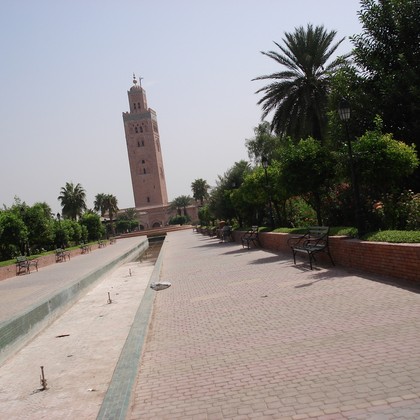
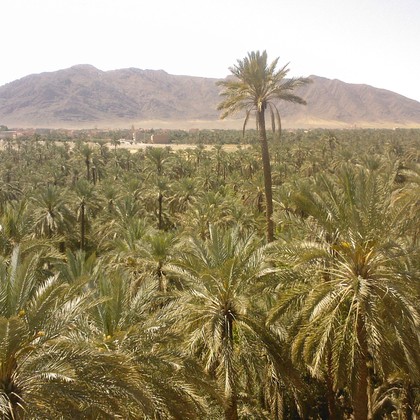
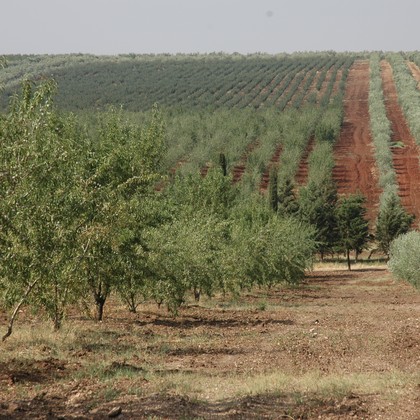
Winters in green parks, golf courses, alfalfa fields and irrigated farmland, orchards and date-palm groves, even in the middle of Gulf cities, where it sits in trees and searches lawns for the larvae of wasps and beetles; it also raids beehives. On migration over desert and mountains, resting in oases and lines of trees.
Where the bird is most at home, classified by the habitats of North Africa and the Middle East.
Range and movements
Winter visitor and passage migrant in the Emirates (especially Dubai and Abu Dhabi), Oman (Muscat, Batinah, Dhofar), Qatar, Bahrain, Kuwait and eastern Saudi Arabia. In Israel a scarce but annual passage migrant and small-scale winter visitor, mainly around Eilat, and in smaller numbers in Jordan, Lebanon and Sinai. Breeds in Siberia, East Asia and South and South-East Asia; the migrants mostly winter in South-East Asia and Indonesia.
- Resident
- Summer visitor (c. Apr–Sep)
- Winter visitor (c. Oct–Mar)
- Passage (Mar–Apr, Oct–Nov)
- dark = core range, pale = thinly spread
How and when to look
In the Emirates check the green parks and irrigated fields of Dubai and Al Ain from November to March; it sits still in a tree for long periods and often becomes identifiable only when it takes off. At Eilat in March – May look among the migrating European Honey-Buzzards for a broad-winged, short-tailed bird with six fingers.
Conservation status
Not threatened. The westward spread of wintering birds is linked to the creation of parks and irrigated farmland in the Gulf states. Locally vulnerable to poisoning and shooting.
Scientific name
Pernis ptilorhynchus | (Temminck, 1821)
Temminck described the species in 1821 as Falco ptilorhyncus; because it was later moved to another genus, the author and year stand in brackets. The genus Pernis was introduced in 1816 by Cuvier, GLCFD. Pernis goes back to the Greek pernēs, the name Aristotle used for a bird of prey. ptilorhynchus is Greek for 'feather-billed', from ptilon 'feather' and rhunkhos 'bill', for the feathered lores. The specimen the first description was based on came from Java, Indonesia.